Community sea slug and nudibranch survey dive in Koh Tao, documenting marine biodiversity through citizen science participation.
Sea slug and nudibranch research surveys in Koh Tao, documenting marine biodiversity through underwater species monitoring dives.
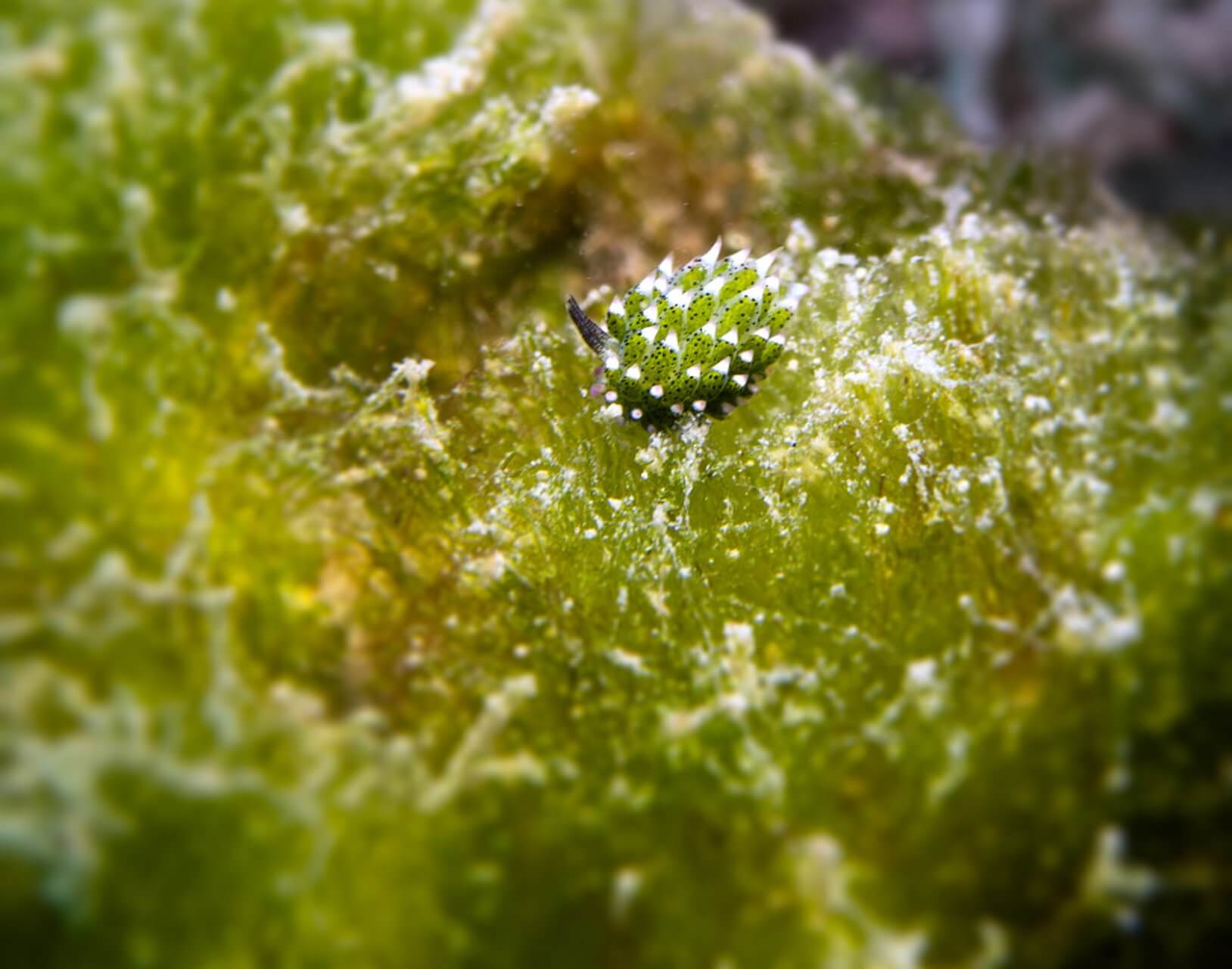
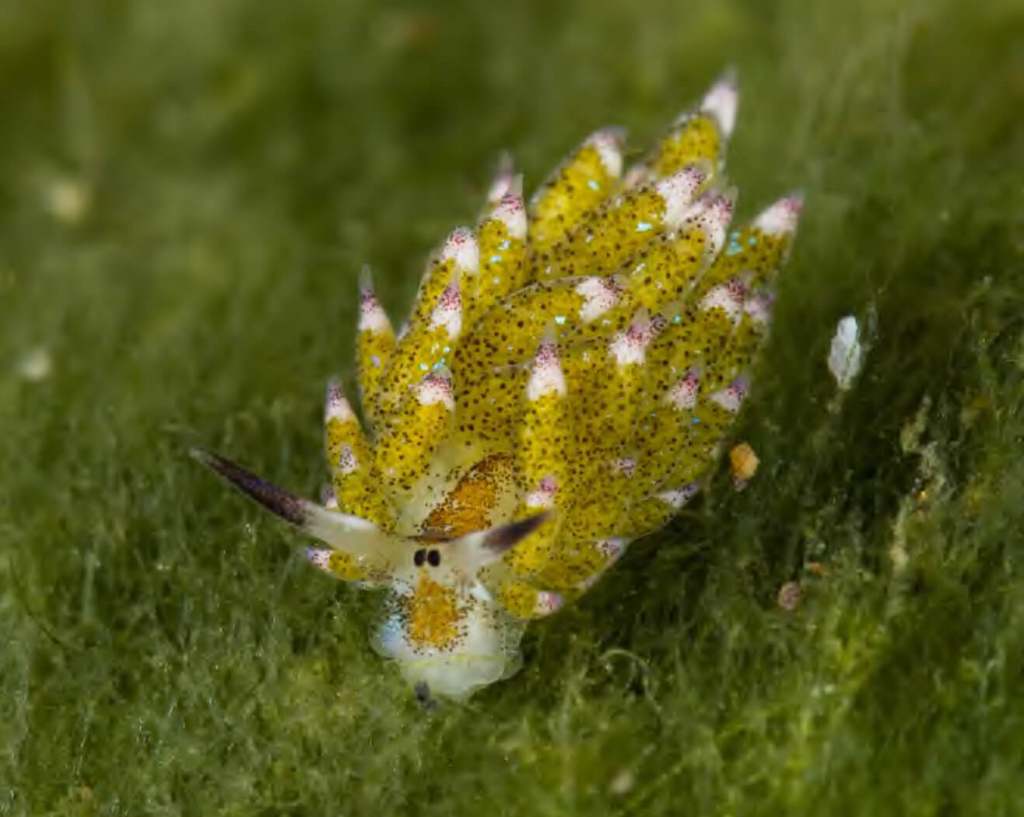
Sea slug (Costasiella sp.) photographed during the Sea Slug Ecology course at Black Turtle Conservation, exploring nudibranch identification and behavior in Koh Tao, Thailand.

Unlike the broad-mantled dorid nudibranchs of the family Chromodorididae, Lomanotus vermiformis has a slender, worm-like body — hence its scientific epithet vermiformis, from the Latin for “worm-shaped”. The mantle margins on either side are developed into sinuous ridges bearing short, pointed cerata, and the whole animal is remarkably well camouflaged against the branching architecture of its hydroid food. Adults typically reach only 15–25 mm in length, and specimens are so cryptic on their prey that they are frequently missed even by experienced macro divers.

The species is an obligate specialist on aglaopheniid hydroids of the genera Lytocarpus and Macrorhynchia — the notorious “fire hydroids” whose stings can cause painful welts on careless divers. Living directly on and feeding upon these stinging colonies, Lomanotus vermiformis has evolved a set of adaptations that allow it to grip the hydroid stems with a narrow grooved foot and a sticky mucous secretion, and to thrash wildly with lateral body flexions when dislodged.

This guide explores the biology, morphology, feeding, ecological role, and identification of Lomanotus vermiformis, alongside the conservation and training context provided by Black Turtle Conservation on Koh Tao.

Common Names: Wormy Nudibranch, Vermiform Lomanotus

Family: Lomanotidae Order: Nudibranchia

Learn About Lomanotus vermiformis

Community sea slug and nudibranch survey dive in Koh Tao, documenting marine biodiversity through citizen science participation.
Sea slug and nudibranch research surveys in Koh Tao, documenting marine biodiversity through underwater species monitoring dives.
Sea slug (Costasiella sp.) photographed during the Sea Slug Ecology course at Black Turtle Conservation, exploring nudibranch identification and behavior in Koh Tao, Thailand.
Marine conservation diver photographing nudibranch species on Koh Tao coral reef as part of biodiversity documentation.
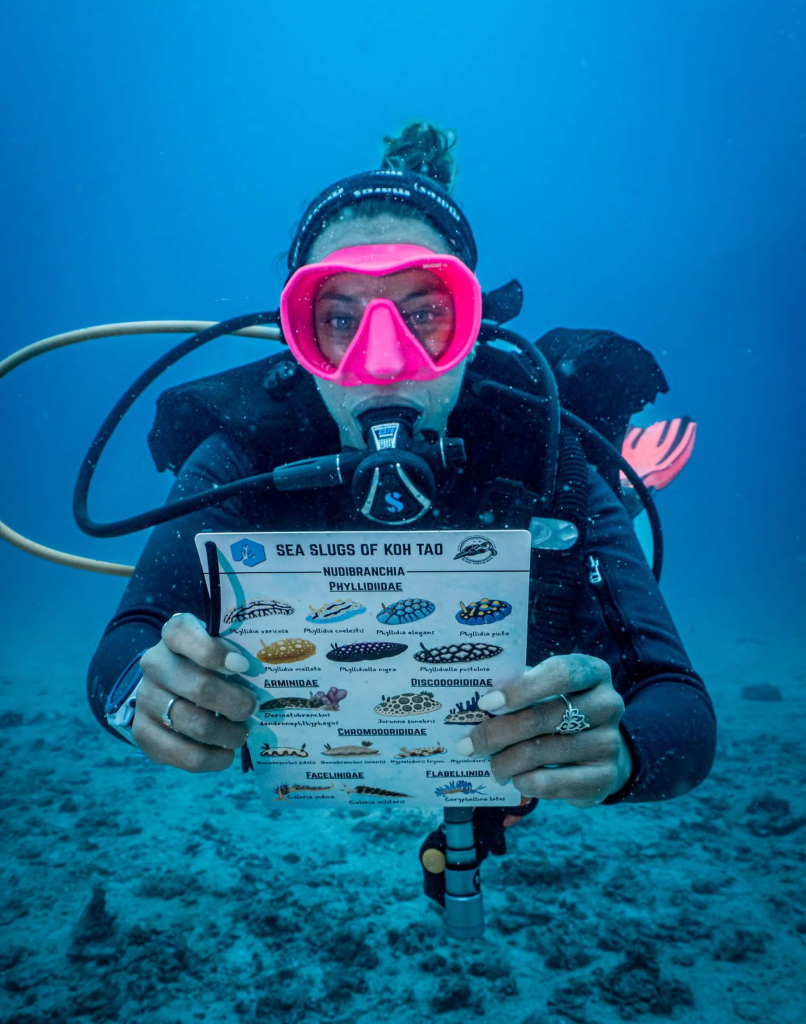
Conservation divers performing underwater research and sea slug identification training in Koh Tao, Thailand.
White nudibranch observed during marine biodiversity survey conducted as part of the conservation diving programs on Koh Tao, Thailand.
Marine conservation students improving underwater species identification and reef awareness during the Conservation Specialist program in Koh Tao.

Overview of the Species

Lomanotus vermiformis is a member of the family Lomanotidae, a small family of dendronotid nudibranchs whose members share an elongate, ridged body form and a specialised association with hydroid colonies. The family is placed within the suborder Dendronotina, one of the four main branches of the order Nudibranchia, and its members can be distinguished from the more familiar dorids and aeolids by the characteristic sinuous mantle ridges lining either side of the body.

The species was formally described by Eliot in 1908 in his “Notes on a collection of nudibranchs from the Red Sea”, published in the Journal of the Linnean Society of London. In 1976, Kerry Clark and Anthony Goetzfried described a similar-looking species from central Florida under the name Lomanotus stauberi, but subsequent work by García-Gómez and colleagues in 1990 recognised that the two names refer to the same species with a very broad circumtropical range. The Atlantic name was formally synonymised with L. vermiformis, and the older name has priority under current WoRMS taxonomy.

Size and Appearance Highlights

Lomanotus vermiformis is a small nudibranch. Adults typically reach only 15–25 mm in length, with 15 mm being the maximum reported by many field observers and 25 mm reported by more optimistic accounts. The body is highly elongate and narrow — vermiform — with the mantle developed into sinuous ridges on either side that bear short, pointed cerata.

The ground colour is a translucent white overlaid with brown mottling across the notum, head, and sides of the body. Irregular darker brown lines extend the length of the notum, and a network of opaque white lines covers much of the oral tentacles, rhinophores, and branchial lobes. This pattern is not decorative — it is a highly effective camouflage that allows the animal to blend against the tangled stems of its hydroid prey, where the pale reticulation matches the fine architecture of the hydroid colony.

Daily Behaviours and Activity Patterns

Lomanotus vermiformis lives its entire adult life on a single hydroid colony. Movement is slow and deliberate along the hydroid stems, with the narrow grooved foot providing a specialised grip and a sticky mucous secretion helping the animal cling tightly to its host. Encounters between individuals are usually solitary, though pairs can sometimes be seen together during peak reproductive periods.

When disturbed or dislodged, the species exhibits a striking defensive response: it thrashes wildly with lateral flexions of the body, which allows the animal to swim short distances through open water and often to return to the safety of the hydroid colony. This swimming response is unusual among small dendronotids and is one of the more memorable behaviours to observe in the field.

Like all nudibranchs, Lomanotus vermiformis is a simultaneous hermaphrodite. Reciprocal mating is followed by deposition of a white egg mass consisting of a convoluted ribbon oriented along the longitudinal axis of the hydroid stem, so that the egg ribbon itself is difficult to distinguish from the hydroid architecture.

Role in Koh Tao Marine Life

On Koh Tao, Lomanotus vermiformis fits into the wider sea slug community documented in the Mehrotra and colleagues 2021 ZooKeys inventory. Black Turtle Conservation divers have built an ongoing photographic and video record of the species on its aglaopheniid hydroid prey around the island, contributing to regional documentation of a species that is easily overlooked by non-specialists.

As a highly specialised predator of stinging hydroids, Lomanotus vermiformis contributes to the local regulation of Lytocarpus and Macrorhynchia colonies, and represents one of the few animals capable of consuming these otherwise well-defended cnidarians. The species’ obligate association with a single prey lineage makes it a useful indicator of local hydroid community health.

Key Behavioural Adaptations

Lomanotus vermiformis has three notable adaptations to life on stinging hydroids. First, it possesses a narrow grooved foot combined with a strongly adhesive mucous secretion, allowing it to maintain grip on individual hydroid stems even in current. Second, it displays highly cryptic coloration and body form that make it extremely difficult to see against the tangled hydroid colony. Third, it has an active swimming escape response, thrashing with lateral body flexions when dislodged that allows brief locomotion through open water.

Importantly, members of the family Lomanotidae lack the cnidosacs that aeolid nudibranchs use to sequester stinging cells from their cnidarian prey. Lomanotus vermiformis therefore does not repurpose nematocysts from its hydroid food as a defence, relying instead on crypsis, secure attachment, and the swimming escape response to avoid predation.

Lomanotus vermiformis Morphology

Community sea slug and nudibranch survey dive in Koh Tao, documenting marine biodiversity through citizen science participation.

Body Shape and Texture

Lomanotus vermiformis has a highly elongate, narrow, cylindrical body that gives the species its “wormy” appearance. On either side of the body, the edge of the mantle is developed into a sinuous ridge, and along these ridges are short, pointed cerata. The exact development of these cerata is somewhat variable between individuals and populations, and in some specimens the ridge is more pronounced than in others.

The overall body shape is fundamentally different from both the broad flattened dorids and the club-shaped aeolids that are more familiar to most reef divers. The vermiform silhouette reflects the species’ tight association with the branching architecture of its hydroid prey, in which a slender body is a distinct advantage for navigating between hydroid stems.

Sensory and Respiratory Structures

The rhinophores of Lomanotus vermiformis are relatively short and compact, positioned at the front of the head. Nudibranch Domain and other specialist references note that species living permanently on large hydroid colonies tend to have shorter oral tentacles than species that hunt across the substrate, because the resident species does not need to sample a broad territory. In Lomanotus vermiformis the oral tentacles are similarly reduced, an adaptation to sedentary life on a single hydroid colony.

Respiration in dendronotids occurs across the general body surface and through the specialised cerata that line the mantle ridges. The cerata themselves are branches of the digestive system extending outward from the body, and their high surface area serves both digestive and respiratory functions.

Size Variations and Defensive Features

Juvenile Lomanotus vermiformis are correspondingly smaller than the 15–25 mm adults, and the mantle ridge cerata are less well developed in young specimens. As the animal grows the ridge cerata become more pronounced and the body proportions become more distinctly elongate.

The principal defence of the species is crypsis. The body colouration, ridge morphology, and body form together make Lomanotus vermiformis extremely difficult to spot against its hydroid host, and this passive camouflage is the animal’s first and most important defence. When crypsis fails and the nudibranch is dislodged, the secondary defence is the swimming escape response, which allows the animal to leave the immediate area and re-attach to the substrate elsewhere.

Lomanotus vermiformis Diet and Feeding Strategy

Community sea slug and nudibranch survey dive in Koh Tao, documenting marine biodiversity through citizen science participation.
Sea slug and nudibranch research surveys in Koh Tao, documenting marine biodiversity through underwater species monitoring dives.
Sea slug (Costasiella sp.) photographed during the Sea Slug Ecology course at Black Turtle Conservation, exploring nudibranch identification and behavior in Koh Tao, Thailand.
White nudibranch observed during marine biodiversity survey conducted as part of the conservation diving programs on Koh Tao, Thailand.

Primary Food Sources

Lomanotus vermiformis is a specialised predator of aglaopheniid hydroids, particularly Lytocarpus philippinus and Macrorhynchia philippina (both formerly placed in Lytocarpus). Macrorhynchia philippina is commonly known as the “fire hydroid” for the sharp stings it delivers to divers, and both hydroid species are notably well-defended by their nematocyst batteries. The nudibranch has also been recorded feeding on other members of the same hydroid family, indicating some flexibility within the aglaopheniid group.

Feeding Behaviour in Detail

Feeding involves the nudibranch positioning itself directly on the hydroid stem and using its radula to grasp and consume individual polyps. Feeding is generally slow and continuous, with the animal moving methodically along the hydroid branches. Because Lomanotus vermiformis lives permanently on its host colony, feeding, resting, and reproduction all take place on the same hydroid.

The nudibranch is often surrounded by a sticky mucous cocoon, which may form as a by-product of the animal’s adhesive locomotion or as a specific defensive structure. The cocoon appears frequently in field photographs of the species and is a useful additional cue for identification in the field.

Chemical Defence Mechanisms

In contrast to aeolid nudibranchs that sequester nematocysts from their cnidarian prey and repurpose them as defensive weapons, Lomanotus vermiformis and other members of the family Lomanotidae lack cnidosacs entirely. This means that the nudibranch does not carry stolen stinging cells for its own defence, despite feeding on some of the most heavily armed hydroids in the reef ecosystem.

The absence of kleptocnidy makes the species even more dependent on its cryptic body plan and cocoon-forming mucus for protection. Sequestration of specific chemical compounds from the hydroid diet has not been documented in Lomanotus vermiformis, and the species appears to rely primarily on physical and behavioural rather than chemical defence.

Activity Patterns and Ecological Impact

Lomanotus vermiformis is active throughout the day and night on its host hydroid colony. Feeding rates are difficult to quantify given the animal’s small size and cryptic behaviour, but continuous residence on a single hydroid colony means that the cumulative impact on that colony can be substantial over the course of the animal’s life span.

By feeding on the polyps of Lytocarpus and Macrorhynchia colonies, Lomanotus vermiformis contributes to the regulation of hydroid populations on the reef. These hydroids are themselves significant predators of zooplankton and small invertebrates, so predation by the nudibranch fits into a wider trophic cascade in the reef community.

Lomanotus vermiformis Substrate Preference

Community sea slug and nudibranch survey dive in Koh Tao, documenting marine biodiversity through citizen science participation.

Lomanotus vermiformis is not associated with substrate in the conventional sense, because its entire adult life is spent on individual hydroid colonies rather than on hard reef, sand, or rubble. The distribution of the species therefore tracks the distribution of its aglaopheniid hydroid hosts across a range of shallow to mid-depth reef environments.

Why Substrate Matters

Aglaopheniid hydroids grow attached to stable hard substrate, including reef walls, coral rubble, rocky overhangs, and even artificial structures such as wreck plates and mooring lines. Because Lomanotus vermiformis depends absolutely on these hydroid hosts, the species is found wherever colonies of Lytocarpus philippinus and Macrorhynchia philippina occur.

The species’ cryptic body plan and permanent residence on the host mean that finding Lomanotus vermiformis requires careful macro searching of individual hydroid colonies rather than the broader visual scanning of reef substrate that works for many other nudibranchs.

Response to Environmental Conditions

Lomanotus vermiformis tolerates a wide range of environmental conditions, as reflected in its circumtropical distribution. The species has been recorded from the Red Sea, the tropical Indo-West Pacific including Thailand and Koh Tao, the eastern Pacific along the coasts of southern Baja California, and the western Atlantic including Florida, the Bahamas, and Panama.

Around Koh Tao, sites with dense colonies of aglaopheniid fire hydroids on reef walls and shallow reef sites are the most productive locations for encountering the species. The nudibranch’s obligate association with these hydroids means that its presence directly follows the abundance of its host.

Lomanotus vermiformis Ecological Role(s)

Broader Reef Contributions

Lomanotus vermiformis contributes to reef community dynamics as one of the few predators capable of consuming aglaopheniid fire hydroids. These hydroids are extremely well-defended by their potent nematocyst batteries and are avoided by most reef fish, so the nudibranch occupies a rare and specialised niche as a resident consumer.

By feeding on Lytocarpus and Macrorhynchia colonies, Lomanotus vermiformis contributes to the regulation of hydroid abundance on the reef. This indirect effect extends into the wider planktonic and benthic food web, because hydroids themselves are significant consumers of zooplankton and small invertebrates.

Value as a Bioindicator

The presence of Lomanotus vermiformis on a reef indicates a healthy population of its aglaopheniid host hydroids and a stable hard-substrate community capable of supporting these cnidarians. Tracking sightings of the species over time can provide an indirect indicator of hydroid community health, though the difficulty of spotting the nudibranch in the field means that absence of records does not necessarily mean absence of the species.

The species’ obligate specialisation on aglaopheniid hydroids means that any decline in these hydroid populations would directly affect Lomanotus vermiformis, making it a useful monitoring target within a broader reef biodiversity programme.

Opportunities for Citizen Science

Records of Lomanotus vermiformis from recreational divers are particularly valuable given the species’ cryptic body plan and easy overlooking. Photographs of the nudibranch on its host hydroid provide simultaneous documentation of both the sea slug and its prey, contributing to regional understanding of species associations and distribution.

Black Turtle Conservation supports this work through training in nudibranch identification, ethical macro-photography of stinging hydroids, and structured species recording during conservation dives.

Community sea slug and nudibranch survey dive in Koh Tao, documenting marine biodiversity through citizen science participation.
Sea slug and nudibranch research surveys in Koh Tao, documenting marine biodiversity through underwater species monitoring dives.
Sea slug (Costasiella sp.) photographed during the Sea Slug Ecology course at Black Turtle Conservation, exploring nudibranch identification and behavior in Koh Tao, Thailand.
Costasiella kuroshimae, also known as “Shaun the Sheep” sea slug, found during the Sea Slug Ecology course in Koh Tao, Thailand.

Lomanotus vermiformis Fun and Interesting Facts

Community sea slug and nudibranch survey dive in Koh Tao, documenting marine biodiversity through citizen science participation.

Discovery and Naming

The species was described in 1908 by Charles Norton Edgcombe Eliot, a British colonial administrator and prolific amateur nudibranch taxonomist whose descriptions from the Red Sea, East Africa, and the Sudan remain fundamental references more than a century later. The Latin epithet vermiformis means “in the shape of a worm” and directly references the species’ highly elongate body form.

Circumtropical Distribution

Lomanotus vermiformis has one of the broadest geographic distributions of any nudibranch species, ranging across the tropical Indo-West Pacific, the eastern Pacific along the coasts of southern Baja California, and the western Atlantic including Florida, the Bahamas, and Panama. This distribution reflects both the widespread occurrence of the species’ aglaopheniid host hydroids and successful long-distance larval dispersal.

The 1988 Synonymy

For much of the twentieth century the Atlantic and Indo-Pacific populations of this species were treated as different species: Lomanotus vermiformis Eliot, 1908 from the Indo-Pacific, and Lomanotus stauberi Clark & Goetzfried, 1976 from the Atlantic. Careful comparison of morphological and geographic evidence by García-Gómez and colleagues in 1990 recognised that the two names refer to the same species, and L. stauberi was formally synonymised with L. vermiformis. The older name has priority under WoRMS taxonomy.

Swimming Escape Response

When dislodged from its hydroid host, Lomanotus vermiformis exhibits a dramatic swimming escape response, thrashing wildly with lateral flexions of the elongate body. This allows the animal to swim short distances through open water and often to re-attach to substrate elsewhere. The behaviour is unusual among small dendronotids and is one of the more memorable behaviours to observe in the field, though it should never be triggered deliberately by divers.

No Kleptocnidy

Despite living permanently on some of the most heavily nematocyst-armed hydroids in the reef ecosystem, Lomanotus vermiformis does not sequester nematocysts from its prey for its own defence. Members of the family Lomanotidae lack cnidosacs entirely, and the nudibranch instead relies on crypsis, secure attachment via its grooved foot and sticky mucus, and the swimming escape response for protection.

Lomanotus vermiformis Vulnerability Profile

Community sea slug and nudibranch survey dive in Koh Tao, documenting marine biodiversity through citizen science participation.

Lomanotus vermiformis is currently classified as Not Evaluated on the IUCN Red List. As a small marine invertebrate with no commercial value, the species has not been the subject of dedicated conservation assessment, and reliable population trend data are not available. The species’ very wide circumtropical distribution suggests a low overall extinction risk.

Local populations depend absolutely on the availability of aglaopheniid hydroid hosts, particularly Lytocarpus philippinus and Macrorhynchia philippina. Any decline in these hydroid populations would directly and severely affect local Lomanotus vermiformis abundance. Threats to hydroid populations include sedimentation, physical damage to hard substrate, and climate-driven changes in reef community composition.

Around Koh Tao, the species is best monitored as part of broader sea slug community surveys, with particular attention to sites where aglaopheniid hydroid colonies are well developed. The animal’s cryptic body plan means that even well-conducted surveys are likely to underestimate its true abundance.

How to Identify Lomanotus vermiformis

Identification of Lomanotus vermiformis in the field requires close macro searching of aglaopheniid hydroid colonies, and the species is easily overlooked even at close range. Look for a small, highly elongate, worm-shaped nudibranch, typically 15–25 mm long, with a translucent white body overlaid by brown mottling and a network of opaque white lines on the oral tentacles, rhinophores, and branchial lobes. The sinuous mantle ridges on either side, bearing short pointed cerata, are diagnostic for the genus.

The animal is usually found directly on colonies of Lytocarpus philippinus or Macrorhynchia philippina (the fire hydroid), which is itself a useful identification cue. A sticky mucous cocoon around the nudibranch is often visible in photographs, and egg ribbons oriented along the hydroid stem may also be present.

Lomanotus vermiformis is morphologically similar to other Indo-Pacific Lomanotus species including undescribed Lomanotus sp. records from New Caledonia and elsewhere. Differentiation requires attention to mantle lobe development, papilla distribution, and colour pattern. Photographs documenting the mantle ridge, ceras structure, oral tentacles, and host hydroid all assist in confirmation.

Colorful Coryphellina nudibranch feeding on a coral reef in Koh Tao, Thailand, during a marine biodiversity survey.

Mastering Identification with Black Turtle Conservation

Black Turtle Conservation on Koh Tao offers structured nudibranch identification training as part of our marine conservation pathway. Lomanotus vermiformis is included as a particularly rewarding identification target because it illustrates the specialist dendronotid body plan, the extreme camouflage adaptations of hydroid-resident nudibranchs, and the challenge of searching for cryptic species on their specific host colonies.

Our programmes help divers move beyond the more visible chromodorids and aeolids toward the harder-to-spot cryptic specialists, developing the macro search skills and slow-diving discipline required for species-level documentation across the wider nudibranch community.

Our Training Approach: From Theory to Survey

Training begins with classroom sessions covering the biology and ecology of Indo-Pacific nudibranchs, the structure of the family Lomanotidae, the contrast between dendronotid, dorid, and aeolid body plans, and the conservation context for Koh Tao reefs. Participants review reference photographs, taxonomic keys, and recent literature including Eliot 1908, the 1988 synonymy work by García-Gómez and colleagues, and BTC’s in-house photographic archive from Koh Tao dive sites.

In-water training takes participants to dive sites around Koh Tao where aglaopheniid hydroid colonies are well developed. Practical skills include close macro searching of hydroid colonies for cryptic residents, careful non-invasive observation of stinging hydroids, macro-photography for identification, and structured species logging using BTC’s standardised templates.

Graduates contribute to BTC’s ongoing nudibranch biodiversity monitoring, helping to refine site-level inventories of cryptic species, track changes in specialist nudibranch abundance over time, and support the long-term documentation of Koh Tao’s remarkable invertebrate biodiversity.

External Link Citations and References

Eliot, C.N.E. (1908). Reports on the Marine Biology of the Sudanese Red Sea. XI. Notes on a Collection of Nudibranchs from the Red Sea. Journal of the Linnean Society of London, Zoology 31(204): 86–122.

García-Gómez, J.C. et al. (1990). Taxonomic and morphological considerations regarding the genus Lomanotus Vérany, 1844 (Gastropoda: Nudibranchia) in the Iberian Peninsula. Journal of Molluscan Studies 56(4): 435–438.

Mehrotra, R. et al. (2021). An updated inventory of sea slugs from Koh Tao, Thailand. ZooKeys 1042: 73–188.

World Register of Marine Species: Lomanotus vermiformis Eliot, 1908.

Wikipedia: Lomanotus vermiformis.

Black Turtle Conservation: Advanced Nudibranch and Reef Ecology Training, Koh Tao.