Overview of the Species
Goniobranchus aureopurpureus is a member of the family Chromodorididae, one of the most species-rich families of dorid nudibranchs and the most familiar to recreational divers worldwide. Chromodorids are characterised by their bright colour patterns, by their habit of moving openly across the reef surface during daylight hours, and by their specialised diet of sponges.
The species was formally described by Cuthbert Collingwood in 1881, who placed it in the now largely deprecated genus Chromodoris. The type locality was given as “Slut Island”, one of many small islands in the strait between Haitan (Pingtan) Island and mainland China. The species has since been transferred to the genus Goniobranchus, reflecting the 2012 molecular revision of the Chromodorididae by Johnson and Gosliner, which split the historically broad genus Chromodoris into more clearly defined groups.
Size and Appearance Highlights
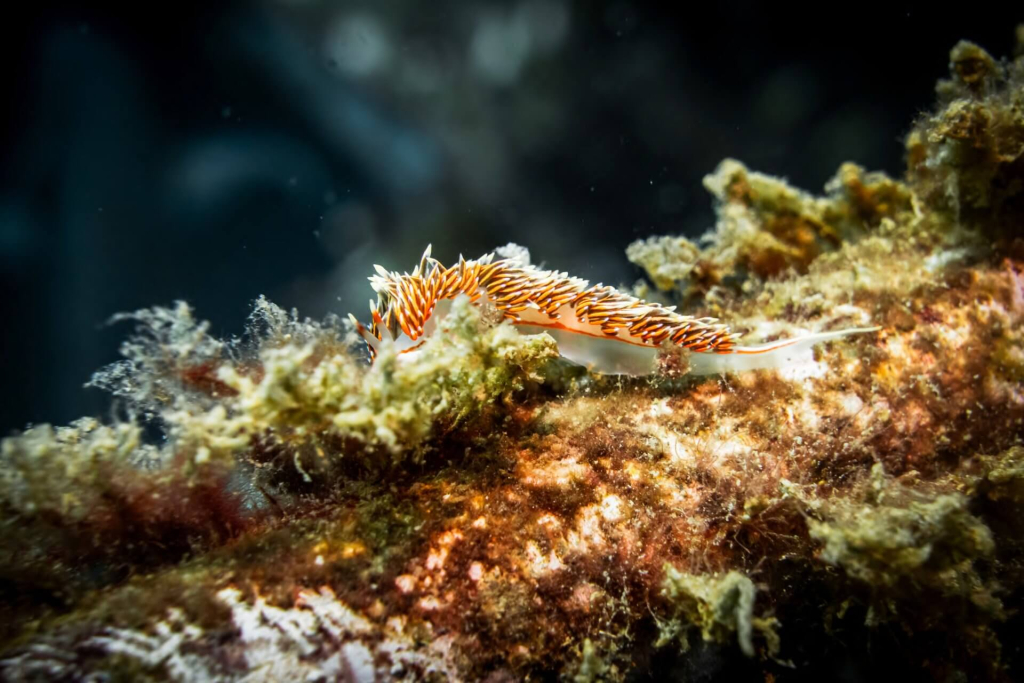
Mature Goniobranchus aureopurpureus typically reach around 4 cm (40 mm) in length. The body is elongate and dorsoventrally flattened, as is typical for chromodorids, and is bordered by a flared mantle skirt that extends slightly beyond the foot on either side.
The most striking feature is its colour pattern. The dorsal surface is white or cream-coloured, scattered with numerous round yellow spots of varying size. The mantle edge is marked by a distinct border of purple spots, which gives the species its common name Gold and Purple Chromodoris. The rhinophores and gills, both retractable, are typically white with darker tips or pigmented bands.
Daily Behaviours and Activity Patterns
Goniobranchus aureopurpureus is a daytime-active nudibranch, openly visible on reef substrates during normal recreational diving hours. Unlike many sea slugs that hide during daylight, chromodorids rely on chemical defence rather than crypsis and so move openly across coral rubble, hard reef, and sponge-encrusted surfaces in search of food and mates.
Movement is slow and methodical, with the animal gliding on its muscular foot at a rate of only a few centimetres per minute. When approached by a diver or photographer, the species may pause briefly but does not typically retract or attempt to flee. The rhinophores remain extended in good conditions and are used to detect chemical cues from sponges, mates, and potential threats.
As with all nudibranchs, Goniobranchus aureopurpureus is a simultaneous hermaphrodite. When two adults meet they exchange sperm reciprocally before each lays a coiled, ribbon-like egg mass on the substrate near their preferred food source.
Role in Koh Tao Marine Life
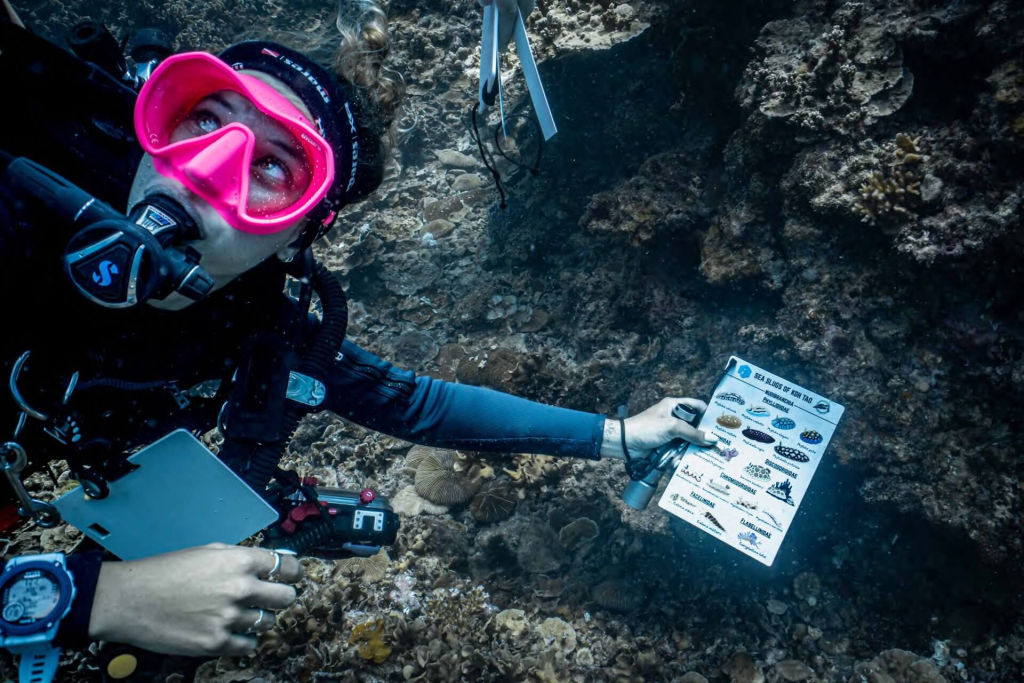
On Koh Tao, Goniobranchus aureopurpureus is part of the broader chromodorid community that contributes to the island’s reputation as a regional hotspot for sea slug biodiversity. The Mehrotra and colleagues (2021) ZooKeys inventory documented more than 100 sea slug species across Koh Tao, making it one of the best-studied sea slug sites in mainland Southeast Asia.
Like other chromodorids, Goniobranchus aureopurpureus plays a specialised role as a top-down regulator of certain sponge species, indirectly influencing space competition between sponges, corals, and other sessile organisms on the reef.
Key Behavioural Adaptations
The most important adaptation of Goniobranchus aureopurpureus is the integration of chemical defence with open, daytime activity. By feeding selectively on sponges that produce defensive secondary metabolites, the species sequesters these compounds in specialised mantle dermal formations and releases them when threatened.
This combination of bright warning colouration (aposematism), chemical defence, and slow exposed movement is a textbook example of how chromodorid nudibranchs have decoupled themselves from the need for crypsis. Many chromodorid species share variations on the same yellow/orange/purple/white colour palette, creating a Müllerian mimicry complex that benefits all participating species.