Overview of the Species
Costasiella kuroshimae is a member of the family Costasiellidae within the order Sacoglossa. The Sacoglossa are a distinct order of gastropod sea slugs characterised by a specialised radula bearing only a single row of teeth used to pierce individual algal cells, and by the striking ability of many species to sequester functional chloroplasts from their prey. Sacoglossans are herbivores, in complete contrast to the predatory nudibranchs with which they are often confused by non-specialists.
The species was formally described by Masashi Ichikawa in 1993 in his paper “Saccoglossa (Opisthobranchia) from the Ryukyu Islands”, published in the Publications of the Seto Marine Biological Laboratory. The type locality is Kuroshima Island (Taketomi, Okinawa, Ryukyu Islands), and the species epithet kuroshimae derives directly from this locality — Kuroshima meaning “black island” in Japanese.
Size and Appearance Highlights
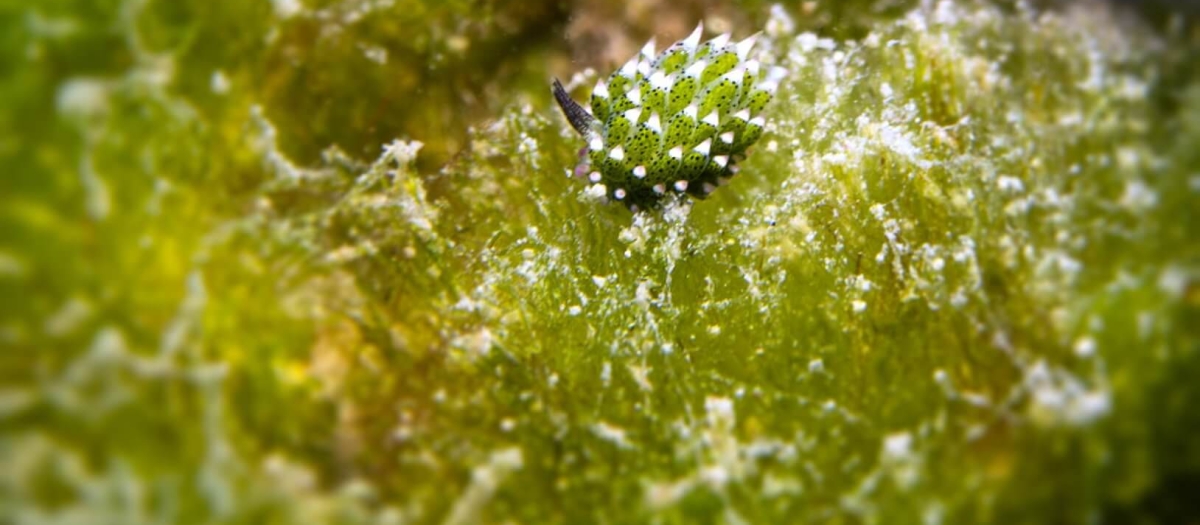
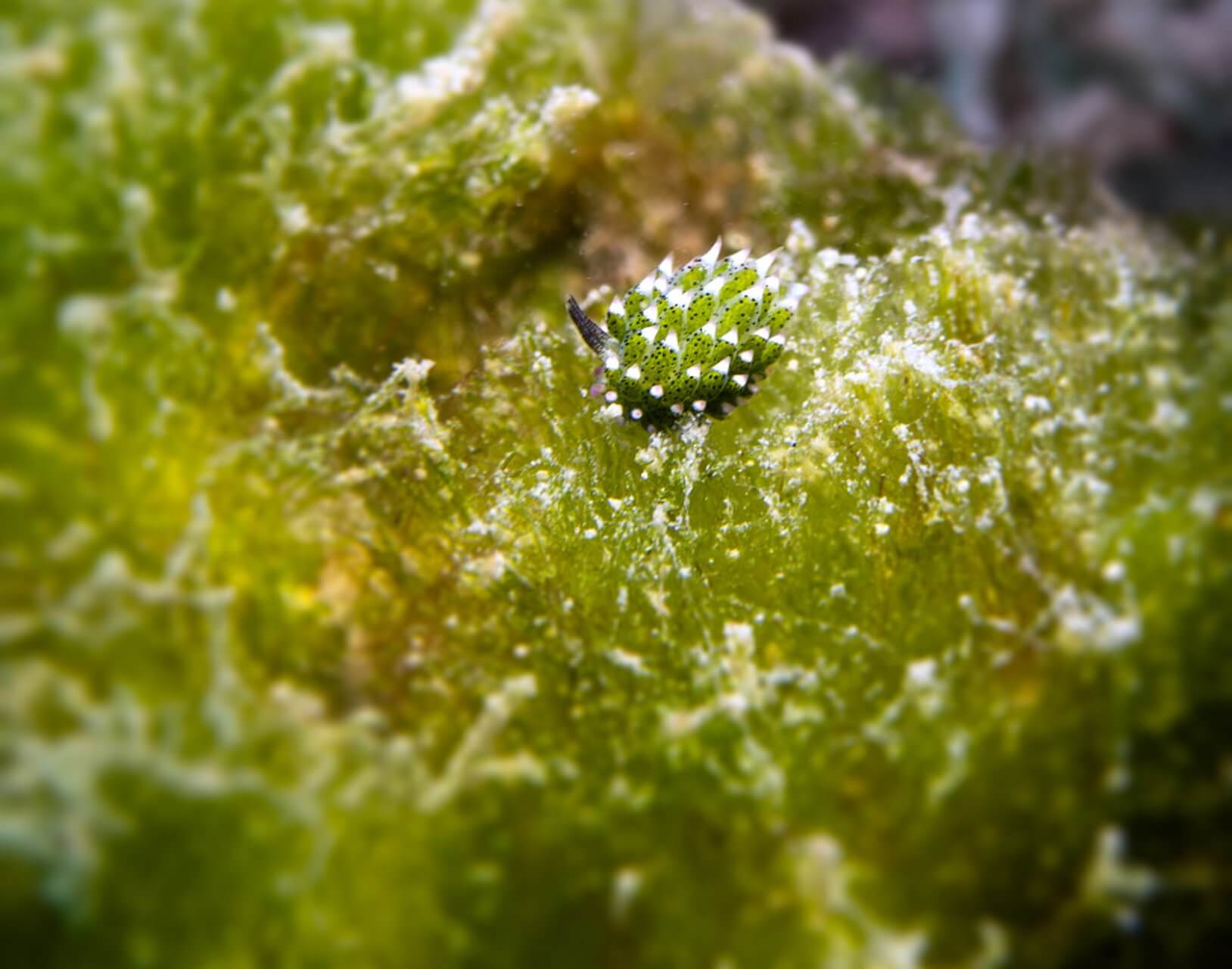
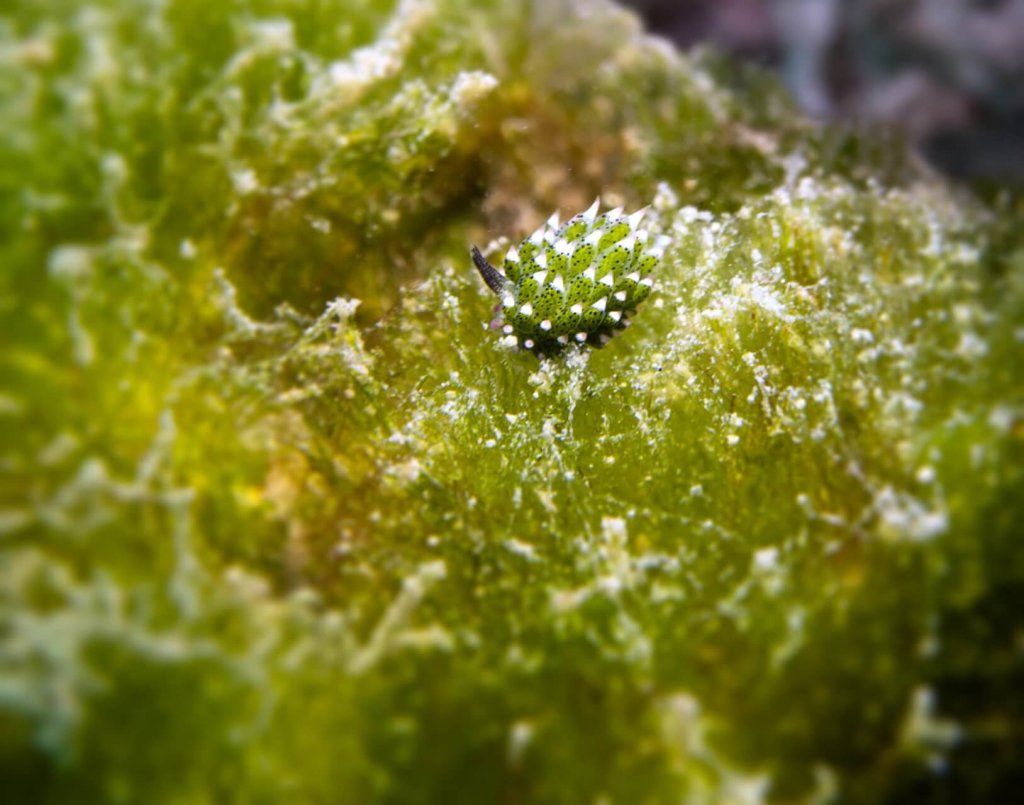
Costasiella kuroshimae is a very small sea slug, typically measuring 5–10 mm in length. Some references give a slightly narrower range of 2–7 mm or 3–8 mm, and individuals under 5 mm are common. The overall body shape is short and stout, with a rounded head, dense clusters of leaf-shaped cerata covering most of the dorsum, and a small tapered tail.
The colour pattern is highly distinctive. The head is white or cream with dark markings, including a characteristic dark streak running across the head just in front of the rhinophores. The two rhinophores are rolled, white with black tips, and stand upright from the head like tiny sheep’s ears. Two large dark eyes are positioned close together on the head. The cerata are typically green with white tips and often display iridescent bright blue spots when caught in sunlight, giving the animal an almost luminescent appearance under macro lighting.
Daily Behaviours and Activity Patterns
Costasiella kuroshimae is a strictly sedentary sea slug that spends its entire adult life on individual Avrainvillea algae. Movement is slow and deliberate along the algal blade, and the species does not swim, burrow, or actively hunt as many other sea slugs do. When resting on the alga, the cerata are held upright, giving the classic “flock of leaf sheep” appearance in photographs.
Like all sacoglossans, Costasiella kuroshimae is a simultaneous hermaphrodite. Mating produces small egg masses that are laid directly on the Avrainvillea host, so that newly settled juveniles have immediate access to their obligate food source. Individual sea slugs live between six months and one year.
Role in Koh Tao Marine Life
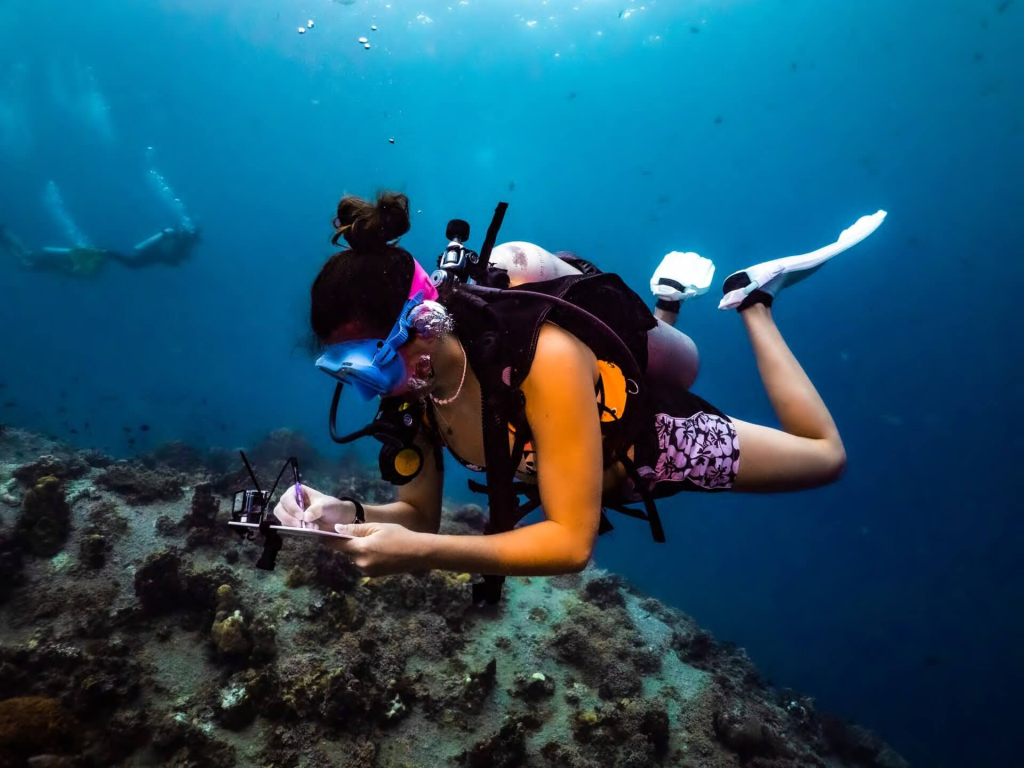
Around Koh Tao, Costasiella kuroshimae is documented through ongoing photographic and video records compiled by Black Turtle Conservation divers, particularly on shallow sandy sites where Avrainvillea algae grow. The species is one of the smallest and most challenging sea slugs to find, and its confirmed presence around the island reflects both the healthy state of local algal communities and the sharp macro-observation skills of local divers.
As a specialist grazer of a single algal genus, Costasiella kuroshimae fits into a very different ecological role from the sponge-feeding chromodorids or hydroid-feeding aeolids that dominate harder reef substrates. The species contributes to top-down regulation of Avrainvillea populations and provides one link in the chain that connects primary producers to higher-level consumers in soft-sediment ecosystems.
Key Behavioural Adaptations
The most remarkable adaptation of Costasiella kuroshimae is the ability to sequester functional chloroplasts from its Avrainvillea food. When the sea slug pierces individual algal cells with its needle-like radula, the algal contents including the chloroplasts are drawn into the digestive gland. Rather than being fully digested, the chloroplasts are retained inside specialised cells lining the branches of the digestive system that extend into the cerata. There they continue to photosynthesise, converting sunlight into chemical energy that supplements the sea slug’s diet.
This kleptoplasty is one of the most extraordinary examples of animal-plant integration in nature. In some sacoglossan species chloroplasts can remain functional for weeks or even months after being taken up. The exact duration of chloroplast retention in Costasiella kuroshimae has not been fully characterised, but the species is generally regarded as a functional kleptoplast.