Marine flatworms on Koh Tao

Close-up of a healthy brain coral colony photographed during the Ecological Monitoring Program (EMP) with Black Turtle Conservation in Koh Tao, Thailand.

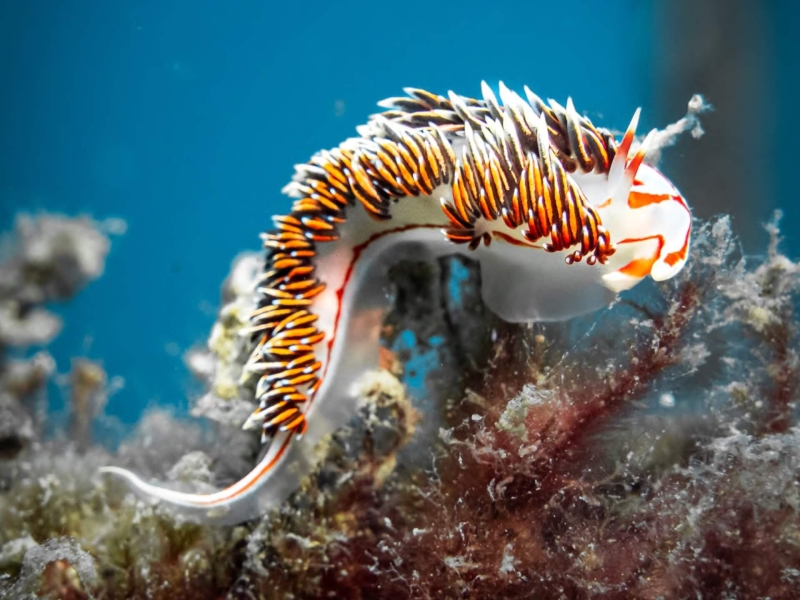
If you have spent any time looking closely at Koh Tao’s reefs, you have almost certainly seen a marine flatworm. They drift across coral plates and reef walls with a smooth gliding motion, often patterned in stripes, spots, or lace-like reticulations that would not look out of place on a chromodorid nudibranch. Some of the largest and most striking macro subjects on a Koh Tao dive site are polyclad flatworms.

This field guide is Black Turtle Conservation’s ongoing catalogue of the marine flatworms we regularly encounter around the island. Every species page is built from our own underwater photography and video, cross-referenced against the primary scientific literature on Indo-Pacific polyclads, and grounded in current WoRMS taxonomy. Marine flatworms are one of the less-studied invertebrate groups in the Gulf of Thailand, and building this record is part of an ongoing effort to document what actually lives on our local reefs.

Marine flatworms are not sea slugs — here is why it matters

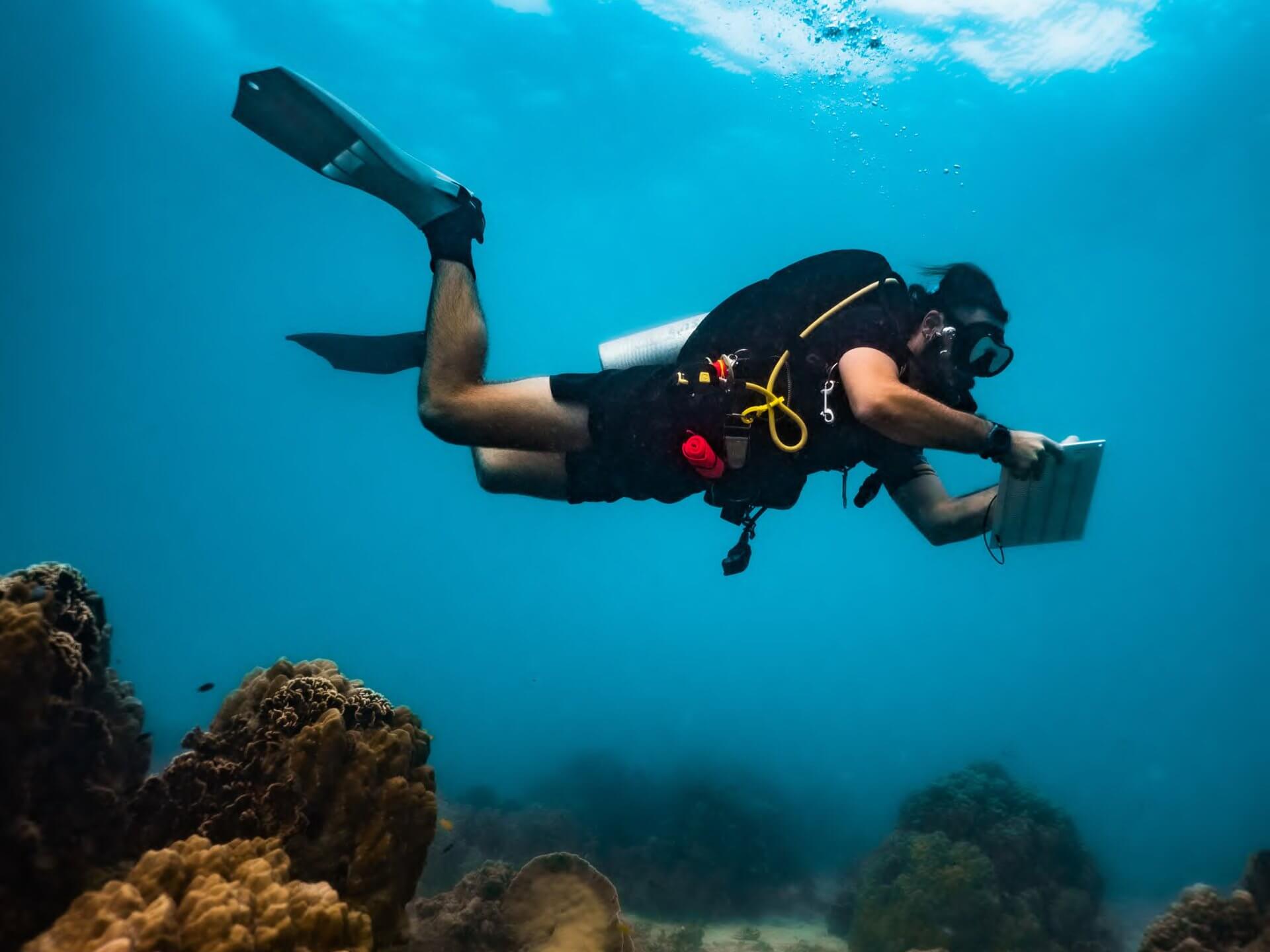
Scientific Diver students completing advanced underwater reef monitoring surveys with precise buoyancy and scientific diving techniques in Koh Tao, Thailand.

Marine flatworms and sea slugs are so often confused that it is worth stating clearly at the start of any field guide: they are not the same kind of animal. They are not even the same kind of animal in a broad sense. Sea slugs are molluscs, closely related to snails and octopuses. Marine flatworms are members of the phylum Platyhelminthes, an entirely separate branch of the animal kingdom that split off from the ancestors of molluscs somewhere around six hundred million years ago. The similarity between the two groups is a textbook case of convergent evolution: two very distantly related lineages have arrived at similar answers to the same problem — how to live on a reef as a soft-bodied, chemically defended, colourful macro invertebrate — by independent routes.

The differences between flatworms and sea slugs are fundamental. Flatworms have no coelom (the fluid-filled body cavity present in most animal phyla), no gills, no heart, and no shell to lose. Their paper-thin body is so slim that no part of the animal is more than a fraction of a millimetre from the surrounding seawater, and gas exchange happens by simple diffusion across the body wall. Sea slugs, by contrast, are anatomically much more complex, with a well-developed body cavity, specialised gills or cerata for respiration, and internal organs organised in ways that reflect their gastropod ancestry.

The two groups also move differently, and this is often the fastest way to tell them apart underwater. Flatworms glide across the substrate using millions of microscopic cilia on their underside, beating in coordinated waves against a thin layer of secreted mucus. The result is a smooth, undulation-free motion, as if the animal were floating just above the surface. Sea slugs, by contrast, crawl on a muscular foot, and their body visibly ripples as the muscular waves pass along it. Once you have seen both, the difference is unmistakable.

Feeding differs too. Sea slugs use a radula — a ribbon of microscopic teeth — to scrape or pierce their food. Marine flatworms have no radula. Instead, they use a muscular pharynx that can be everted through the mouth on the underside of the body, fanned out across the prey, and used to secrete digestive enzymes externally. The partially digested food is then absorbed through the pharynx into a branched intestine that distributes nutrients throughout the body without any need for a circulatory system.

Even reproduction is different. Both groups are simultaneous hermaphrodites, but marine flatworms are famous for a courtship behaviour known as penis fencing: two flatworms engage in a literal fencing match with their stylet-tipped penises, each trying to inseminate the other while avoiding being inseminated in return. Sea slug mating is far more sedate, with reciprocal sperm exchange during a coordinated pairing.

For the diver, the practical upshot is straightforward. If it glides smoothly across the reef, has a paper-thin ruffled body, and shows no visible gills or cerata on its back, you are almost certainly looking at a marine flatworm. If it crawls with visible muscular waves and carries a plume of gills or a cluster of cerata on its dorsum, it is a sea slug. Knowing which is which is the first step toward accurate species identification.

Koh Tao’s polyclad flatworm community

Scientific research reef monitoring dive in Koh Tao, collecting coral reef health data and ecological survey observations underwater.
Reef-focused conservation action carried out during Ocean Aware Week as part of community-led marine protection in Koh Tao.
Marine conservation diver photographing nudibranch species on Koh Tao coral reef as part of biodiversity documentation.

Almost every marine flatworm a diver sees on Koh Tao belongs to the order Polycladida, and most belong to the family Pseudocerotidae — the largest and most colourful family of polyclad flatworms. Pseudocerotids are characterised by oval to elongate bodies, bright contrasting colour patterns, and pseudotentacles formed by simple folds of the anterior body margin. Where sea slugs use paired sensory rhinophores standing upright from the head, pseudocerotids use these folded pseudotentacles for the same chemosensory function — another example of convergent evolution between the two groups.

The Koh Tao polyclad community includes species with a range of body forms. Genera such as Pseudoceros and Pseudobiceros have smooth dorsums with distinctive colour patterns and ruffled body margins. The genus Thysanozoon is instantly recognisable by dense dorsal papillae that give the animal a bumpy, textured appearance quite different from the smooth-dorsed pseudocerotids. Other genera, including Maiazoon and its recently revised synonym Nymphozoon, have unusual anatomical features such as multiple male gonopores that led to their original placement in separate genera before molecular work revealed the true relationships. The 2016 revision by Bolaños, Gan and Ong of pseudocerotid flatworms from Singapore is the most recent major taxonomic reference for the region.

Compared with the sea slugs, the polyclad flatworm fauna of the Gulf of Thailand is less thoroughly catalogued. The definitive general reference remains the 2003 book Marine Flatworms: The World of Polyclads by Leslie Newman and Lester Cannon, and much regional-level work is still ongoing. This makes each well-documented Koh Tao sighting genuinely valuable for building the local record, and part of the purpose of this field guide is to make that documentation as accessible as possible for divers who want to contribute.

How to spot and photograph a flatworm on a dive

The single most useful behavioural cue for spotting a flatworm on a Koh Tao dive site is the smooth, undulation-free ciliary gliding described above. Once you learn to recognise that motion, marine flatworms become far easier to notice than they seem at first — they are simply moving in a way that no sea slug can match. Watch for it on sponge-encrusted walls, on the undersides of coral plates, and across coral rubble zones both in shallow water and on deeper reef sites.

Some polyclads are also capable of brief active swimming. Members of the genus Pseudobiceros are particularly famous for undulating through the water column with rhythmic flexions of the ruffled body margin — a behaviour so striking it has been compared with a wedding dress rippling underwater. Seeing a flatworm swimming, however briefly, is one of the more memorable experiences a macro diver can have.

When you find a marine flatworm, the features that matter for species-level identification include the overall body form (smooth versus papillate dorsum, ruffled versus straight margin), the colour pattern across the entire dorsal surface, the shape and position of the pseudotentacles at the anterior margin, and the pattern of the cerebral eyespot cluster on the head. Photograph the animal from directly above to capture the full dorsal pattern, and ideally photograph the anterior margin in profile to show the pseudotentacles and eyespots clearly. If the flatworm swims, a video sequence is invaluable, both for identification and for the sheer visual reward of the behaviour.

Back on the boat or at your accommodation, use the species pages in this guide to check your photographs. The individual species pages include comparison notes for the polyclads most commonly confused with each subject, and cross-references to the closely related sea slugs that share similar reef habitats.

Marine conservation students identifying nudibranch species underwater during the Sea Slug Ecology course at Black Turtle Conservation.
Close-up photo of a nudibranch taken during the Nudibranch & Sea Slug Ecology course at Black Turtle Conservation, Koh Tao.
Night dive for nudibranch research during the Sea Slug Ecology course at Black Turtle Conservation, Koh Tao.
Scientific Diver students completing advanced underwater reef monitoring surveys with precise buoyancy and scientific diving techniques in Koh Tao, Thailand.

Contributing to Koh Tao’s polyclad archive

Marine conservation students improving underwater species identification and reef awareness during the Conservation Specialist program in Koh Tao.

Marine flatworm identification is one of the areas where recreational divers can make a genuinely useful contribution to the regional biodiversity record. Polyclads are less well documented than sea slugs across most of Southeast Asia, and each carefully photographed sighting has the potential to add to the local knowledge base. Black Turtle Conservation welcomes contributions from divers who want their sightings added to the archive. If you have photographs of a marine flatworm from a Koh Tao dive site and can provide the date, depth, dive site, and the substrate the animal was on, we can include it in our ongoing documentation.

For divers who want to develop identification skills in a more structured way, our nudibranch and reef ecology programmes include marine flatworms as part of the wider soft-bodied invertebrate curriculum. Learning to tell a Thysanozoon from a Pseudobiceros, or a Maiazoon from a Pseudoceros, is a genuine achievement in a group where the diagnostic features are subtle and the regional taxonomy is still being worked out.

Explore the guide

Marine conservation students improving underwater species identification and reef awareness during the Conservation Specialist program in Koh Tao.

Individual species pages appear below this introduction and are added as new species are documented from Koh Tao dive sites. To return to the main field guides index, visit Field Guides.