Duncanopsammia is a monotypic genus of stony corals in the family Dendrophylliidae, represented by a single species, Duncanopsammia axifuga (Milne Edwards & Haime, 1848), commonly known as Sunflower Coral or Duncan Coral. The genus was described by Wells in 1936 to accommodate this distinctive species, which forms varied colonies, from branching with long tubular corallites bifurcating at irregular intervals, to thick plates of plocoid corallites with a smooth coenosteum and flower-like polyps.

Duncanopsammia is unusual within the largely azooxanthellate family Dendrophylliidae in that it does host symbiotic dinoflagellates, although the symbiosis is facultative and contributions vary considerably with depth and light availability. Colonies in shaded environments retain very few zooxanthellae and rely heavily on heterotrophic feeding, while shallow, well-lit colonies obtain a more substantial proportion of their energy from photosynthesis.

Around Koh Tao, Duncanopsammia is most commonly encountered on shaded slopes, overhang margins, and in transition zones between hard substrate and sand at moderate to deeper depths. This guide explores the morphology, feeding strategy, distribution, environmental requirements, vulnerability profile, field identification, and conservation training opportunities offered by Black Turtle Conservation.

Common Names: Sunflower Coral, Duncan Coral, Whisker Coral, Daisy Coral

Family: Dendrophylliidae

Order: Scleractinia (Stony Corals)

Subclass: Hexacorallia | Class: Anthozoa | Phylum: Cnidaria

Learn About Duncanopsammia Coral Genus

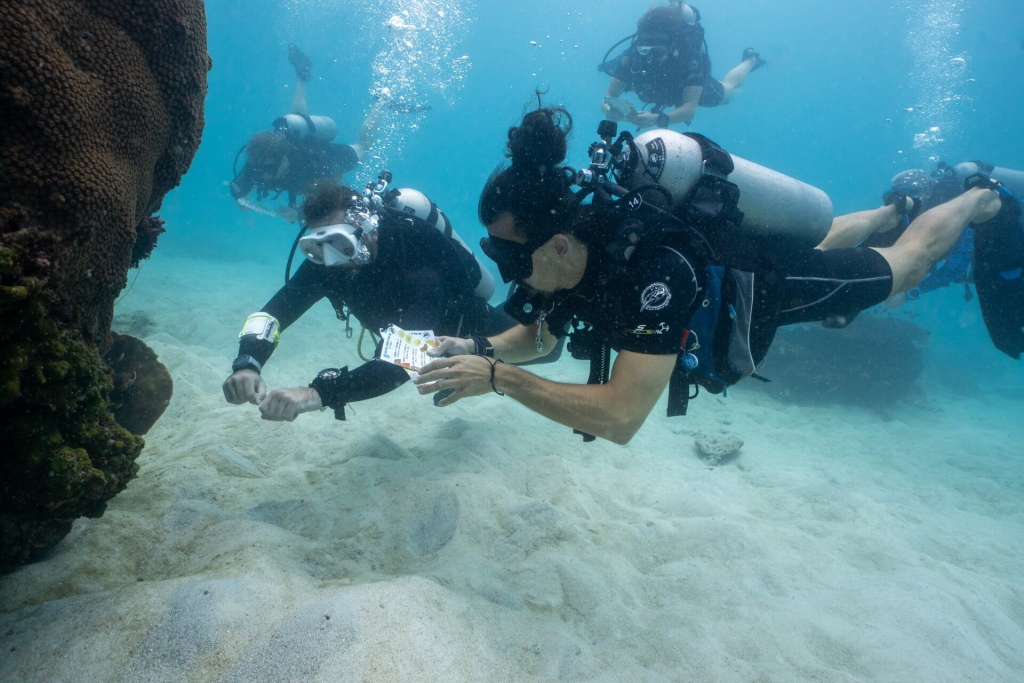
Student identifying coral species underwater during the Coral Taxonomy & Identification course with Black Turtle Conservation in Koh Tao, Thailand.
Diver recording fine-scale coral identification data during the Advanced Coral Taxonomy and Marine Conservation course at Black Turtle Conservation, Koh Tao, Thailand.
Scientific research coral restoration monitoring project in Koh Tao, combining reef rehabilitation techniques and long-term coral health data collection.

Overview of the Genus

Duncanopsammia is one of the smallest reef-coral genera, containing only one currently accepted species. Despite this taxonomic narrowness, the genus has wide ecological relevance because its biology straddles the boundary between fully zooxanthellate reef-builders and heterotrophic dendrophylliids.

The genus belongs to the same family as Tubastraea, the well-known azooxanthellate “sun” coral, but differs in retaining a functional symbiosis with Symbiodiniaceae. This intermediate position makes Duncanopsammia an interesting reference point for understanding the evolution of coral-algal symbiosis within the Dendrophylliidae.

Around Koh Tao, Duncanopsammia is uncommon but distinctive. Its showy fleshy polyps and pale pink to brown colouration make it readily recognisable when present, and keen-eyed divers often note it as a highlight on slope and overhang sites.

Global and Local Importance

Globally, Duncanopsammia occurs across the Indo-Pacific from the Andaman Sea and South China Sea through Indonesia and the Philippines to northern Australia. Recent records have extended the known northern distribution further into West Papua and the Bird’s Head region.

On Koh Tao, the genus has minor relative abundance compared with dominant reef-builders such as Porites, but contributes meaningfully to slope-zone biodiversity. Its presence and condition serve as a useful indicator of stable, low-disturbance habitat conditions on reef slopes.

Reef Contribution and Habitat Provision

Duncanopsammia colonies are not significant reef-builders in volumetric terms, but the extending, thick plate-like habit of mature colonies creates microhabitat that small reef fish and cryptobenthic invertebrates can exploit, particularly in zones where massive reef-building corals are sparse.

The genus contributes to Koh Tao’s overall biogenic structure as a slope-zone accent rather than a framework constructor, with most colonies remaining under 30 cm across despite individual corallite sizes of up to 10–14 mm in diameter.

Growth Form and Colony Variation

Duncanopsammia colonies are often phaceloid, meaning individual cylindrical corallites stand upright and packed together, sharing a common base but each retaining its own structurally distinct wall. Branches bifurcate at irregular intervals, producing a candelabra-like or whisker-like branching pattern.

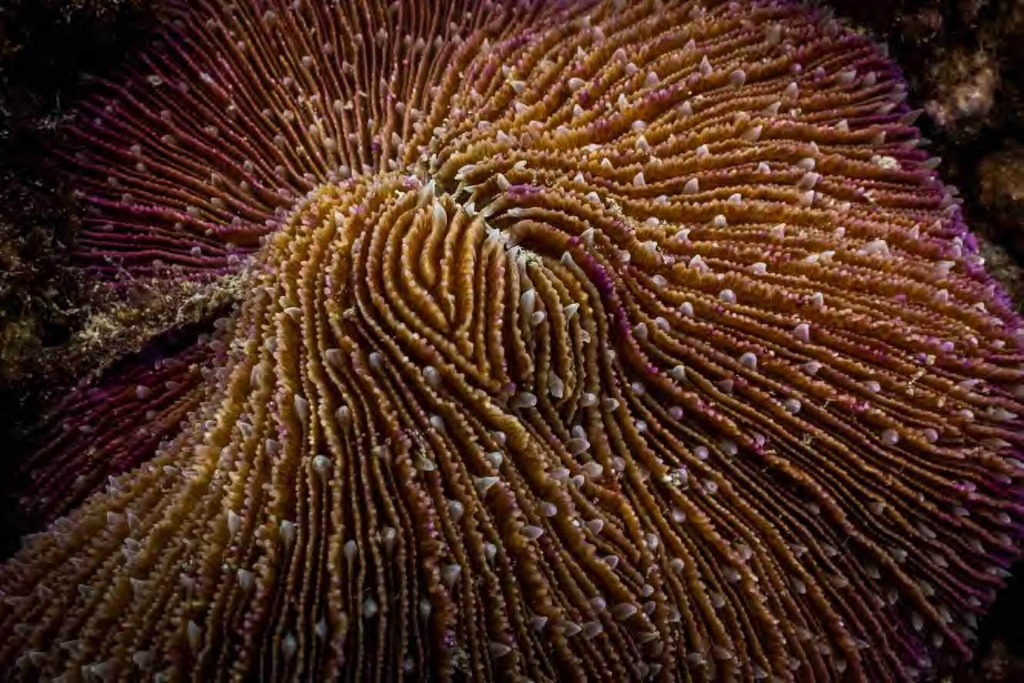
On Koh Tao, the colonies we see are usually laminar, encrusting or foliose growth formations, with a plocoid colony formation consisting of “sunflower”-like polyps and a pink-brown fleshy coenosteum.

Colour varies from pale pink and beige through olive and brown, with each polyp displaying a wide flat circular oral disc surrounded by distinct tentacles. Faint stripes or contrasting darker centres are common, contributing to the coral’s distinctive visual identity in the field.

Evolutionary and Taxonomic Notes

Duncanopsammia sits within the family Dendrophylliidae alongside Tubastraea, Turbinaria, Heteropsammia, Balanophyllia, and Dendrophyllia. The family is unusual in scleractinian taxonomy in containing both fully azooxanthellate genera and partially or majority zooxanthellate ones, with Duncanopsammia and Turbinaria representing the photosynthetic end of the spectrum and Tubastraea the azooxanthellate end.
Morphology

Student identifying coral species underwater during the Coral Taxonomy & Identification course with Black Turtle Conservation in Koh Tao, Thailand.
Diver recording fine-scale coral identification data during the Advanced Coral Taxonomy and Marine Conservation course at Black Turtle Conservation, Koh Tao, Thailand.
Scientific research coral restoration monitoring project in Koh Tao, combining reef rehabilitation techniques and long-term coral health data collection.

Colony Structure and Skeletal Features

Broadly, Duncanopsammia colonies are often phaceloid in form, with corallites that are long, cylindrical, and tubular. Branches bifurcate at irregular intervals and face upwards, giving mature colonies a candelabra-like appearance distinct from the more compact phaceloid form of Tubastraea.

Corallites typically measure 10–14 mm in diameter and may extend several centimetres above the colony base before bifurcating. Internally, septa follow the diagnostic Pourtalès plan of the family Dendrophylliidae, with septal cycles arranged in a characteristically asymmetric pattern around the central columella.

Locally, colonies more often display laminar, encrusting or foliose growth formations, with a plocoid colony formation consisting of a pink-brown fleshy colouration with flower-like polyps that give it the “sunflower coral” nickname – often used as a perfect example of why scleractinian corals fall into the Anthozoa class, the “flower animal” (Anthos meaning “flower” and zoa meaning “animal”). .

Polyps and Tissue Characteristics

Each corallite houses a single large polyp with a wide, flat oral disc that may be up to 10–14 mm across when fully extended. Short tentacles surround the disc and bear nematocysts effective at capturing zooplankton.

Tissue colour ranges from pale beige to pink, brown, or fluorescent green, depending on the density and clade of zooxanthellae present. Polyps are often extended during daylight hours when conditions are favourable, distinguishing the genus immediately from the nocturnal Tubastraea.

Skeletal Microstructure and Calcification

Duncanopsammia skeletons are aragonitic and moderately robust, with corallite walls thick enough to provide structural integrity for the relatively long tubular corallites. Calcification rates are slower than in fast-growing branching genera such as Acropora but adequate to support the genus’s modest colony sizes.

Because Duncanopsammia is at least partially photosynthetic, its calcification is sensitive to both light reduction and reductions in seawater carbonate saturation. Ocean acidification is therefore a relevant long-term concern for the genus despite its facultative symbiosis.

Size, Growth, and Defensive Adaptations

Individual colonies on Koh Tao reefs typically reach 10–30 cm across, though some significantly larger colonies have been documented.. Although colonies are slow-growing, they can persist for many years in stable habitat conditions.

Defensive adaptations include nematocyst-armed tentacles, mucus production, and the ability to retract polyps fully into the corallite cup when disturbed. The relatively deep cup architecture also provides physical protection from passing physical disturbance and corallivorous predators.

Mixotrophic Feeding Strategy: How Duncanopsammia Feeds and Thrives

Duncanopsammia is a true mixotroph, drawing energy from both photosynthesis carried out by symbiotic dinoflagellates and active heterotrophic capture of zooplankton. The relative contribution of each pathway shifts with depth, light, and food availability, giving the genus considerable flexibility in habitat choice.

1. Autotrophy: Facultative Photosynthesis

Symbiotic dinoflagellates of the family Symbiodiniaceae living within the gastrodermis carry out photosynthesis and translocate organic compounds to the coral host. Under good light conditions, this pathway can supply a substantial proportion of the colony’s daily carbon budget.

Unlike obligately zooxanthellate genera, Duncanopsammia can persist with very low symbiont densities in shaded conditions, switching its energetic dependence toward heterotrophy when light is limiting. This facultative use of symbiosis is unusual within the broader scleractinian assemblage.

Duncanopsammia polyps are large and well-armed compared with most reef-building corals, and they extend tentacles for active feeding during both day and night when zooplankton density permits. The genus is an effective particle capturer, taking advantage of currents that deliver suspended food.

Heterotrophic input supplies essential nitrogen, phosphorus, and trace elements, and is critical when the symbiotic pathway is reduced in low-light or turbid environments. This dietary flexibility is one of the main reasons Duncanopsammia can occupy a wider range of habitat depths than most photosynthetic corals.

The combination of facultative autotrophy and active heterotrophy gives Duncanopsammia a notable resilience advantage over fully zooxanthellate corals. During thermal stress events that compromise the symbiosis, colonies retain a viable energetic pathway through heterotrophy, although prolonged zooxanthellae loss still ultimately weakens the colony if heterotrophic supply is insufficient.

Where to Find Duncanopsammia Around Koh Tao and at Which Dive Sites

Student identifying coral species underwater during the Coral Taxonomy & Identification course with Black Turtle Conservation in Koh Tao, Thailand.
Diver recording fine-scale coral identification data during the Advanced Coral Taxonomy and Marine Conservation course at Black Turtle Conservation, Koh Tao, Thailand.
Scientific research coral restoration monitoring project in Koh Tao, combining reef rehabilitation techniques and long-term coral health data collection.

Duncanopsammia is uncommon on Koh Tao reefs and is most reliably encountered on shaded slopes, overhang margins, and in transition zones between hard substrate and sandy bottom at moderate to deeper depths. Its plocoid laminar form often makes it stand out against the more uniform massive and encrusting corals around it.

Sheltered Slopes and Overhang Margins

Sites such as Aow Leuk, Hin Wong Bay, and Tanote Bay occasionally host Duncanopsammia colonies on shaded slope faces and at the edges of overhang structures, typically at depths of 10–20 m where light is moderate but not strongly limiting.

Pinnacle Slope Zones

At Chumphon Pinnacle and Southwest Pinnacle, occasional Duncanopsammia colonies occupy intermediate depths around the pinnacle bases and on shaded ledges, where moderate currents deliver zooplankton supply that complements the partial photosynthetic budget.

Transition Zones and Sand Margins

Duncanopsammia is also occasionally observed at the margins of hard substrate where reef meets sandy substrate. These transition zones provide the moderate light, moderate flow, and access to suspended particulate matter that the genus particularly favours.

Depth Distribution and Site Variation

Most Koh Tao Duncanopsammia records fall in the 10–25 m range, with isolated colonies occasionally observed shallower or deeper. Because the genus tolerates moderately low light, it extends meaningfully into depth zones where many photosynthetic corals become sparse, although it is never abundant in any single site.

Environmental Thresholds: Conditions for Optimal Growth

Duncanopsammia tolerates a relatively wide environmental envelope thanks to its mixotrophic flexibility, performing well in conditions that would be marginal for strictly photosynthetic reef-builders.

Optimal Parameters

  • Light Intensity: moderate to low; tolerates conditions from well-lit shallow slopes to deeply shaded overhang margins.
  • Water Movement: moderate flow that delivers zooplankton without subjecting fragile plates to high mechanical stress.
  • Temperature Range: 24–30°C tolerated at Koh Tao; thermal stress responses occur at extended exposure above 31°C.
  • Salinity: stable marine conditions of 33–35 ppt; vulnerable to freshwater pulses from heavy monsoon runoff.
  • Substrate: hard substrate with stable attachment, often near sand-reef transitions and shaded slope zones.

Stress Responses on Koh Tao

Duncanopsammia can experience symbiosis breakdown and partial bleaching under prolonged thermal stress, but its capacity to subsist on heterotrophy alone gives it some resilience advantage relative to obligately zooxanthellate corals. Recovery is generally slow given the genus’s modest growth rates.

Sedimentation, freshwater runoff, and reduced light penetration following heavy monsoon rainfall reduce both photosynthetic and heterotrophic performance simultaneously. Colonies in nearshore settings show the clearest stress responses, while offshore pinnacle colonies typically remain in more stable condition.

Vulnerability Profile

Scientific research coral restoration monitoring project in Koh Tao, combining reef rehabilitation techniques and long-term coral health data collection.
Student identifying coral species underwater during the Coral Taxonomy & Identification course with Black Turtle Conservation in Koh Tao, Thailand.

Duncanopsammia is currently listed as Near Threatened on the IUCN Red List, reflecting concerns about habitat decline . The genus is also covered under CITES Appendix II, which has regulated international trade in scleractinian corals since 1990.

Major Threats

  • Coral Bleaching: partial bleaching during prolonged thermal stress, although heterotrophic capacity provides some buffering.
  • Wild Collection: targeted harvesting in some regions of the genus’s range adds pressure beyond the climate threats.
  • Ocean Acidification: progressive reduction in calcification efficiency as aragonite saturation state declines.
  • Sedimentation: nearshore colonies are particularly affected by runoff-driven turbidity and substrate burial.
  • Local Anthropogenic Impacts: anchoring, fin damage, and ghost fishing gear in zones where colonies are accessible to recreational diving.

On Koh Tao, Duncanopsammia is treated as a low-density indicator taxon. Tracking its presence and condition contributes to broader slope-zone health assessments and complements the more abundance-driven monitoring of dominant genera such as Porites and Acropora.

Black Turtle Conservation includes Duncanopsammia in slope-zone surveys and uses sightings to refine site-level biodiversity inventories around the island.

How to Identify Duncanopsammia Coral

The defining features of Duncanopsammia in the field are the distinct sunflower-looking corallites, the wide fleshy oral discs of extended polyps, and the spread-out plocoid pattern that gives the genus its fleshy, ear-like form.

Student identifying coral species underwater during the Coral Taxonomy & Identification course with Black Turtle Conservation in Koh Tao, Thailand.
Diver recording fine-scale coral identification data during the Advanced Coral Taxonomy and Marine Conservation course at Black Turtle Conservation, Koh Tao, Thailand.

Key Identification Features

  • Colony Form: plocoid, with a large fleshy coenosteum.
  • Corallites: sunflower-like, with daytime extended tentacles, 10–14mm in diameter, several centimetres tall.
  • Polyps: large, with wide flat oral discs (10–14mm) and short surrounding tentacles, often extended during daylight.
  • Coloration: typically pale pink, beige, olive, or brown, sometimes with faint striping or contrasting centres.
  • Habitat: shaded slopes, overhang margins, and reef-sand transition zones at 10–25 m depth.

Distinguishing from Similar Genera

Turbinaria is the genus most easily confused with Duncanopsammia at first glance, but the two are distinguished by textural features and habitat: Turbinaria is domed, and displays significantly smaller corallites, while Duncanopsammia is flat, often day-active giving the polyps the signature “sunflower” appearance, and predominantly pink to beige.

Mastering Duncanopsammia Identification with Black Turtle Conservation

Diver recording fine-scale coral identification data during the Advanced Coral Taxonomy and Marine Conservation course at Black Turtle Conservation, Koh Tao, Thailand.

At Black Turtle Conservation we treat reliable Duncanopsammia identification as a useful entry point into the broader Dendrophylliidae family. Because the genus straddles the boundary between zooxanthellate and azooxanthellate dendrophylliids, learning to recognise it provides students with a clearer understanding of the diverse symbiotic strategies operating within a single coral family on Koh Tao reefs.

Our Training Approach: From Theory to Survey

Scientific research coral restoration monitoring project in Koh Tao, combining reef rehabilitation techniques and long-term coral health data collection.
Student identifying coral species underwater during the Coral Taxonomy & Identification course with Black Turtle Conservation in Koh Tao, Thailand.

Our Coral Taxonomy and Identification training addresses Duncanopsammia through a structured, progressive sequence designed to build confident in-water surveyors familiar with the full dendrophylliid spectrum.

  • Classroom Theory: students learn the Pourtalès septal plan, dendrophylliid family-level diagnostics, and the contrast between zooxanthellate and azooxanthellate members.
  • In-Water Practice: guided dives at Aow Leuk, Hin Wong Bay, Chumphon Pinnacle, and similar sites where Duncanopsammia is occasionally encountered alongside Tubastraea and Turbinaria.
  • Applied Monitoring: participation in slope-zone surveys, where Duncanopsammia presence, colony condition, and habitat context are recorded as part of broader biodiversity assessments.
  • Comparative Identification: side-by-side comparison with Tubastraea, Cladopsammia, and Turbinaria to consolidate dendrophylliid family-level recognition skills.

Graduates leave with the practical ability to identify Duncanopsammia at genus level under field conditions and to interpret its presence as a useful indicator of stable slope-zone habitat conditions around Koh Tao.

Frequently Asked Questions

Is Duncanopsammia related to Turbinaria?

Yes. Both genera belong to the family Dendrophylliidae alongside Turbinaria, Heteropsammia, Balanophyllia, and Dendrophyllia. Duncanopsammia and Turbinaria share the diagnostic extended tentacles, plocoid growth form and colouration. However, Duncanopsammia displays larger corallites and the coenosteum is flat compared to the domed corallites of Turbinaria.

Does Duncanopsammia bleach?

Duncanopsammia can experience partial bleaching during prolonged thermal stress because it does host zooxanthellae, but its capacity to subsist on heterotrophy alone gives it an advantage over fully zooxanthellate corals. Recovery is generally slow given the genus's modest growth rates, but the dual energetic strategy provides genuine resilience under moderate stress events.

How big do Duncanopsammia colonies grow on Koh Tao?

Mature Duncanopsammia colonies on Koh Tao typically reach 10 to 30 cm across, with individual corallites measuring 10 to 14 mm in diameter. The genus is never abundant at any single site but contributes meaningfully to slope-zone biodiversity through its distinctive form and characteristic pale pink to brown colouration.

When are Duncanopsammia polyps extended?

Unlike the nocturnal relative Tubastraea, Duncanopsammia polyps are often extended during daylight hours when conditions are favourable. The wide flat oral discs of expanded polyps are visually striking and one of the genus's distinguishing field features. Expansion patterns vary with light, flow, and food availability.

Where on Koh Tao should I look for Duncanopsammia?

Duncanopsammia is most reliably encountered on shaded slope habitats and at transition zones where reef meets sand at moderate to deeper depths, typically 10 to 25 m. Sites such as Aow Leuk, Hin Wong Bay, and the bases of Chumphon Pinnacle and Southwest Pinnacle occasionally host colonies, though the genus is never abundant.

External Link Citations and References

Veron, J.E.N. (2000). Corals of the World. Australian Institute of Marine Science.

World Register of Marine Species (WoRMS): Duncanopsammia Wells, 1936.

IUCN Red List of Threatened Species: Duncanopsammia axifuga (Near Threatened).

Department of Marine and Coastal Resources (DMCR), Thailand: Reef monitoring reports.

Black Turtle Conservation: Coral conservation, monitoring and restoration on Koh Tao.