Overview of the Genus
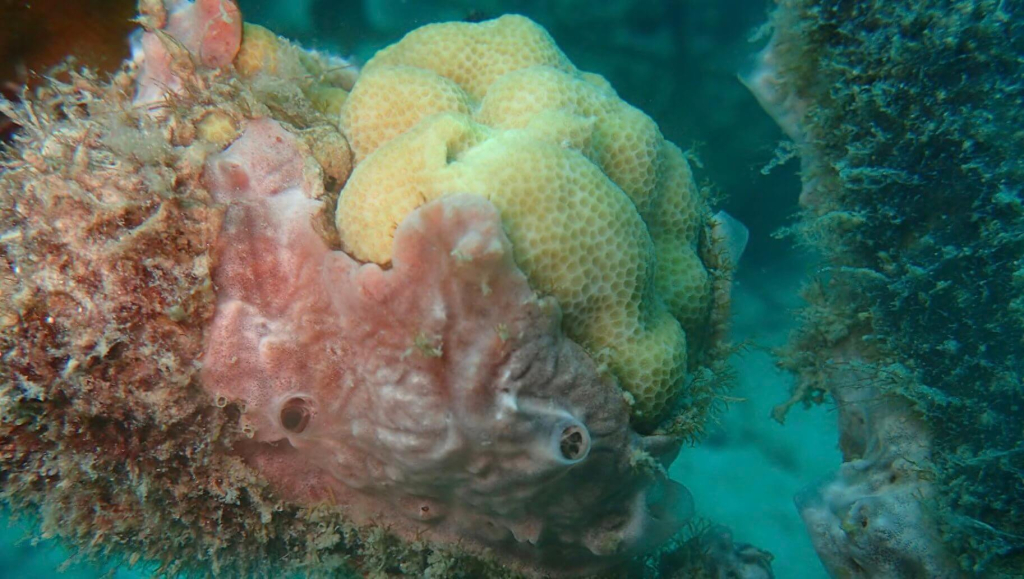
Montipora is one of the most important reef-building genera in the Indo-Pacific, second only to Acropora in species richness within the family Acroporidae. The genus is characterised by very small, immersed corallites and a coenosteum that often bears small bumps or papillae called monticules, giving the colony surface its distinctive sandpaper-like texture.
Montipora differs from its closely-related genus Acropora by lacking axial corallites at the branch tips. This means that branching Montipora species do not have a single dominant lead corallite at the tip of each branch but instead grow more diffusely, and the absence of axial corallites is the most reliable way to distinguish branching Montipora from branching Acropora.
On Koh Tao, Montipora has historically been one of the dominant reef-building genera, although it has experienced significant declines in recent decades alongside Acropora. Its presence and condition therefore serve as an important reference point for tracking community-level changes in stress-sensitive coral assemblages.
Global and Local Importance
Globally, Montipora is widespread across the tropical Indo-Pacific from the Red Sea and East Africa through Southeast Asia and out to the Pacific Islands. The genus is one of the most important contributors to reef framework across this range and supports extensive cryptobenthic invertebrate and small reef fish communities.
On Koh Tao, Montipora has historically been a major reef-building component but has declined significantly between 2006 and 2014 according to peer-reviewed survey data. This pattern places Montipora alongside Acropora and Diploastrea as a ‘loser’ genus under repeated thermal stress, in contrast to expanding ‘winner’ genera such as Porites, Pavona, and Fungiidae.
Reef-Building Contribution and Habitat Provision
Montipora colonies are major contributors to reef framework in shallow to mid-depth habitats. Plating Montipora species produce broad horizontal sheets that contribute substantial three-dimensional structure, while encrusting and columnar forms cover hard substrate and add habitat complexity at smaller scales.
The diverse growth forms of Montipora support a wide range of reef-associated species, with cryptobenthic invertebrates and small reef fish exploiting the spaces between plating colonies and the protected microhabitats created by the monticule-covered surfaces.
Growth Forms and Colony Variation
Montipora exhibits remarkable growth-form plasticity. Encrusting Montipora species produce flat sheets that cover rocky substrate. Plating species produce broad horizontal plates and bowls. Columnar species form upright pillars, while branching Montipora species produce digitate or finger-like branches without axial corallites.
On Koh Tao, the most commonly encountered forms are encrusting and plating Montipora, with branching forms occurring less frequently. Colour is typically uniform brown, cream, green, blue, or purple, with bright colour morphs particularly common in plating species under good light conditions.
Evolutionary and Taxonomic Notes
Montipora related to the genus Acropora, among others, within Acroporidae. Recent phylogenetic work has confirmed the close evolutionary relationship between the two genera while maintaining clear separation between them at the genus level. Montipora is also notable for hosting a substantial cryptic species complex within the so-called M. dilatata group, where morphologically very different species nest within a single genetic lineage.