Tubulophilinopsis pilsbryi is a medium-sized headshield slug that hunts on sand and muck across the tropical Indo-West Pacific (Rudman, 2007b; Mehrotra et al., 2021). Around Koh Tao it is uncommon. Even so, it is the headshield slug divers meet most often in the island's muck habitats, and it is often found in pairs or small groups (Mehrotra and Urgell, 2018). Published local records all come from the deeper sand beyond the coral reef (Mehrotra et al., 2021).

It is a favourite with local sea slug enthusiasts because its bold black-on-white net pattern varies so much that no two animals look quite alike. Its ecology is just as distinctive. A rounded bump on its head hides a long, tube-shaped mouth that may reach into burrows for prey, and at Koh Tao one was caught and partly swallowed by a free-living coral. This guide covers how to recognise it, how it lives and how divers can help record it.

At a glance

Feature Details
Common names Pilsbry's headshield slug; Pilsbry's Philinopsis (Kimoto, 2026b; Palomares and Pauly, 2026)
Scientific name Tubulophilinopsis pilsbryi (Eliot, 1900); formerly Philinopsis pilsbryi (MolluscaBase eds., 2026)
Classification Mollusca › Gastropoda › Heterobranchia › Order Cephalaspidea › Family Aglajidae (MolluscaBase eds., 2026)
Size Koh Tao animals 19–42 mm (Mehrotra et al., 2021); maximum about 76 mm (Pittman and Fiene, n.d.)
Colour Translucent white with a black net of lines; some forms mostly black with white spots (Rudman, 2007b)
Habitat Sand and silt beyond the coral reef, 12–28 m at Koh Tao (Mehrotra et al., 2021); intertidal elsewhere (Cobb, 2007)
Diet Carnivore; prey not yet documented, possibly worms (Zamora-Silva and Malaquias, 2016; Rudman, 2007a)
Defences Burrowing into sand; headshield slugs also have a pigment ("yellow") gland, untested in this species (Mehrotra and Urgell, 2018)
Conservation status Not Evaluated on the IUCN Red List (IUCN, n.d.)
Koh Tao look-alike Tubulophilinopsis reticulata and T. lineolata (Mehrotra and Urgell, 2018)

Identification

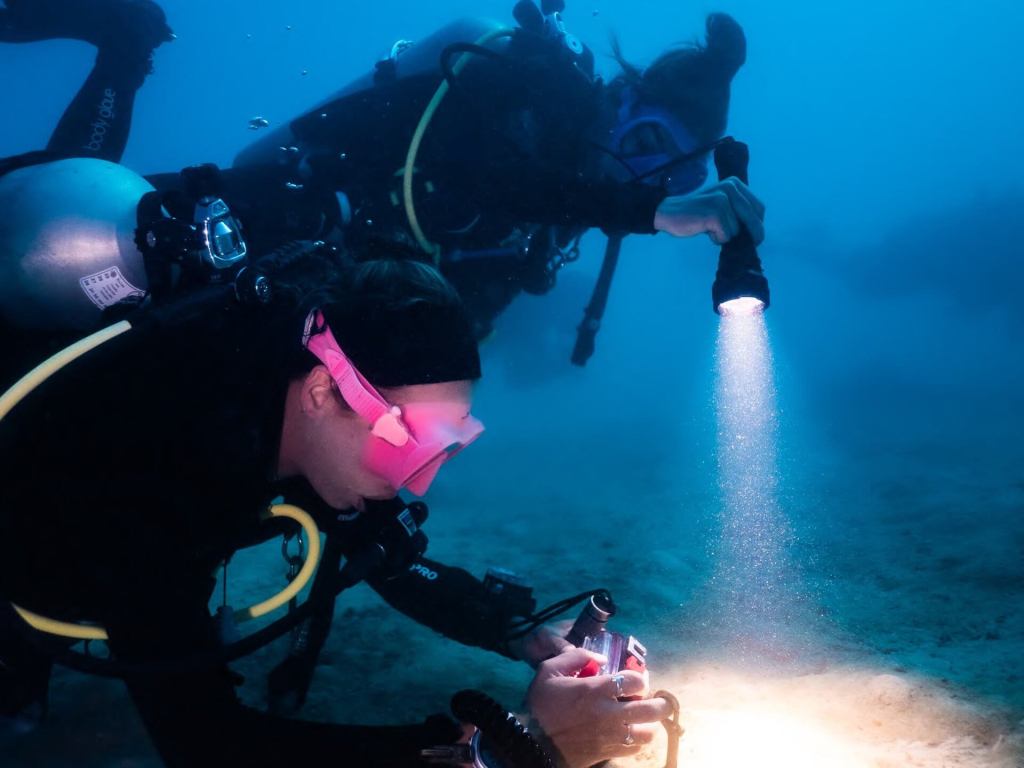
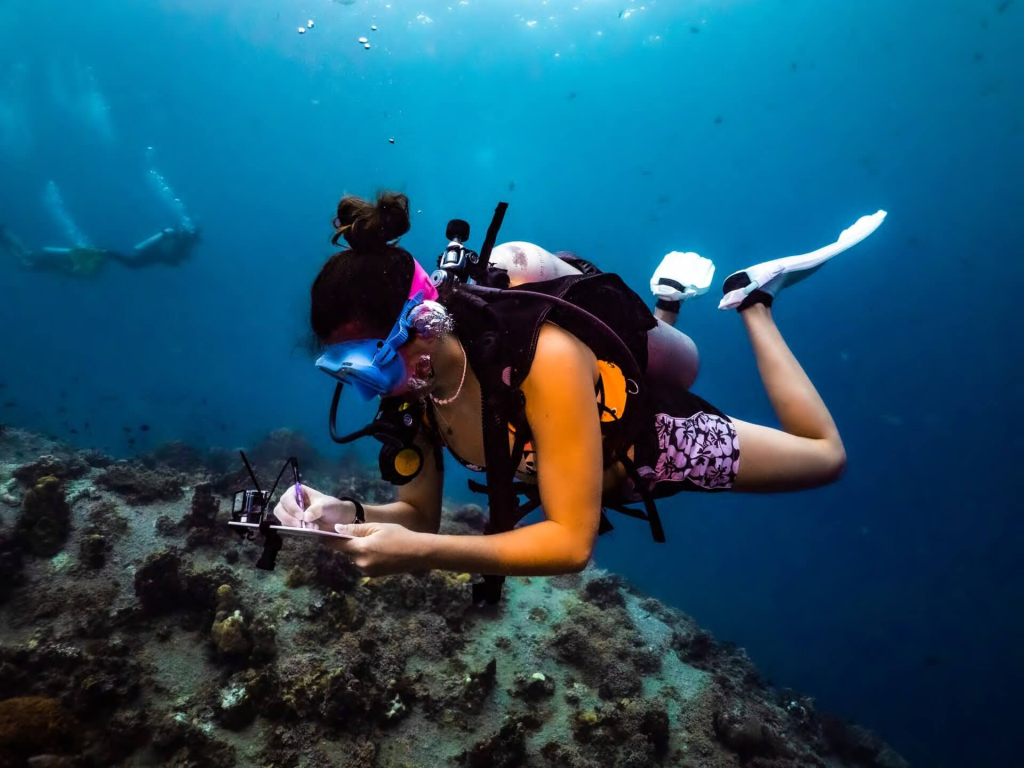
Conservation divers performing underwater research and sea slug identification training in Koh Tao, Thailand.
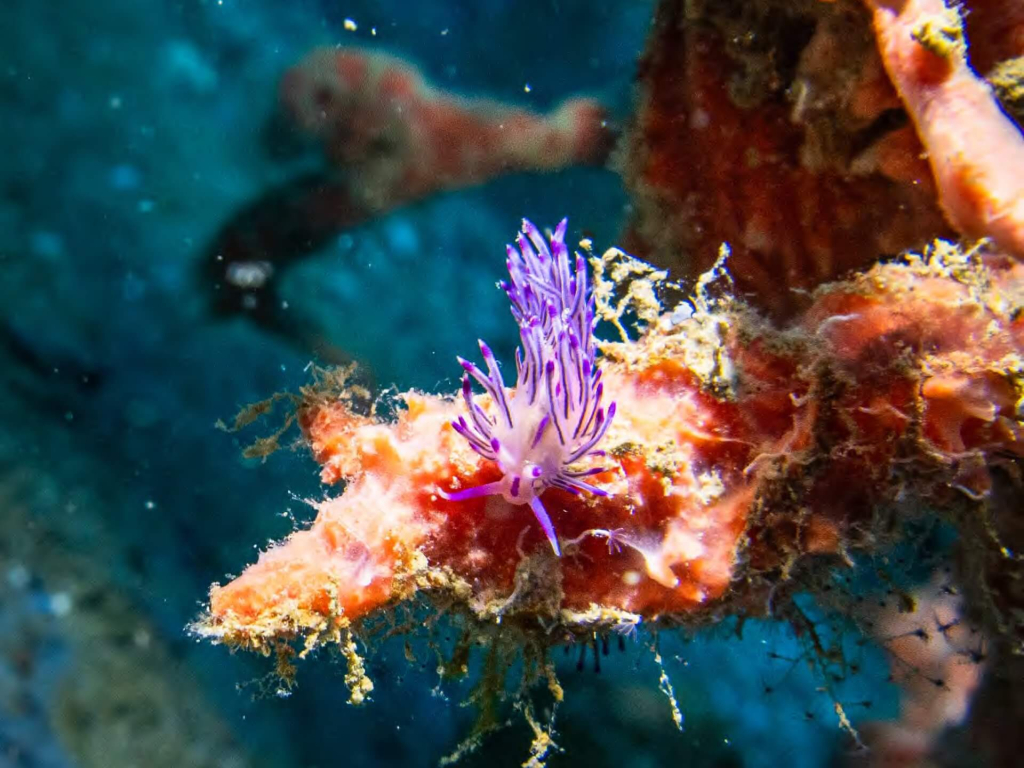
Colorful Coryphellina nudibranch feeding on a coral reef in Koh Tao, Thailand, during a marine biodiversity survey.
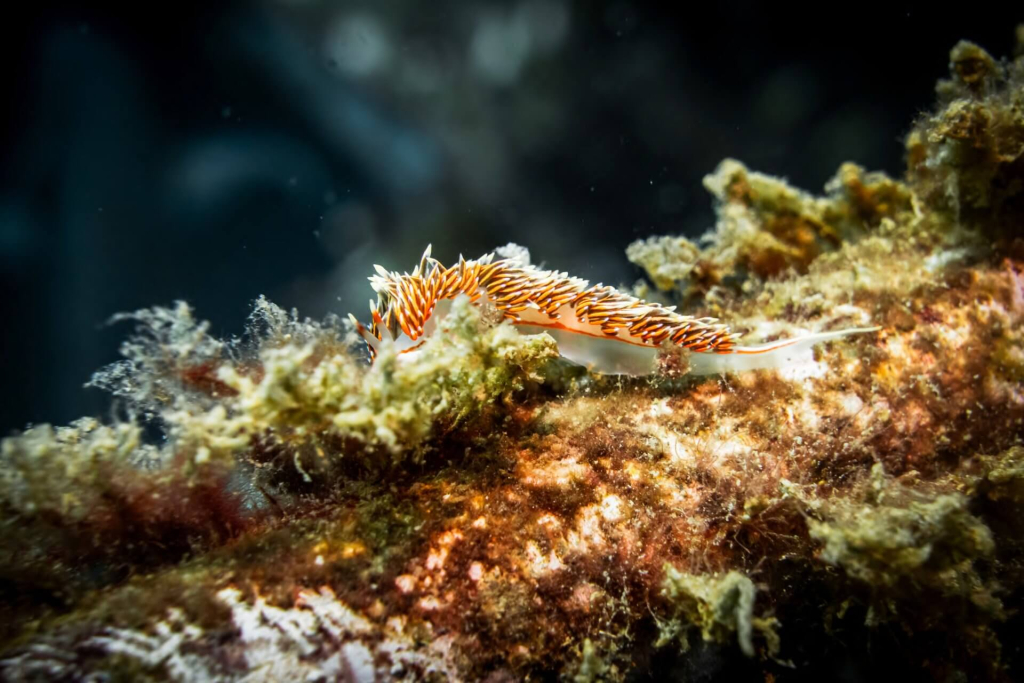
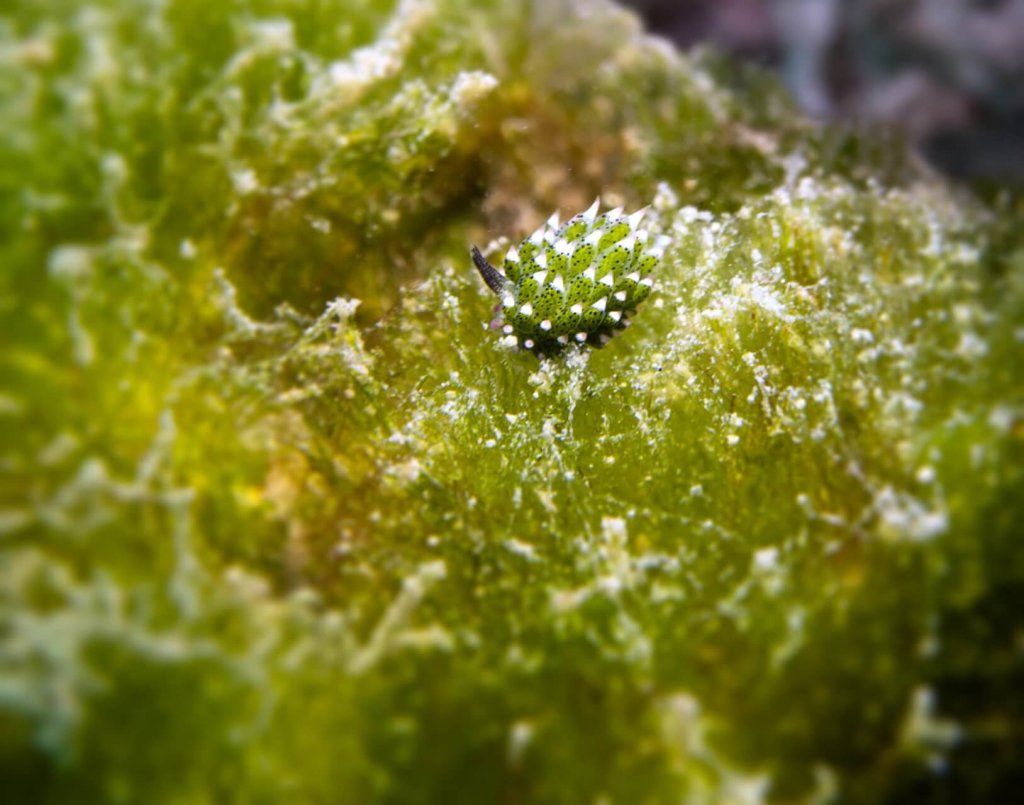
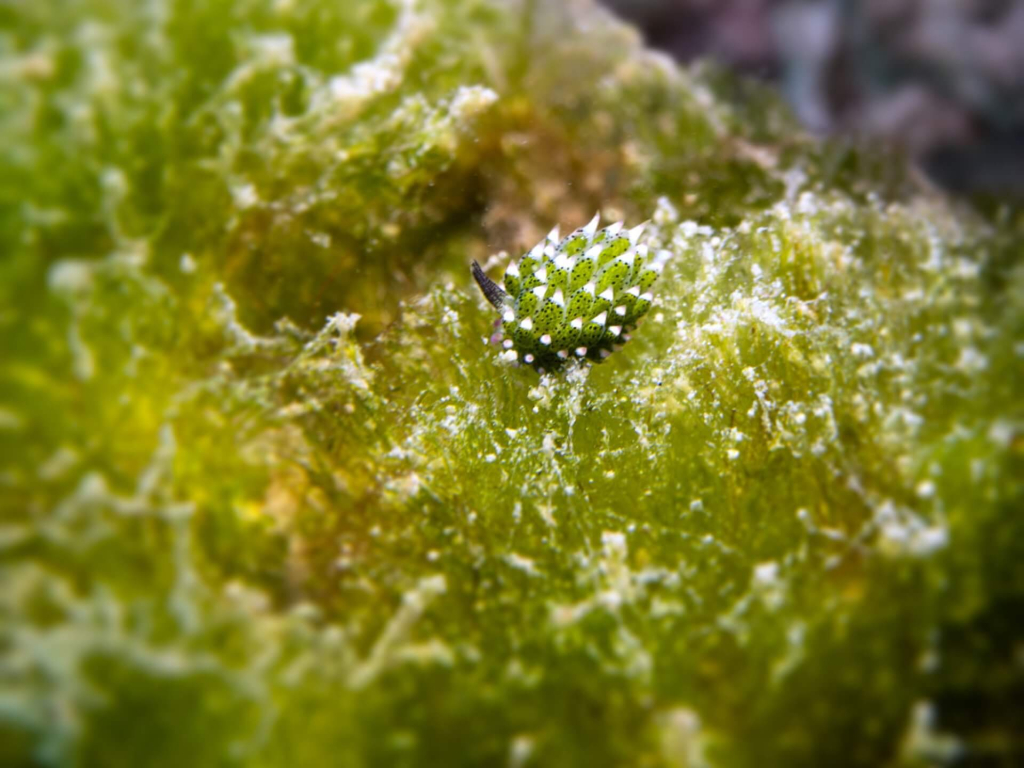
Close-up photo of a nudibranch taken during the Nudibranch & Sea Slug Ecology course at Black Turtle Conservation, Koh Tao.

Look for a white, tube-shaped slug 2–4 cm long, covered in a bold black net pattern, ploughing slowly across deep sand or silt with a rounded bump on its head.

Key field marks

  • Body: elongate and oval, with a headshield in front and a second shield over the rear half; Koh Tao animals measured 19–42 mm (Mehrotra et al., 2021).
  • Head bump: a rounded crest on the headshield. It is made by the long, folded, tube-shaped buccal bulb (the muscular mouth pump) inside the head, the feature that defines the genus (Rudman, 2007a; Zamora-Silva and Malaquias, 2018).
  • Colour: translucent white with black net-like lines. On thin-lined animals the headshield pattern forms a black figure of eight; dark forms are black with white spots, usually two large white spots on each shield (Rudman, 2007b). In pale animals the internal shell may show as a blur through the skin (Mehrotra and Urgell, 2018).
  • Head: no rhinophores (the sensory “horns” of nudibranchs). The eyes sit near the front of the headshield in small pale patches (Zamora-Silva and Malaquias, 2018).
  • Back and sides: the side flaps (parapodia) fold up along the body, with black netting on their upper edge. The underside of the flaps and the sole of the foot are colourless, at most with a few black streaks (Rudman, 2000; 2007b).
  • Behaviour: at Koh Tao it is often seen in pairs or groups of 3–4, and it burrows into the sand when disturbed (Mehrotra and Urgell, 2018). Never handle the animal to check the underside. Animals sometimes flip over the edge of a rock and show the foot on their own (Atkinson and Atkinson, 2008).

Similar species

Species How to tell it apart
Tubulophilinopsis reticulata The black net continues across the sole of the foot, and there are blue patches along the side-flap edges (Rudman, 2000). Rare at Koh Tao (Mehrotra and Urgell, 2018).
Tubulophilinopsis lineolata Many fine dark stripes running across the body instead of a net, an iridescent sheen, and blue tips at front and rear (Mehrotra and Urgell, 2018; Kimoto, 2026a). Rare at Koh Tao.
Philinopsis speciosa Square, angular headshield with no rounded crest; usually dark with bright edges, though pale speckled forms occur (Mehrotra and Urgell, 2018)

Taxonomic amendments

This species was described as Doridium (Aglaja) pilsbryi and spent most of the 20th century in Philinopsis. A molecular study of the family Aglajidae split Philinopsis and moved this species into the new genus Tubulophilinopsis, as its type species (Zamora-Silva and Malaquias, 2018). Older books and many photo sites still say Philinopsis pilsbryi; it is the same species.

Two older names, Philinopsis nigra (Pease, 1860) and Doridium alboventralis (Bergh, 1897), describe the dark Hawaiian form of this species. They were proposed as forgotten names (nomina oblita) so that the familiar name pilsbryi stays in use (Rudman, 1972; 2000).

Record confident sightings as Tubulophilinopsis pilsbryi. Use Tubulophilinopsis cf. pilsbryi for unusually patterned animals, or any with blue edges, until the sole can be seen and T. reticulata ruled out.

What makes it a headshield slug?

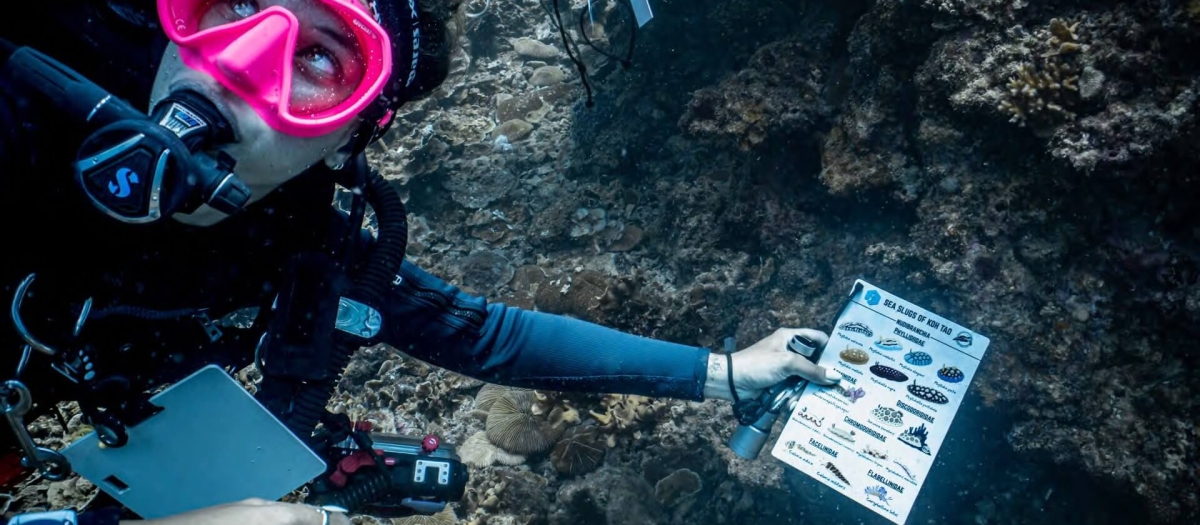
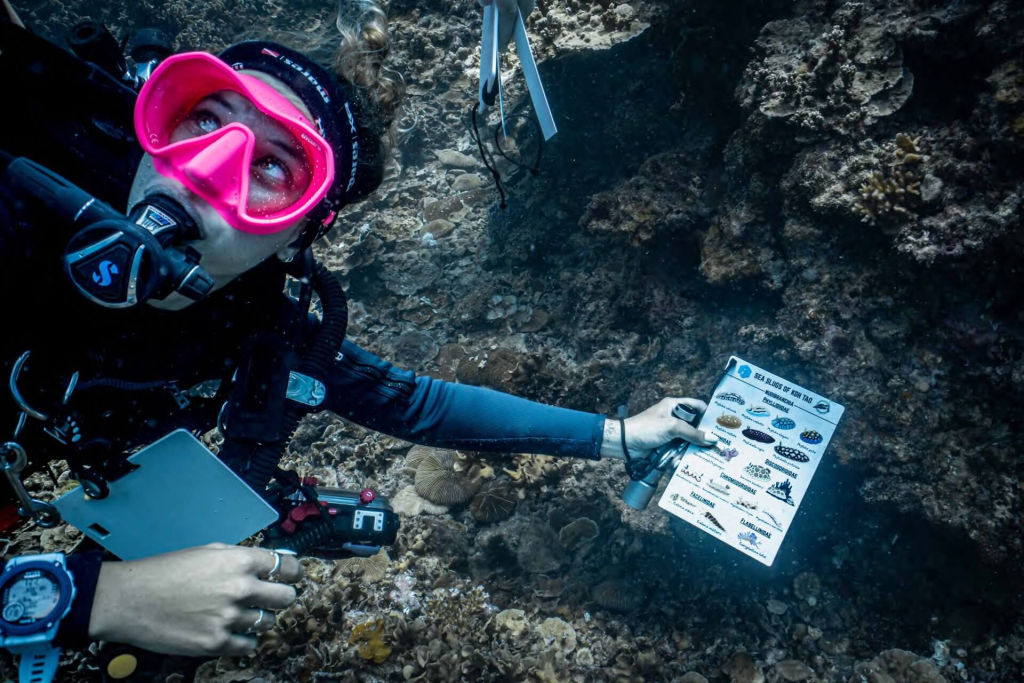
Divers conducting sea slug monitoring surveys to study species diversity and distribution around Koh Tao.

Headshield slugs (Order Cephalaspidea) are sea slugs that push through sediment behind a flat shield on the head. Unlike nudibranchs they have no rhinophores, and most keep a shell, either outside or tucked inside the body (Mehrotra and Urgell, 2018). Their common name comes from that shield, also called the cephalic shield.

Feature Tubulophilinopsis pilsbryi
Diet Carnivore that swallows prey whole; exact prey unknown (Zamora-Silva and Malaquias, 2016; Mehrotra and Urgell, 2018)
Breathing Inside a mantle cavity protected by the shields and side flaps (Mehrotra and Urgell, 2018)
Shell Small internal shell, sometimes visible through pale skin (Mehrotra and Urgell, 2018)
Swimming Mainly crawls and burrows (Mehrotra and Urgell, 2018), but divers on Koh Phangan have seen it swim (Chaloklum Diving, n.d.)
Defence Burrowing; a pigment gland in the mantle cavity, untested in this species (Mehrotra and Urgell, 2018)

The headshield does two jobs: it works as a plough for burrowing, and it helps protect the mantle cavity behind it (Mehrotra and Urgell, 2018). Many aglajids also carry rows of sensory bristles on the head, which pick up chemicals from prey such as worms, small clams and other sea slugs (Mehrotra and Urgell, 2018).

Inside, aglajids have lost the radula (the toothed ribbon most snails feed with) and the grinding gizzard plates of their plant-eating relatives. Instead they swallow prey whole (Mehrotra and Urgell, 2018). In Tubulophilinopsis, the muscular buccal bulb that does the swallowing is long and narrow, like a folded tube, which is what raises the bump on the head (Rudman, 1998; Zamora-Silva and Malaquias, 2018).

This corrects a common error: T. pilsbryi is not a nudibranch and it is not shell-less. It belongs to a separate order and keeps a small shell inside the rear of the body.

What's in the name? Tubulophilinopsis joins the Latin tubulus (small tube) to Philinopsis, the genus it came from, after the tube-shaped buccal bulb shared by all its species (Zamora-Silva and Malaquias, 2018). The species name honours the American malacologist Henry A. Pilsbry of the Academy of Natural Sciences of Philadelphia, which published the original description. Charles Eliot described it in 1900 as Doridium (Aglaja) pilsbryi, from material collected in Samoa (Eliot, 1900; Kimoto, 2026b).

Diet, feeding and defence

Costasiella kuroshimae, also known as “Shaun the Sheep” sea slug, found during the Sea Slug Ecology course in Koh Tao, Thailand.
Marine conservation diver photographing nudibranch species on Koh Tao coral reef as part of biodiversity documentation.
Community sea slug and nudibranch survey dive in Koh Tao, documenting marine biodiversity through citizen science participation.

T. pilsbryi is a carnivore, but nobody has yet recorded exactly what it eats. A gut-content study of 92 specimens from 32 aglajid species confirmed that carnivory is the only feeding strategy in the family (Zamora-Silva and Malaquias, 2016). Aglajids as a group predate on fast-moving prey such as other sea slugs, nematode and polychaete worms and even small fish (Zamora-Silva and Malaquias, 2018).

A tube for a mouth

Most Philinopsis species have a large, bulbous buccal bulb that they use to grab bubble shells and other sea slugs (Rudman, 1998). Tubulophilinopsis species instead have a long, narrow, muscular tube folded up inside the head (Rudman, 1998; Zamora-Silva and Malaquias, 2018). Bill Rudman of the Australian Museum suspected this tube extends out of the mouth to reach down burrows and cracks, perhaps to catch worms, but this has never been observed (Rudman, 2007a).

Some websites state that this species eats bubble snails. That claim appears to come from its bulbous-mouthed relatives and is not backed by any record for T. pilsbryi.

Burrowing, and an unexpected predator

The main defence seen by divers is burrowing: the headshield lets it disappear into soft sand (Mehrotra and Urgell, 2018). Headshield slugs also have a gland in the mantle cavity that releases a yellow secretion harmful to cnidarians and worms, but whether it deters predators is not known, and it has not been tested in this species (Mehrotra and Urgell, 2018).

These defences are not perfect. At Koh Tao a single T. pilsbryi was seen partly swallowed by the free-living coral Heteropsammia cochlea. It is not known whether the coral finished the meal (Mehrotra et al., 2019).

Diver note: do not dig it out, turn it over or blow sand off it to see the pattern. Photograph it as it crawls, and keep your fins well off the silt.

Habitat and distribution

Conservation divers performing underwater research and sea slug identification training in Koh Tao, Thailand.
Colorful Coryphellina nudibranch feeding on a coral reef in Koh Tao, Thailand, during a marine biodiversity survey.
Close-up photo of a nudibranch taken during the Nudibranch & Sea Slug Ecology course at Black Turtle Conservation, Koh Tao.

T. pilsbryi lives on soft bottoms, usually burrowing in sand or sandy mud (Rudman, 1998). Records run from the intertidal shoreline in Queensland, Australia (Cobb, 2007) to 28 m at Koh Tao (Mehrotra et al., 2021).

Global range

It is widespread in the tropical Indo-West Pacific, from Mozambique and Madagascar through Myanmar, Thailand, Vietnam, Malaysia, Indonesia, the Philippines and Australia to Papua New Guinea, Vanuatu, Palau, Guam, the Marshall Islands and Hawaii (Mehrotra et al., 2021). The type locality is Samoa (Eliot, 1900; Kimoto, 2026b).

The move to Tubulophilinopsis did not change the range; records under Philinopsis pilsbryi refer to the same species.

On Koh Tao

T. pilsbryi was first recorded from the Gulf of Thailand at Koh Tao (Mehrotra and Scott, 2016). The 2018 guidebook rates it Uncommon. It describes it as perhaps the most abundant headshield slug living in the island's muck habitats, though not particularly common, and often seen in pairs or groups of 3–4 (Mehrotra and Urgell, 2018).

All published records from Koh Tao were found at 12–28 m in soft-sediment habitat beyond the coral reef, where researchers describe it as abundant (Mehrotra et al., 2021). They define soft sediment as areas outside the reef where more than 90% of the bottom is sand or silt.

Black Turtle Conservation divers have also recorded T. pilsbryi on the sand and muck at Junkyard and Tao Tong (Black Turtle Conservation, n.d.).

On neighbouring Koh Phangan, Chaloklum Diving reports T. pilsbryi as the headshield slug its divers see most often. Although it is usually described as solitary, they have often found it in large groups, photographing at least 18 individuals together and also documenting their egg masses with photographic evidence, and have even described it swimming, though unpublished in literature (Chaloklum Diving, n.d.).

Behaviour and life cycle

T. pilsbryi spends its life ploughing through and under soft sediment, and is often found in company. Very little of its life cycle has been studied.

Burrowing

Like other headshield slugs, it uses the headshield to dig into the sand, where it can spend much of its time out of sight (Mehrotra and Urgell, 2018). Approaching too closely may send it back under the sand.

Pairs and sudden swarms

At Koh Tao it is often recorded in pairs or small groups of 3–4 (Mehrotra and Urgell, 2018). Elsewhere it is normally found in ones or twos (Rudman, 2007c). In July 2007, however, hundreds of animals of 20–55 mm, with egg masses, appeared along the intertidal shoreline at Mooloolaba, Queensland (Cobb, 2007). Rudman noted that finds like this show how hard it is to label any sea slug common or rare (Rudman, 2007c).

Mating

Headshield slugs are mostly simultaneous hermaphrodites, with each animal carrying both male and female organs (Palomares and Pauly, 2026). In Tubulophilinopsis the male organ ends in a cone-shaped penial papilla, fed by a long, narrow prostate (Zamora-Silva and Malaquias, 2018). Several animals may spawn side by side: four were seen laying egg masses together in the Marshall Islands (Kwajalein Underwater, 2013), and the Mooloolaba aggregation described above included egg masses (Cobb, 2007).

Life cycle

  • Eggs: a clear, round to barrel-shaped mass made of a tangled string of white eggs, anchored in the sand (Kwajalein Underwater, 2013; Pittman and Fiene, n.d.). The number of eggs per mass and how long they take to hatch are unknown. None have been recorded at Koh Tao (Black Turtle Conservation, n.d.).
  • Larvae: larval type and how long larvae drift have not been studied for this species.
  • Settlement: not directly documented; adults are found only on soft sediment, so juveniles most likely settle there.
  • Adults: Koh Tao animals measured 19–42 mm (Mehrotra et al., 2021). Growth rate, age at maturity and lifespan are unknown.

Ecological role and value as an indicator

Divers conducting sea slug monitoring surveys to study species diversity and distribution around Koh Tao.

T. pilsbryi is both predator and prey in Koh Tao's soft-sediment community. As a carnivore it is likely to help regulate its prey, though its exact prey is still undescribed (Zamora-Silva and Malaquias, 2016). It is also eaten at least occasionally: the partial swallowing by Heteropsammia cochlea, a free-living coral of the deeper sand at 12–16 m, is one of very few records of corals consuming sea slugs (Mehrotra et al., 2019).

The habitat matters more than the single species. Over a third of Koh Tao's sea slug species have been recorded only from the soft sediments beyond the reef (Mehrotra et al., 2019). Regular sightings of T. pilsbryi at a site therefore show that its muck community is still in place.

One sighting shows only that the individual was there that day, and an absence may simply mean it was buried. Only long-term records at fixed sites, with notes on behaviour and conditions, could reveal real changes in numbers.

Conservation status and threats

Marine conservation diver photographing nudibranch species on Koh Tao coral reef as part of biodiversity documentation.

T. pilsbryi is Not Evaluated on the IUCN Red List (IUCN, n.d.). Its very wide Indo-West Pacific range (Mehrotra et al., 2021) suggests it is not at risk globally, but no population-wide data exist anywhere.

No threats have been studied for this species. Locally its future is tied to the soft-sediment habitats beyond the reef, which hold a large hidden share of Koh Tao's sea slug diversity and have historically received far less survey effort than coral reefs (Mehrotra et al., 2019; 2021). Anything that buries, dredges or churns these sediments could affect it.

Local knowledge gaps:

  • what it eats at Koh Tao;
  • when and where it mates and lays eggs;
  • whether it occurs shallower than the 12 m published minimum (Mehrotra et al., 2021);
  • whether numbers change between seasons or years.

Observing and recording it with Black Turtle Conservation

Community sea slug and nudibranch survey dive in Koh Tao, documenting marine biodiversity through citizen science participation.
Conservation divers performing underwater research and sea slug identification training in Koh Tao, Thailand.

Only five Koh Tao animals have been measured in the published literature, and nothing is known locally about its diet or breeding. Careful BTC records from Junkyard, Tao Tong and other muck sites can fill those gaps.

What to record

  • When and where: date, time, dive site and dominant substrate.
  • Depth and substrate: depth, plus substrate type (sand, silt, rubble, NIA etc.) and anything nearby it may be hunting, such as worm burrows, tubes or other sea slugs.
  • Number: a count, noting pairs and groups.
  • Size: to the nearest mm.
  • Photos: a top view showing the headshield and rear-shield pattern, a side view showing the head bump and side-flap edges, and the sole of the foot only if the animal shows it on its own.

It is good practice with this species to record identifications as Tubulophilinopsis pilsbryi, or Tubulophilinopsis cf. pilsbryi where blue edges or an unusual pattern leave T. reticulata possible.

Good practice

Muck sites disturb easily, so approach slowly with good trim and keep fins high. Never use a pointer or finger to lift, flip or uncover an individual. Note any time it presses its head into a hole or engulfs something: a single clear photo of feeding would be the first local prey photo record for the species. Report egg masses and mating pairs too, with the date and water temperature.

Join us: Sea Slug Ecology & Monitoring course

Our Sea Slug Ecology & Monitoring course turns you from a diver who spots nudibranchs into one who is able to understand where and why we spot them; and one who collects data scientists can use. Every survey you join feeds one of Black Turtle Conservation's current research questions: how sea slug abundance and diversity vary across different substrates around Koh Tao.

Why it matters: Our surveys compare slug numbers across dive sites, substrates, seasons, water temperature and benthic composition. Knowing where each species thrives helps target conservation efforts and guides the planning of artificial reefs around Koh Tao.

What you'll learn

  • Ecology of the five sea slug clades/orders present on Koh Tao
  • Identifying Koh Tao species with our cheat sheets and ID guide
  • Recognising substrates using standard EMP substrate codes
  • Why defences such as aposematism, camouflage and kleptocnidae evolved
  • How sea slugs support ecotourism, medical research and reef monitoring

References

Online sources accessed 31 October 2026.

Atkinson, L. and Atkinson, D. (2008) Philinopsis pilsbryi found Vanuatu [Message in Sea Slug Forum], 4 June. Sydney: Australian Museum. Available at: http://www.seaslugforum.net/find/21586.

Black Turtle Conservation (n.d.) Photographic and video records of Tubulophilinopsis pilsbryi from Koh Tao dive sites. Unpublished data.

Chaloklum Diving (n.d.) Tubulophilinopsis pilsbryi. Marine life guide Koh Phangan. Available at: https://www.chaloklum-diving.com/marine-life-guide-koh-phangan/molluscs-mollusca/sea-slugs-opisthobranchia/headshield-slugs-cephalaspidea/tubulophilinopsis-pilsbryi/.

Cobb, G. (2007) Philinopsis pilsbryi found sthn Queensland [Message in Sea Slug Forum], 2 August. Sydney: Australian Museum. Available at: http://www.seaslugforum.net/find/20325.

Eliot, C.N.E. (1900) 'Notes on tectibranchs and naked mollusks from Samoa', Proceedings of the Academy of Natural Sciences of Philadelphia, 51, pp. 512–523. Available at: https://www.biodiversitylibrary.org/page/26300249.

IUCN (n.d.) The IUCN Red List of Threatened Species. Available at: https://www.iucnredlist.org.

Kimoto, N. (2026a) Tubulophilinopsis lineolata. SEASLUG.WORLD. Available at: https://en.seaslug.world/species/tubulophilinopsis_lineolata.

Kimoto, N. (2026b) Tubulophilinopsis pilsbryi. SEASLUG.WORLD. Available at: https://en.seaslug.world/species/tubulophilinopsis_pilsbryi.

Kwajalein Underwater (2013) Sea slug – Philinopsis pilsbryi. Marshall Islands underwater photos, 12 October. Available at: https://www.underwaterkwaj.com/JJ/2013/131012/P%20pilsbryi%20w%20egg%20mass_5156%20101213.htm.

Mehrotra, R. and Scott, C.M. (2016) 'Species inventory of sea slugs (Gastropoda: Heterobranchia) for Koh Tao, Thailand, with 25 first records for Thai waters', Marine Biodiversity, 46(4), pp. 761–771. Available at: https://doi.org/10.1007/s12526-015-0424-7.

Mehrotra, R. and Urgell, P. (2018) Nudibranchs and sea slugs of Koh Tao and nearby islands: a Conservation Diver guidebook. Koh Tao: Conservation Diver.

Mehrotra, R., Monchanin, C., Scott, C.M., Phongsuwan, N., Caballer Gutierrez, M., Chavanich, S. and Hoeksema, B.W. (2019) 'Selective consumption of sacoglossan sea slugs (Mollusca: Gastropoda) by scleractinian corals (Cnidaria: Anthozoa)', PLoS ONE, 14(4), e0215063. Available at: https://doi.org/10.1371/journal.pone.0215063.

Mehrotra, R., Caballer Gutiérrez, M.A., Scott, C.M., Arnold, S., Monchanin, C., Viyakarn, V. and Chavanich, S. (2021) 'An updated inventory of sea slugs from Koh Tao, Thailand, with notes on their ecology and a dramatic biodiversity increase for Thai waters', ZooKeys, 1042, pp. 73–188. Available at: https://doi.org/10.3897/zookeys.1042.64474.

MolluscaBase eds. (2026) Tubulophilinopsis pilsbryi (Eliot, 1900). Accessed through World Register of Marine Species. Available at: https://www.marinespecies.org/aphia.php?p=taxdetails&id=1055261.

Palomares, M.L.D. and Pauly, D. (eds) (2026) Tubulophilinopsis pilsbryi. SeaLifeBase. Available at: https://www.sealifebase.org/Summary/SpeciesSummary.php?id=141494.

Pittman, C. and Fiene, P. (n.d.) Tubulophilinopsis pilsbryi: main page. Sea Slugs of Hawaii. Available at: https://seaslugsofhawaii.com/species/Tubulophilinopsis-pilsbryi-a.html.

Rudman, W.B. (1972) 'A comparative study of the genus Philinopsis Pease, 1860 (Aglajidae, Opisthobranchia)', Pacific Science, 26(4), pp. 381–399. Available at: https://scholarspace.manoa.hawaii.edu/handle/10125/443.

Rudman, W.B. (1998) Philinopsis gardineri (Eliot, 1903) [In Sea Slug Forum], 14 October. Sydney: Australian Museum. Available at: http://www.seaslugforum.net/factsheet/philgard.

Rudman, W.B. (2000) Comment on Philinopsis pilsbryi from Hawaii by Scott Johnson [Message in Sea Slug Forum], 31 July. Sydney: Australian Museum. Available at: http://www.seaslugforum.net/find/2794.

Rudman, W.B. (2007a) Comment on Philinopsis pilsbryi from Milne Bay, PNG by Clinton Bauder [Message in Sea Slug Forum], 18 July. Sydney: Australian Museum. Available at: http://www.seaslugforum.net/find/20119.

Rudman, W.B. (2007b) Philinopsis pilsbryi (Eliot, 1900) [In Sea Slug Forum], 27 July. Sydney: Australian Museum. Available at: http://www.seaslugforum.net/find/philpils.

Rudman, W.B. (2007c) Comment on Philinopsis pilsbryi found sthn Queensland by Gary Cobb [Message in Sea Slug Forum], 2 August. Sydney: Australian Museum. Available at: http://www.seaslugforum.net/find/20325.

Zamora-Silva, A. and Malaquias, M.A.E. (2016) 'Diet preferences of the Aglajidae: a family of cephalaspidean gastropod predators on tropical and temperate shores', Journal of the Marine Biological Association of the United Kingdom, 96(5), pp. 1101–1112. Available at: https://doi.org/10.1017/S0025315415000739.

Zamora-Silva, A. and Malaquias, M.A.E. (2018) 'Molecular phylogeny of the Aglajidae head-shield sea slugs (Heterobranchia: Cephalaspidea): new evolutionary lineages revealed and proposal of a new classification', Zoological Journal of the Linnean Society, 183(1), pp. 1–51. Available at: https://doi.org/10.1093/zoolinnean/zlx064.