Overview of the Genus
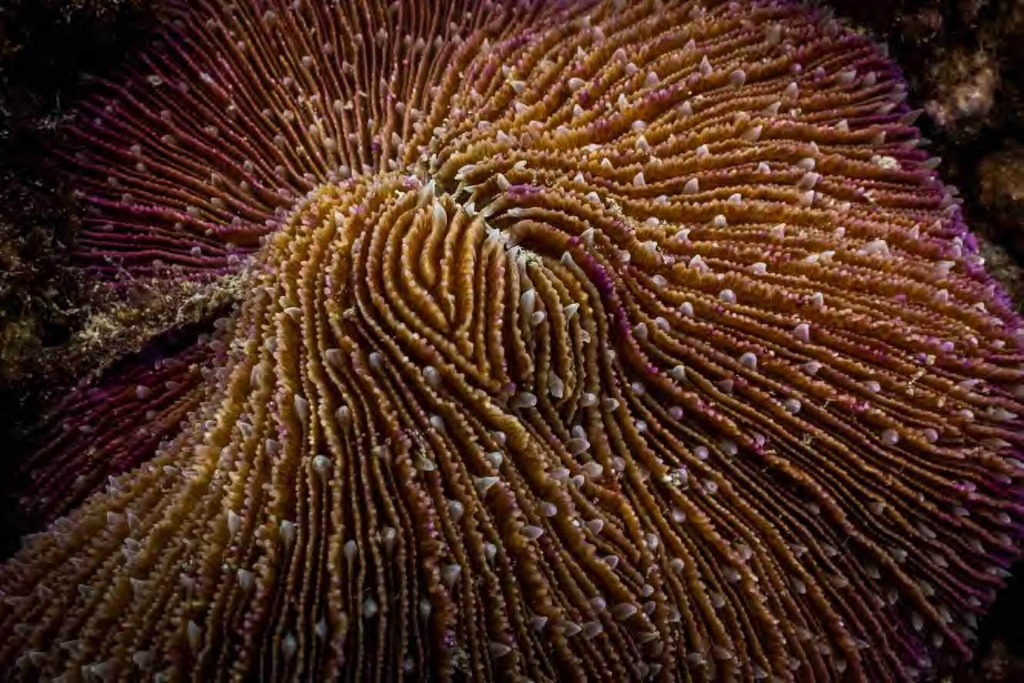
Merulina is the type genus of the family Merulinidae and one of the most morphologically distinctive foliose reef-builders in the Indo-Pacific. Its colonies grow as ruffled fan-shaped plates or columnar projections with characteristic short meandroid valleys, giving mature colonies a lettuce or cabbage-like appearance.
The genus was historically considered a relatively isolated foliose taxon, but molecular phylogenetic work since 2010 has placed Merulina alongside a wide range of other corals in a substantially revised Merulinidae. Hydnophora, Favites, Goniastrea, Platygyra, Leptoria, and Dipsastraea are all now considered members of this expanded family.
On Koh Tao, Merulina is regularly encountered at sheltered slope sites and provides distinctive foliose architecture against the dominant massive and encrusting reef framework. Its “zippered” appearance makes it readily recognisable to trained observers.
Global and Local Importance
Globally, Merulina is widespread across the tropical Indo-Pacific from the Red Sea and East Africa through Southeast Asia and out to Japan and the southern central Pacific. The genus contributes foliose architecture in sheltered reef habitats and supports cryptobenthic invertebrate communities sheltering among colony folds.
On Koh Tao, Merulina contributes to slope-zone biodiversity and is a useful indicator of stable, low-disturbance habitat conditions. Tracking its presence and condition complements monitoring of dominant reef-builders such as Porites and Pavona.
Reef-Building Contribution and Habitat Provision
Merulina colonies, although individually slow-growing, contribute substantial three-dimensional structure relative to their footprint area through their fan-shaped or columnar projections. Mature colonies provide microhabitat for cryptobenthic invertebrates and small reef fish that exploit the protected spaces between folds and ruffles.
The ruffled laminar architecture of Merulina also creates microscale topographic complexity that contributes to reef habitat diversity, complementing the more uniform surfaces of dominant massive reef-builders on Koh Tao slopes.
Growth Forms and Colony Variation
Merulina ampliata, the most common species in the genus and around Koh Tao, produces foliose, fan-shaped, or columnar colonies with characteristic short meandroid valleys arranged across the surface. Growth forms vary depending on habitat, with sheltered colonies often producing more upright columnar or ascendant projections, and more exposed colonies producing flatter fan-shaped plates.
Colour is typically green, olive, cream, or brown, sometimes with pink fringes along the colony edges. The combination of ruffled architecture and meandroid valley patterns gives Merulina a distinctive and recognisable visual identity in the field.
Evolutionary and Taxonomic Notes
As the type genus of Merulinidae, Merulina anchors a family that has expanded substantially since 2010 to incorporate genera previously placed in Faviidae, Pectiniidae, and other revised groupings. Although the genus itself has remained relatively stable taxonomically, its central role in the family means that ongoing phylogenetic work continues to refine its known relationships.