| Feature | Details |
|---|---|
| Common names | Faithful sea slug (Kimoto, 2026); Faithful chromodoris (older name); Reliable chromodoris (SeaLifeBase, n.d.) |
| Scientific name | Goniobranchus fidelis (Kelaart, 1858) |
| Classification | Mollusca › Gastropoda › Heterobranchia › Order Nudibranchia › Family Chromodorididae |
| Size | Usually 6–18 mm at Koh Tao (Mehrotra et al., 2021); maximum reported 40 mm (SeaLifeBase, n.d.) |
| Colour | Creamy white mantle, broad orange to red rim, thin wine-red line between the two; black rhinophores and gills (Rudman, 1999) |
| Habitat | Coral reef, often among coral rubble; 2–25 m at Koh Tao (Mehrotra and Urgell, 2018; Mehrotra et al., 2021) |
| Diet | Sponges; reported on the purple sponge Aplysilla violacea (SeaLifeBase, n.d.) |
| Defences | Distasteful sponge chemicals stored in the skin, advertised by warning colours (Carbone et al., 2013) |
| Conservation status | Not Evaluated on the IUCN Red List (IUCN, n.d.) |
| Koh Tao look-alike | Goniobranchus cf. rubrocornutus and G. verrieri (Mehrotra and Urgell, 2018) |
At a glance
Identification
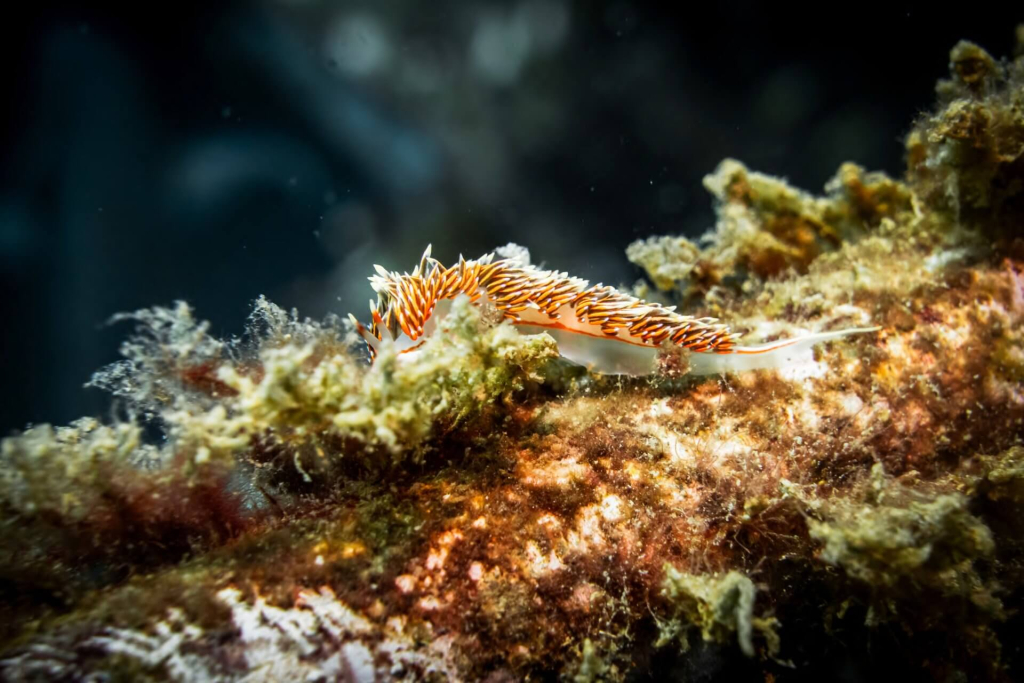
Look for a tiny white oval with a red-orange rim and two black “horns”, crawling over coral rubble.
Key field marks
- Body: a small, smooth, flattened oval, usually 6–18 mm long at Koh Tao and rarely over 20 mm (Mehrotra and Urgell, 2018; Mehrotra et al., 2021).
- Black rhinophores and gills: the clearest single feature. No other white, red-rimmed Goniobranchus on Koh Tao has them (Rudman, 1999; Mehrotra and Urgell, 2018).
- Colour: creamy white centre, sometimes yellowish in the middle, with a broad orange to red rim and a thin wine-red line between the white and the rim. Arch-shaped patches of the rim colour often run into the white (Rudman, 1999; Kimoto, 2026). Juveniles can be paler (see Behaviour and life cycle).
- Head: two rhinophores, the chemical-sensing “horns” on the head. Each has a pale, translucent stalk and a black, ridged club (Kimoto, 2026).
- Back: a small tuft of black-tinged, feathery gills at the rear of the back (Rudman, 1999). The foot underneath is white.
- Behaviour: crawls slowly and openly over rubble and reef by day.
Similar species
| Species | How to tell it apart |
|---|---|
| Goniobranchus cf. rubrocornutus | Translucent gills and rhinophores edged white or very pale pink, not black; a broken red rim followed by an orange band; about 10 mm (Mehrotra and Urgell, 2018) |
| Goniobranchus verrieri | Red rhinophores and translucent, white-edged gills; rim yellow on the outside turning red. Very rare, seen only in the north (Mehrotra and Urgell, 2018) |
Taxonomic amendments
The name is stable, but older books use different ones. It was first described as Doris fidelis in 1858 (GBIF, n.d.). It was later placed in Chromodoris, and moved to Goniobranchus when that genus was revived after DNA work on the family (Johnson and Gosliner, 2012). Chromodoris flammulata, C. lactea and C. krishna are now treated as the same species (Australian Faunal Directory, n.d.b).
DNA puts G. fidelis closest to G. collingwoodi, G. decorus and G. geminus, not to the white, banded Goniobranchus it resembles (Soong et al., 2022).
This corrects a common error: some online descriptions give pale rhinophores, a purple inner line, or adults of 30–45 mm. Koh Tao individuals have black rhinophores and gills and are rarely over 20 mm (Mehrotra and Urgell, 2018). Rudman (1999) also notes three colour variations across the region.
What makes it a nudibranch?
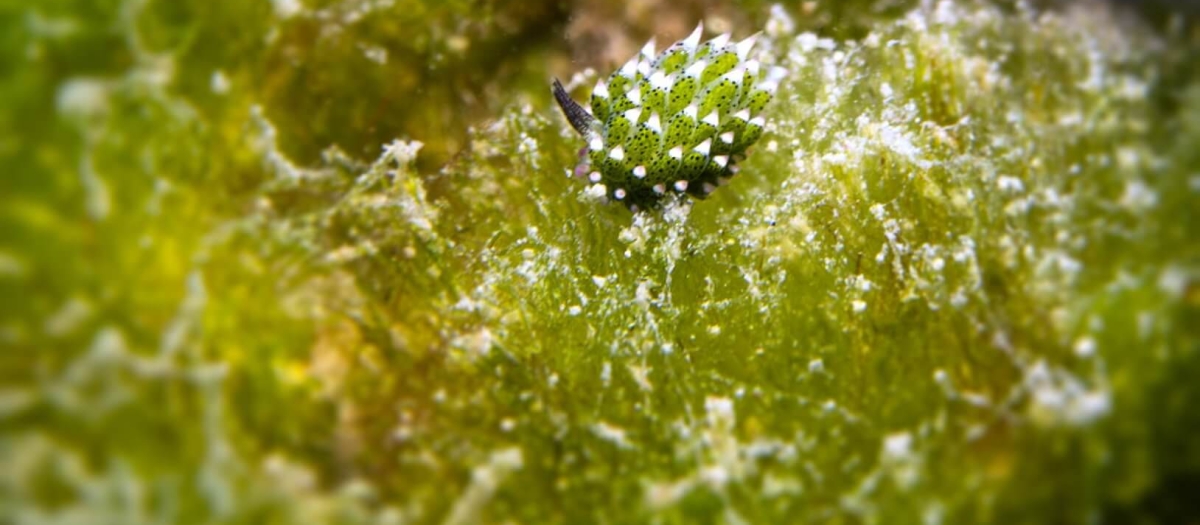
Nudibranchs (Order Nudibranchia) are sea slugs that have lost their shell completely as adults. The name means “naked gills”, and they are the most varied sea slug group, with over 3,000 species described worldwide (Mehrotra and Urgell, 2018). G. fidelis belongs to the chromodorids (Family Chromodorididae), brightly coloured nudibranchs that feed on sponges (Rudman and Bergquist, 2007).
| Feature | Goniobranchus fidelis |
|---|---|
| Diet | Sponges |
| Breathing | A ring of feathery, retractable gills on the rear of the back |
| Shell | None as an adult; a thin larval shell is lost early on |
| Swimming | Does not swim; crawls on its foot |
| Defence | Chemicals taken from its sponge food, plus warning colours |
Nudibranch larvae carry a thin shell, but lose it quickly as they grow (Mehrotra and Urgell, 2018). Without a shell, chromodorids like G. fidelis rely on chemistry and colour instead, explained under Diet, feeding and defence.
In G. fidelis and other dorid nudibranchs, the gills form a small tuft around the anus near the back of the body. The name “naked gills” is not always apt, as many species keep their gills tucked away (Mehrotra and Urgell, 2018).
What’s in the name? The species name fidelis is Latin for “faithful”. Edward Kelaart described the species in 1858 from Ceylon, now Sri Lanka (GBIF, n.d.; Kimoto, 2026). The genus Goniobranchus was named by William Pease in 1866 (Australian Faunal Directory, n.d.a).
Diet, feeding and defence
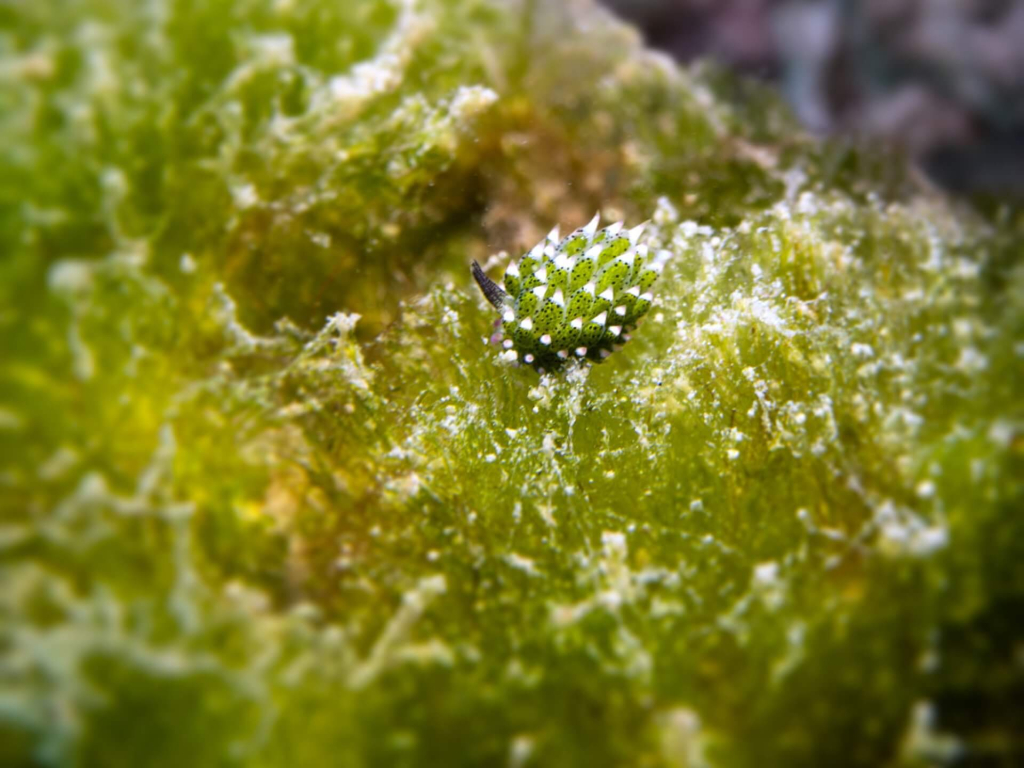
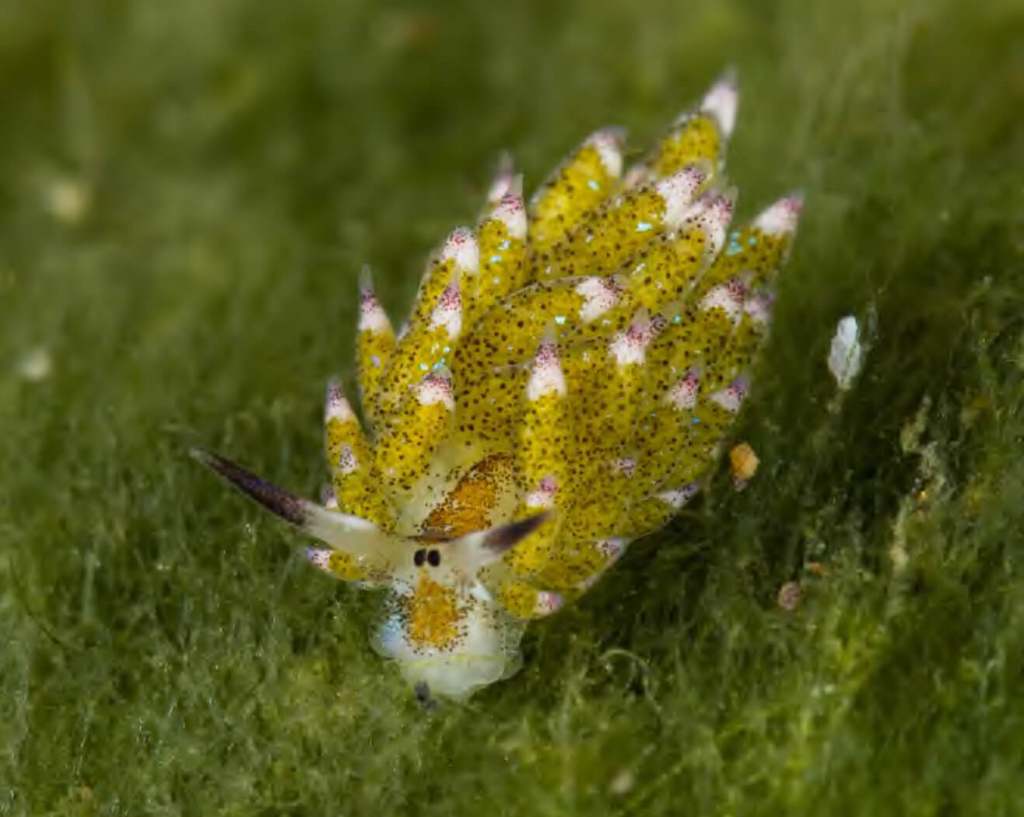
G. fidelis eats sponges. It has been reported feeding on the purple sponge Aplysilla violacea (SeaLifeBase, n.d.). That fits its family: Chromodoris and its close relatives, the group Goniobranchus was split from, mostly eat sponges of the family Darwinellidae, which includes Aplysilla (Rudman and Bergquist, 2007). Like other nudibranchs it feeds with a specialised radula, a ribbon of tiny teeth that rasps off sponge tissue. Its exact prey on Koh Tao has not been documented.
Borrowed chemical weapons
Chromodorids take defensive chemicals from the sponges they eat and store them in the mantle (Forster et al., 2021). In the species studied, the most distasteful compounds are packed into small sacs called mantle dermal formations (MDFs). These have no ducts, so they release nothing on their own. When a fish bites the mantle edge, the sacs burst and fill its mouth with concentrated, foul-tasting chemicals (Carbone et al., 2013). The chemistry of G. fidelis itself has not been tested.
This corrects a common error: chromodorids are often said to ooze a defensive “milky secretion”. The stored chemicals are released when a predator bites, not pumped out (Carbone et al., 2013).
Warning colours
Bright colours on a slow, exposed animal are a warning to predators that it tastes bad. Studies of red-spotted Goniobranchus in Australia show that look-alike species share a similar warning pattern but are not equally toxic (Winters et al., 2018). Whether the white, red and black pattern of G. fidelis belongs to such a group has not been studied.
Diver note: never touch or move G. fidelis. Its defences sit in the soft mantle edge, which is easily damaged, and the animal is small enough to be lost in a careless fin kick.
Habitat and distribution
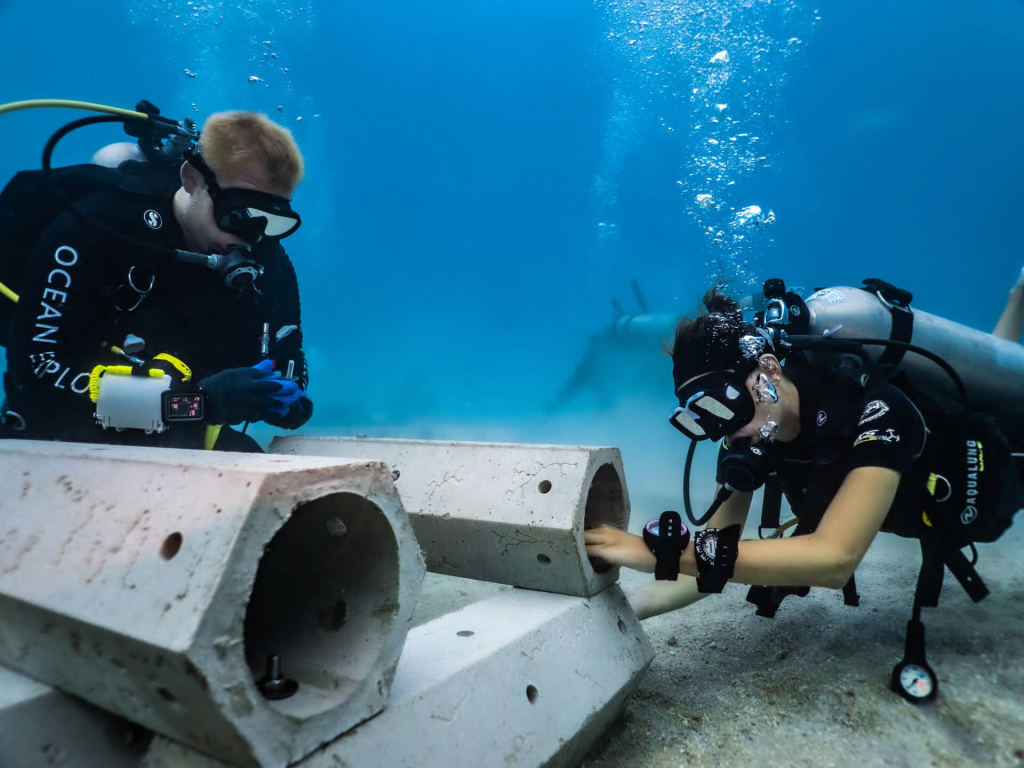
G. fidelis is a coral reef species. At Koh Tao it has been found at 2–25 m (Mehrotra et al., 2021), and elsewhere at 6–30 m (SeaLifeBase, n.d.). It is most often seen on coral rubble rather than on sand or in the muck (Mehrotra and Urgell, 2018).
Global range
It is one of the most widespread chromodorids in the Indo-West Pacific. Published records run from the Red Sea, Mozambique and Madagascar through the Maldives, India and Myanmar to Indonesia, the Philippines, Japan, Australia and New Caledonia (Mehrotra et al., 2021). It reaches the central Pacific at Guam and Palmyra Atoll (Kimoto, 2026). In Thailand it is known from both the Andaman Sea and the Gulf of Thailand (Chavanich et al., 2013).
On Koh Tao
The Koh Tao guidebook rates it between common and uncommon, with records from reefs right around the island, usually among rubble (Mehrotra and Urgell, 2018). The peer-reviewed inventory, based on roving-diver surveys from January 2016 to February 2020, lists four specimens (Mehrotra et al., 2021).
The inventory gives one depth range for all records, 2–25 m, on coral reef habitat (Mehrotra et al., 2021).
Black Turtle Conservation divers have also recorded G. fidelis at Shark Island, Hin Wong Pinnacle, Tanote Bay, No Name Pinnacle, Laem Thian Caves and Chumphon Pinnacle (Black Turtle Conservation, n.d.). These add the offshore pinnacles and the east coast to the published south-coast records.
Behaviour and life cycle
G. fidelis crawls slowly over rubble and reef in full view, relying on its chemical defences rather than hiding.
Growing into its colours
The red rim of most Koh Tao adults is often a softer yellow or orange in juveniles (Mehrotra and Urgell, 2018). A pale-rimmed animal is therefore not necessarily a different species; check the black rhinophores and gills (see Identification).
Mating
Like all nudibranchs it is a simultaneous hermaphrodite, carrying male and female organs at once. Two animals line up side by side and exchange sperm, so both can go on to lay eggs (SeaLifeBase, n.d.). Spawning has been photographed in Japan (Kimoto, 2026), but its egg mass has not been described in detail.
Life cycle
No study has followed G. fidelis from egg to adult. The steps below come from a close relative, the chromodorid Hypselodoris festiva, and from nudibranchs in general.
- Eggs: laid as a wavy ribbon, attached along one edge to the reef. In H. festiva eggs hatched after about 6 days at 22 °C and about 12 days at 20 °C, and failed to hatch at 18 °C (Hayashi and Nakano, 2024).
- Larvae: most nudibranchs hatch as veligers, tiny shelled larvae that swim and feed in the plankton for several weeks (Hayashi and Nakano, 2024).
- Settlement: the larva settles on the reef, loses its shell and becomes a juvenile slug (Mehrotra and Urgell, 2018). The cue for G. fidelis is not known, but in sponge-eating chromodorids it is likely to be its prey.
- Adults: growth rate, age at maturity and lifespan are not known; adults at Koh Tao measure 6–18 mm and rarely exceed 20 mm (Mehrotra and Urgell, 2018; Mehrotra et al., 2021), with a maximum of 40 mm reported elsewhere (SeaLifeBase, n.d.).
Conservation status and threats
G. fidelis has not been assessed for the IUCN Red List, so its status is Not Evaluated (IUCN, n.d.). Its very wide range suggests it is not at risk globally, but no population data exist anywhere.
No threats specific to this species have been studied. As a sponge eater that lives on shallow reef and rubble, it depends on the same habitat as Koh Tao’s corals, and anything that damages that habitat is likely to affect it.
Local knowledge gaps include its exact sponge prey on Koh Tao, how numbers change between seasons and years, its egg mass and breeding season, and whether it is more common at the offshore pinnacles than on the coastal reefs.
Observing and recording it with Black Turtle Conservation
The peer-reviewed record for Koh Tao is based on relatively few specimens from majority southern-island sites, so every BTC sighting adds valuable data to the records. Records from the pinnacles and the east coast, with depth and substrate, can show where this species is most common and whether that changes over time.
What to record
- When and where: date, time, dive site and dominant substrate.
- Depth and substrate: depth, plus substrate type (sand, silt, rubble, NIA etc.) and any sponge the slug is sitting on or near.
- Number: a count, noting any aggregations or mating pairs.
- Size: to the nearest mm.
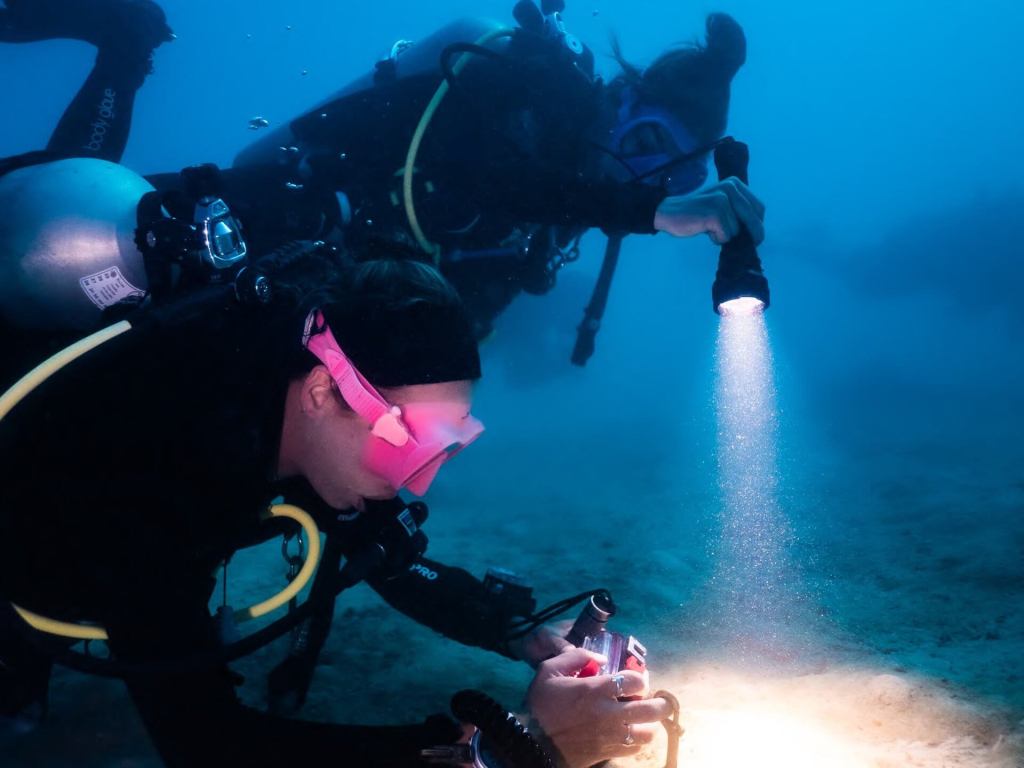
- Photos: one from directly above showing the whole rim, and one from the side showing the rhinophores and gills clearly. Add a photo of any sponge it is on.
It is good practice with this species to record identifications as Goniobranchus fidelis only when the black rhinophores and gills are visible in a photo, and as Goniobranchus sp. otherwise.
Good practice
At 6–18 mm this slug is easy to lose, so hover above it with neutral buoyancy and keep fins well clear of the rubble. Never touch it or move it for a better angle. If you lift a piece of rubble to look underneath, put it back exactly as it was. Note pale-rimmed juveniles too: they are part of the same population and show when young animals are settling.
Join us: Sea Slug Ecology & Monitoring course
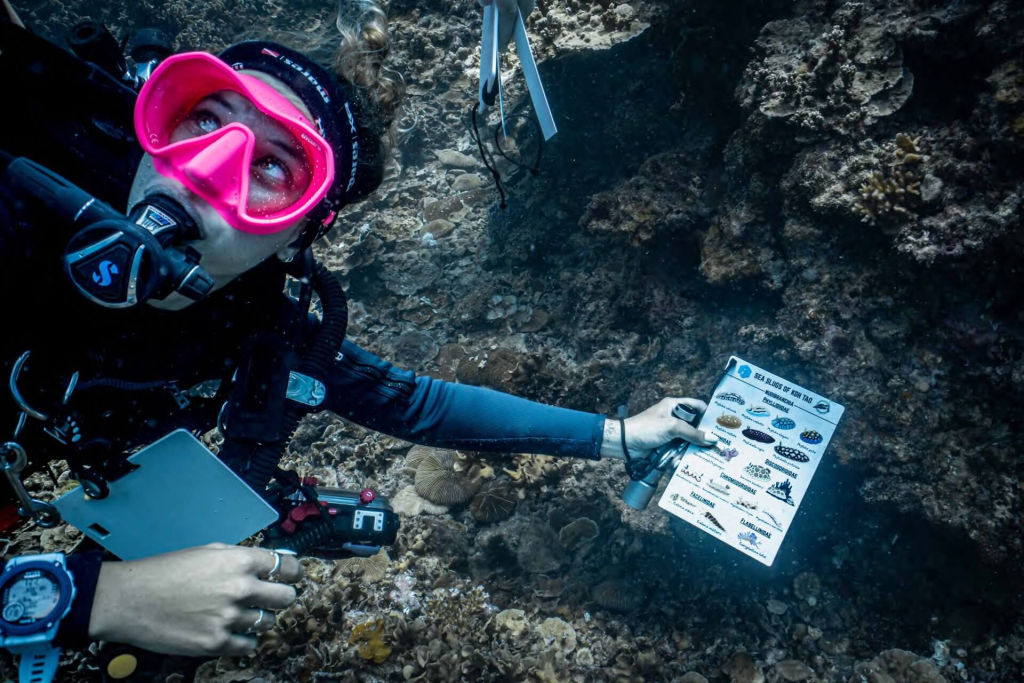
Our Sea Slug Ecology & Monitoring course turns you from a diver who spots nudibranchs into one who is able to understand where and why we spot them; and one who collects data scientists can use. Every survey you join feeds one of Black Turtle Conservation’s current research questions: how sea slug abundance and diversity vary across different substrates around Koh Tao.
Why it matters: Our surveys compare slug numbers across dive sites, substrates, seasons, water temperature and benthic composition. Knowing where each species thrives helps target conservation efforts and guides the planning of artificial reefs around Koh Tao.
What you’ll learn
- Ecology of the five sea slug clades/orders present on Koh Tao
- Identifying Koh Tao species with our cheat sheets and ID guide
- Recognising substrates using standard EMP substrate codes
- Why defences such as aposematism, camouflage and kleptocnidae evolved
- How sea slugs support ecotourism, medical research and reef monitoring
References
Online sources accessed 29 October 2026.
Australian Faunal Directory (n.d.a) Genus Goniobranchus Pease, 1866. Available at: https://biodiversity.org.au/afd/taxa/Goniobranchus.
Australian Faunal Directory (n.d.b) Species Goniobranchus fidelis (Kelaart, 1858). Available at: https://biodiversity.org.au/afd/taxa/Goniobranchus_fidelis.
Black Turtle Conservation (n.d.) Photographic and video records of Goniobranchus fidelis from Koh Tao dive sites. Unpublished data.
Carbone, M., Gavagnin, M., Haber, M., Guo, Y.-W., Fontana, A., Manzo, E., Genta-Jouve, G., Tsoukatou, M., Rudman, W.B., Cimino, G., Ghiselin, M.T. and Mollo, E. (2013) ‘Packaging and delivery of chemical weapons: a defensive Trojan horse stratagem in chromodorid nudibranchs’, PLoS ONE, 8(4), e62075. Available at: https://doi.org/10.1371/journal.pone.0062075.
Chavanich, S., Viyakarn, V., Sanpanich, K. and Harris, L.G. (2013) ‘Diversity and occurrence of nudibranchs in Thailand’, Marine Biodiversity, 43(1), pp. 31–36. Available at: https://doi.org/10.1007/s12526-012-0141-4.
Forster, L.C., Clegg, J.K., Cheney, K.L. and Garson, M.J. (2021) ‘Expanding the repertoire of spongian-16-one derivatives in Australian nudibranchs of the genus Goniobranchus and evaluation of their anatomical distribution’, Marine Drugs, 19(12), 680. Available at: https://doi.org/10.3390/md19120680.
GBIF (n.d.) Doris fidelis Kelaart, 1858. GBIF Backbone Taxonomy. Available at: https://www.gbif.org/species/6519828.
Hayashi, M. and Nakano, H. (2024) ‘Staging of post-settlement growth in the nudibranch Hypselodoris festiva’, Scientific Reports, 14, 16157. Available at: https://doi.org/10.1038/s41598-024-66322-4.
IUCN (n.d.) The IUCN Red List of Threatened Species. Available at: https://www.iucnredlist.org.
Johnson, R.F. and Gosliner, T.M. (2012) ‘Traditional taxonomic groupings mask evolutionary history: a molecular phylogeny and new classification of the chromodorid nudibranchs’, PLoS ONE, 7(4), e33479. Available at: https://doi.org/10.1371/journal.pone.0033479.
Kimoto, N. (2026) Goniobranchus fidelis (Kelaart, 1858). SEASLUG.WORLD. Available at: https://en.seaslug.world/species/goniobranchus_fidelis.
Mehrotra, R. and Urgell, P. (2018) Nudibranchs and sea slugs of Koh Tao and nearby islands: a Conservation Diver guidebook. Koh Tao: Conservation Diver.
Mehrotra, R., Caballer Gutiérrez, M.A., Scott, C.M., Arnold, S., Monchanin, C., Viyakarn, V. and Chavanich, S. (2021) ‘An updated inventory of sea slugs from Koh Tao, Thailand, with notes on their ecology and a dramatic biodiversity increase for Thai waters’, ZooKeys, 1042, pp. 73–188. Available at: https://doi.org/10.3897/zookeys.1042.64474.
Rudman, W.B. (1999) Chromodoris fidelis (Kelaart, 1858) [Message in Sea Slug Forum], 1 June. Sydney: Australian Museum. Available at: https://www.seaslugforum.net/chrofide.htm.
Rudman, W.B. and Bergquist, P.R. (2007) ‘A review of feeding specificity in the sponge-feeding Chromodorididae (Nudibranchia: Mollusca)’, Molluscan Research, 27(2), pp. 60–88. Available at: https://www.mapress.com/mr/content/v27/2007f/n2p088.htm.
SeaLifeBase (n.d.) Goniobranchus fidelis, Reliable Chromodoris. Available at: https://sealifebase.org/summary/speciessummary.php?id=87235.
Soong, G.Y., Bonomo, L.J., Reimer, J.D. and Gosliner, T.M. (2022) ‘Battle of the bands: systematics and phylogeny of the white Goniobranchus nudibranchs with marginal bands (Nudibranchia, Chromodorididae)’, ZooKeys, 1083, pp. 169–210. Available at: https://doi.org/10.3897/zookeys.1083.72939.
Winters, A.E., Wilson, N.G., van den Berg, C.P., How, M.J., Endler, J.A., Marshall, N.J., White, A.M., Garson, M.J. and Cheney, K.L. (2018) ‘Toxicity and taste: unequal chemical defences in a mimicry ring’, Proceedings of the Royal Society B: Biological Sciences, 285, 20180457. Available at: https://doi.org/10.1098/rspb.2018.0457.