| Feature | Details |
|---|---|
| Common names | Tryon's Hypselodoris (SeaLifeBase, n.d.); older guides use Tryon's Risbecia |
| Scientific name | Hypselodoris tryoni (Garrett, 1873) |
| Classification | Mollusca › Gastropoda › Heterobranchia › Order Nudibranchia › Suborder Doridina (dorid nudibranchs) › Family Chromodorididae (Moles et al., 2026) |
| Size | 30–35 mm in Koh Tao specimens (Mehrotra et al., 2021); the first specimen described was 71 mm (Garrett, 1873); reported to 90 mm (Solitary Islands Underwater Research Group, n.d.). BTC divers have recorded 19–79 mm (Black Turtle Conservation, n.d.). |
| Colour | Cream to light brown with brown mottling, small dark purple to black spots ringed in white, and a thin violet line round the mantle edge (Garrett, 1873; Rudman, 1999a) |
| Habitat | Rocks and rubble within coral reef, 1–30 m (Mehrotra et al., 2021) |
| Diet | Sponges, especially Dysidea (Solitary Islands Underwater Research Group, n.d.; Turner and Wilson, 2008) |
| Defences | Sponge-derived chemicals such as furodysinin, stored in mantle glands and advertised by warning colours (Dean and Prinsep, 2017; Rudman, 2001b) |
| Conservation status | Not Evaluated on the IUCN Red List (IUCN, n.d.) |
| Koh Tao look-alike | None recorded; its regional look-alikes have not been found at Koh Tao (Mehrotra et al., 2021) |
At a glance
Identification
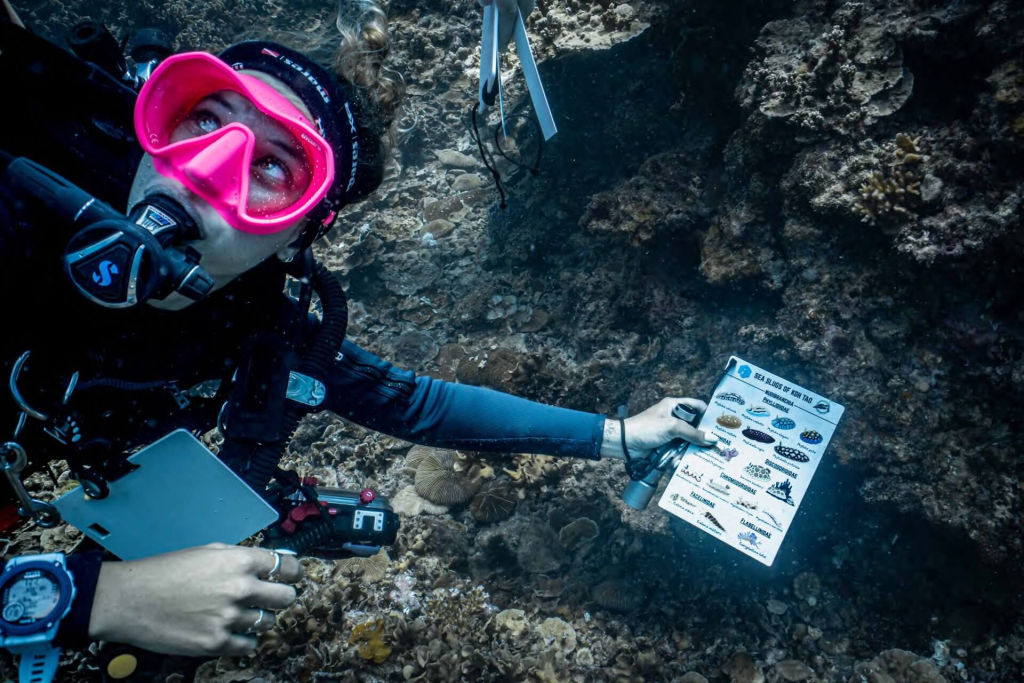
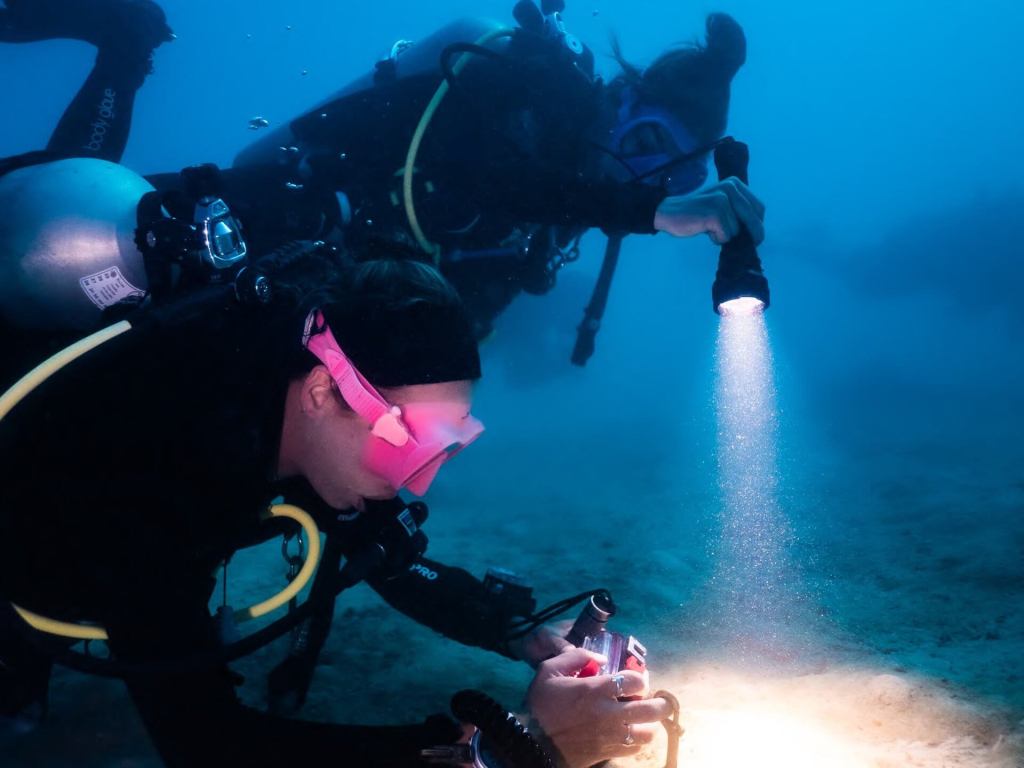
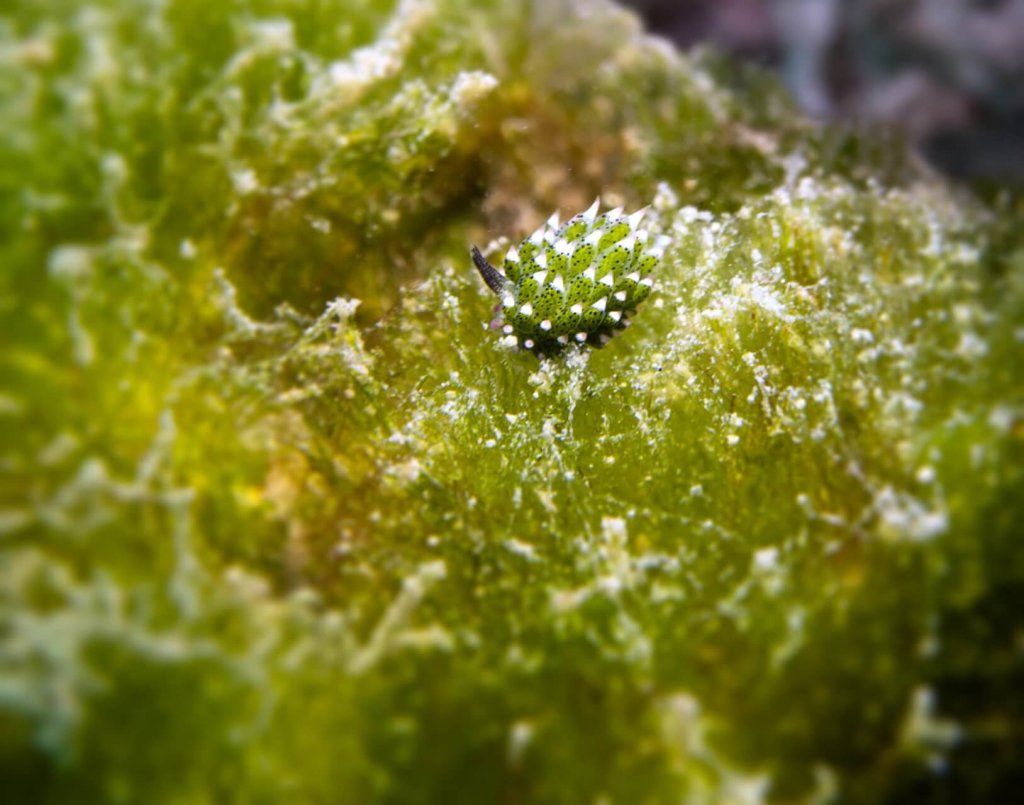
Look for a tall, creamy-brown slug sprinkled with tiny dark spots, each in a white ring, crawling over reef rock or rubble, often with a second one nearby.
Key field marks
- Body: high and elongate, with only a narrow mantle skirt (the fleshy “cape” over the back) and a long foot that sticks out well behind the mantle (Garrett, 1873; Rudman, 1999a). Koh Tao animals measured 30–35 mm (Mehrotra et al., 2021).
- Spots: small, round, dark purple to almost black spots, each ringed in opaque white, scattered over the back and sides (Garrett, 1873). The purple spots are the main local field mark (Mehrotra and Urgell, 2018).
- Colour: cream to light brown ground with darker brown mottling, and a thin violet line around both the mantle edge and the foot (Garrett, 1873; Rudman, 1999a).
- Head: two rhinophores (chemical-sensing “horns” with stacked plates), light brown shading to violet at the tips, with white edges to the plates (Garrett, 1873).
- Back: a ring of about 24 feathery gill plumes, pale brown with darker and violet edges (Garrett, 1873); the gills often vibrate (Epstein et al., 2019). Small white glands may show as beads right at the mantle edge, larger towards the rear (Rudman, 2001b).
- Behaviour: often found trailing, with two or more animals in single file (Mehrotra and Urgell, 2018). Never handle them to affect behaviour.
Similar species
None of these look-alikes has been recorded at Koh Tao (Mehrotra et al., 2021), so a slug matching the field marks above here is almost certainly H. tryoni.
| Species | How to tell it apart |
|---|---|
| Goniobranchus leopardus | Spots grouped into hollow, square-ish "leopard" rosettes; wide mantle skirt hides the foot (Rudman, 1999a); glands form a diffuse band inside the mantle edge, not white beads at the edge (Rudman, 2001b) |
| Goniobranchus kuniei | Broad purple mantle border made of three bands of slightly different colour; wide mantle skirt (Rudman, 1999a) |
| Goniobranchus geminus | Four coloured bands around the mantle edge instead of one thin violet line (Rudman, 1999a) |
| Hypselodoris pulchella | Yellow rather than dark spots; has been seen trailing H. tryoni (Rudman, 2001a) |
Taxonomic amendments
Garrett (1873) described this species as Goniodoris tryoni. It was later moved to Chromodoris and then to Risbecia (MolluscaBase eds., 2026). DNA studies then showed that Risbecia tryoni sits inside Hypselodoris (Turner and Wilson, 2008), and Risbecia was merged into Hypselodoris (Johnson and Gosliner, 2012). A later revision of the whole genus kept H. tryoni as a single species, with no split (Epstein et al., 2019).
Older dive guides still say Risbecia tryoni, and some use the synonym Chromodoris odhneri. The higher classification has also been debated. Korshunova et al. (2025) proposed moving the dorids out of Nudibranchia into their own order, Doridida. Moles et al. (2026) rejected this and kept Nudibranchia whole, with the dorids as the suborder Doridina; this guide follows Moles et al. (2026), though some 2025–2026 sources and databases still show Doridida. Both Koh Tao sources use H. tryoni (Mehrotra and Urgell, 2018; Mehrotra et al., 2021), so record it as Hypselodoris tryoni.
What makes it a nudibranch?
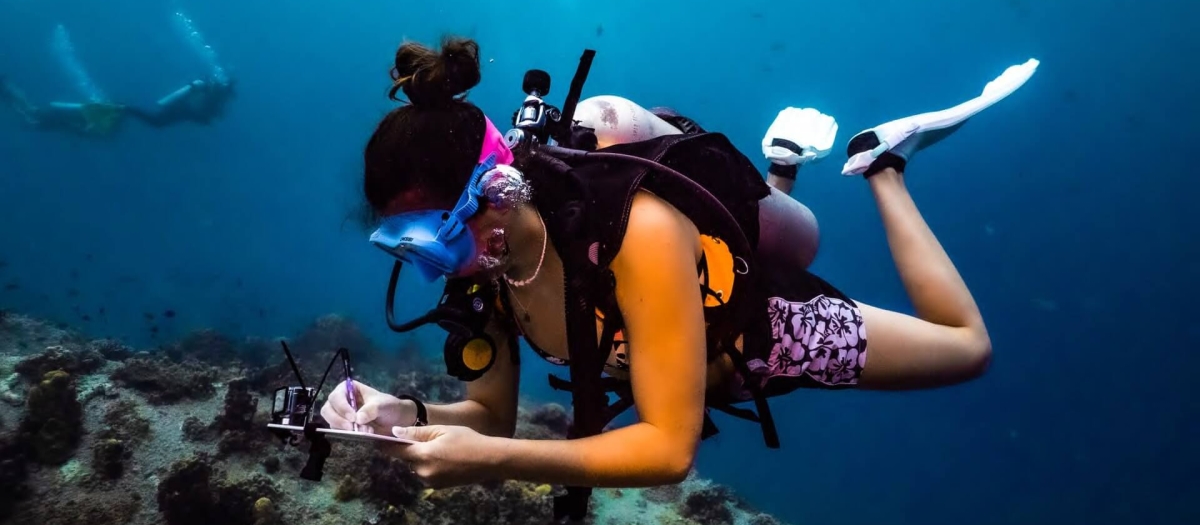
Nudibranchs are the most varied of the sea slugs, and all of them have lost the shell completely as adults; Koh Tao's sea hares and headshield slugs keep more of their shelled past (Mehrotra and Urgell, 2018). The name means "naked gills". H. tryoni is a dorid nudibranch (suborder Doridina), the group with a feathery ring of gills around the anus on the back (Dean and Prinsep, 2017; Moles et al., 2026).
| Feature | Hypselodoris tryoni |
|---|---|
| Diet | Sponges (Solitary Islands Underwater Research Group, n.d.) |
| Breathing | A ring of about 24 feathery gill plumes on the rear of the back (Garrett, 1873) |
| Shell | None as an adult; only the larva has a thin shell (Mehrotra and Urgell, 2018) |
| Swimming | Not known to swim; crawls on a long foot (Garrett, 1873) |
| Defence | Chemicals taken from its sponge prey, stored in mantle glands (Dean and Prinsep, 2017) |
The defining dorid feature is the gill ring. The second is the mantle (the thick skin of the back), which in many dorids holds mantle dermal formations: small glands where defence chemicals are stored (Dean and Prinsep, 2017). In H. tryoni these show as tiny white beads along the mantle edge (Rudman, 2001b). This corrects a common error: nudibranch gills are not always on show, and in many species they are tucked away (Mehrotra and Urgell, 2018).
What's in the name? Hypselodoris combines the Greek hypsēlos, "high", with Doris, a sea nymph whose name is used for many sea slugs; it suits this tall-bodied species. The species name honours the American malacologist George Washington Tryon Jr. (1838–1888), who started the Manual of Conchology (Kimoto, 2026). Andrew Garrett described it as Goniodoris tryoni in 1873, from a 71 mm individual from the Society Islands, French Polynesia (Garrett, 1873).
Diet, feeding and defence
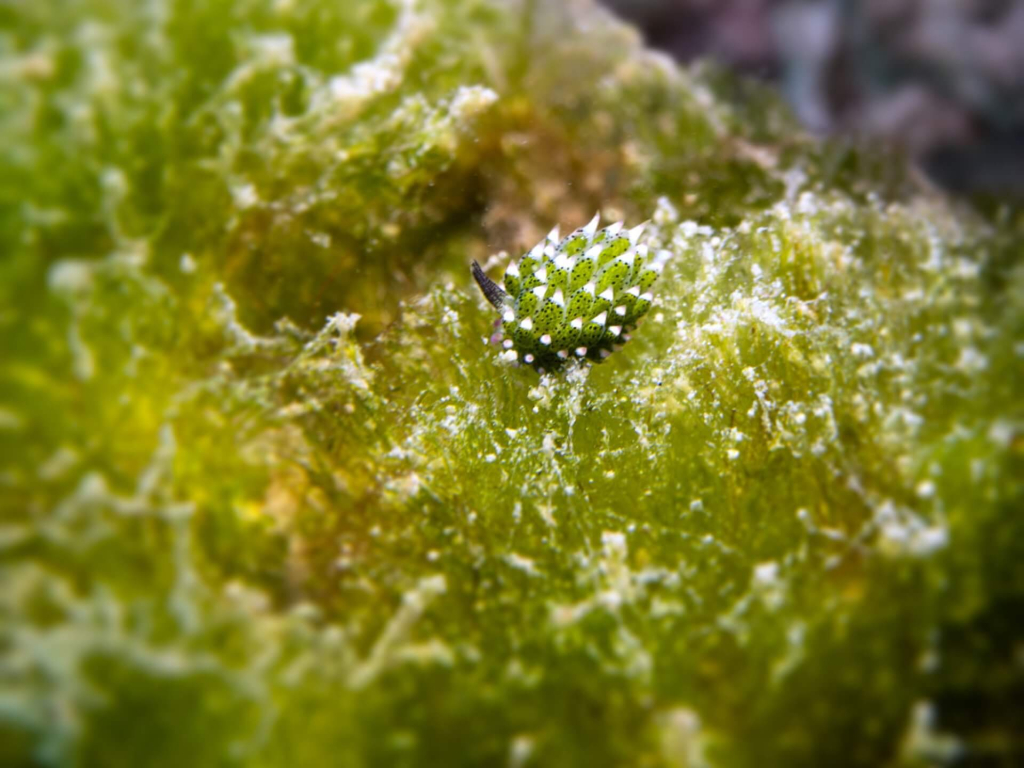
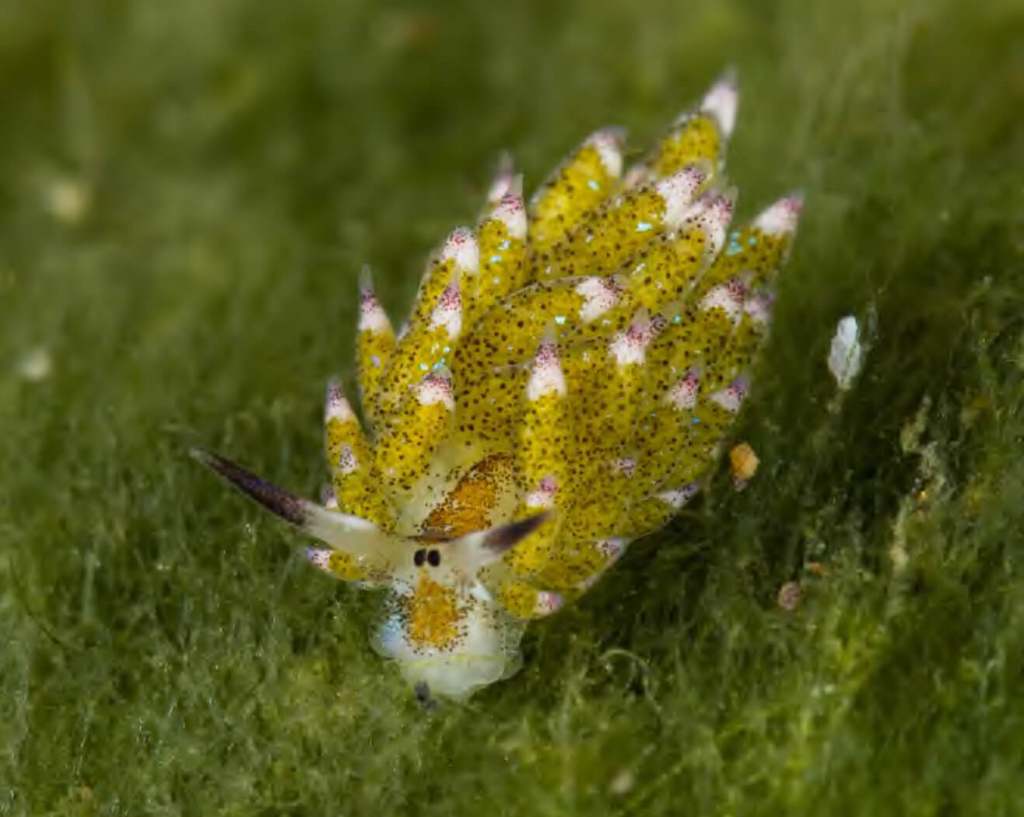
H. tryoni eats sponges and has been recorded feeding on Dysidea fragilis (Solitary Islands Underwater Research Group, n.d.). That fits its family: Hypselodoris and the former Risbecia species are known to prey on Dysidea sponges (Turner and Wilson, 2008). Like other dorids it rasps sponge tissue with its specialised radula, a ribbon of tiny teeth. What it eats at Koh Tao has not been formally documented.
Borrowed chemicals
A chemical study of H. tryoni found furodysinin, a compound made by its sponge prey (Dean and Prinsep, 2017). Furodysinin is one of the slug's major compounds, and it deters fish and is toxic to them (Dean and Prinsep, 2017; Mudianta et al., 2024). The slug does not make it; it takes it from its food and keeps it.
Glands at the mantle edge and warning colours
The stored chemicals sit in mantle glands, which in H. tryoni are small white spheres right at the mantle edge, larger towards the rear (Rudman, 2001b). Its bold, contrasting spots work as aposematism: warning colours that tell a would-be predator the slug will taste unpleasant (Mehrotra and Urgell, 2018).
Diver note: never touch or move H. tryoni. Its defence chemicals are concentrated at the mantle edge and the sacs can burst easily; and lifting it off its sponge or breaking a trail disturbs feeding and mate-finding.
Habitat and distribution
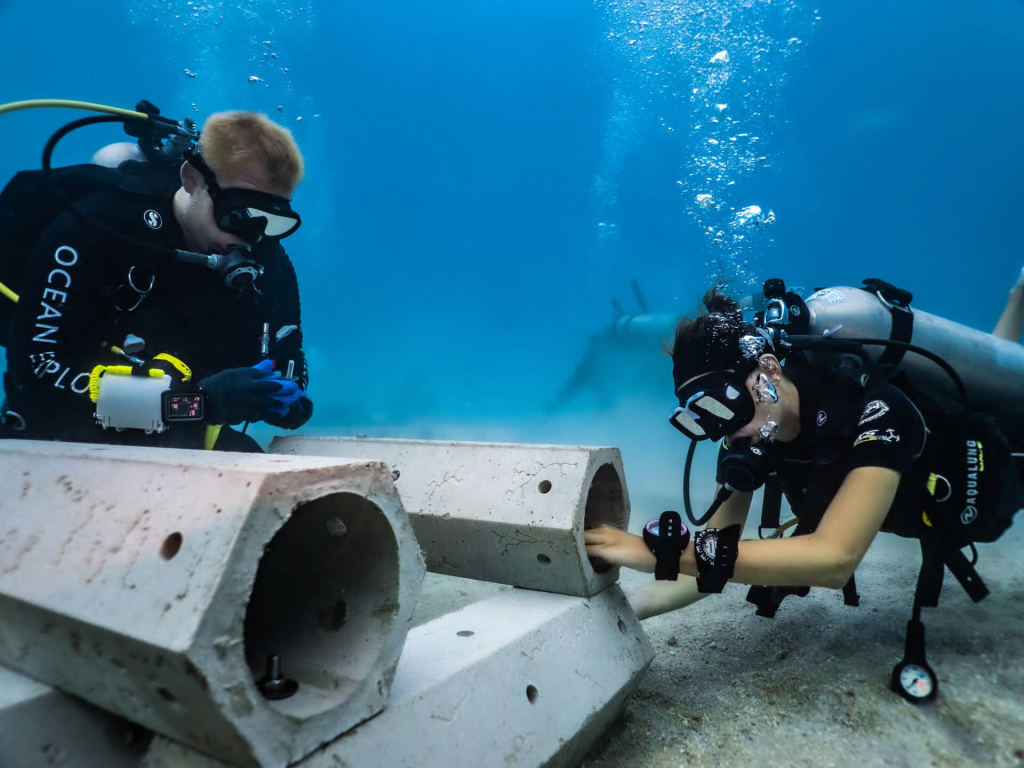
H. tryoni lives on rocks and rubble within coral reef, from 1 to 30 m (Mehrotra et al., 2021). Off eastern Australia it is found on reefs down to 25 m (Solitary Islands Underwater Research Group, n.d.).
Global range
It ranges across the Indo-Pacific, from Tanzania east to the Society Islands and north to Japan (SeaLifeBase, n.d.). Published records include Singapore, Vietnam, Australia, Malaysia, the Philippines, Indonesia, Palau, Papua New Guinea, Vanuatu, the Marshall Islands, and both the Andaman and Gulf coasts of Thailand (Mehrotra et al., 2021). The Solitary Islands, New South Wales, are likely its southern limit (Solitary Islands Underwater Research Group, n.d.). Older sources limit it to the tropical western Pacific (Rudman, 1999a); later records extend that west into the Indian Ocean.
On Koh Tao
- Guidebook: recorded as uncommon (U), usually found on coral reef and reef rubble around the whole island, with numbers that vary from year to year (Mehrotra and Urgell, 2018).
- Peer-reviewed inventory: specimens 30–35 mm, examined during surveys from 2016 to 2020. Further sightings were on rocks and rubble within coral reef at 1–30 m (Mehrotra et al., 2021).
Black Turtle Conservation divers have also recorded H. tryoni at Junkyard, Lighthouse, Twins, Hin Wong Pinnacle and Laem Thian (Black Turtle Conservation, n.d.). On nearby Koh Phangan it is seen at most dive sites (Chaloklum Diving, n.d.).
Behaviour and life cycle
H. tryoni crawls openly across reef and rubble, relying on chemical defence and warning colours rather than hiding (Mehrotra and Urgell, 2018).
Trailing
Trailing is when one slug follows another so closely that they touch, as if in a train. H. tryoni is one of the best-known trailers: usually two animals, sometimes three or four (Rudman, 2003). The follower picks up chemical cues in the leader's slime trail (Mehrotra and Urgell, 2018), following the mucus until the two make contact (Rudman, 2003).
Nobody knows for sure why it happens. The leading idea is that it helps uncommon animals find a mate (Rudman, 1999b). Other suggestions include sharing a food source (Mehrotra and Urgell, 2018). H. tryoni has even been seen trailing the yellow-spotted H. pulchella, which suggests the two species use similar chemical signals (Rudman, 2001a).
Mating
All sea slugs are hermaphrodites: each animal has both male and female reproductive organs (Mehrotra and Urgell, 2018). Two slugs pair up and exchange sperm, and both can then lay eggs. Mating in H. tryoni has not been described formally; in the related H. festiva, it began with one slug touching the other with its oral tentacles and mouth (Hayashi and Nakano, 2024).
Life cycle
The early stages of H. tryoni have not been studied. The steps below come from H. festiva, the first chromodorid raised from egg to adult in the laboratory, so treat the timings as a guide only (Hayashi and Nakano, 2024).
- Eggs: laid as a ribbon fixed along one edge, with one embryo per capsule. They hatched after about 6 days at 22 °C and 12 days at 20 °C, and did not hatch at 18 °C (Hayashi and Nakano, 2024).
- Larvae: hatch as veligers, tiny swimming larvae with a shell that feed on plankton. In H. festiva they settled 21 days after hatching (Hayashi and Nakano, 2024). The larval shell is lost as the animal grows (Mehrotra and Urgell, 2018).
- Settlement: young H. festiva needed Dysidea sponge to develop beyond the first juvenile stage (Hayashi and Nakano, 2024). The settlement cue for H. tryoni is unknown.
- Adults: H. festiva reached the adult form at 164 days and first laid eggs at 175 days, about six months after hatching (Hayashi and Nakano, 2024). The lifespan of H. tryoni is unknown.
Ecological role and value as an indicator
H. tryoni is a specialist sponge predator, one of many chromodorids that link reef sponges to the rest of the food web through the chemicals they borrow (Dean and Prinsep, 2017). Those chemicals interest medical researchers too: furodysinin from Balinese H. tryoni showed antimalarial activity in laboratory tests (Mudianta et al., 2024).
Sea slugs are monitored as indicators of overall biodiversity because many have narrow diets (Mehrotra and Urgell, 2018). A single sighting of H. tryoni only shows that the individual and, probably, its food sponges were present that day. Its numbers already swing from year to year at Koh Tao (Mehrotra and Urgell, 2018), so only long-term, standardised records could show whether a change reflects reef condition or natural ups and downs.
Conservation status and threats
H. tryoni is Not Evaluated on the IUCN Red List (IUCN, n.d.), so there is no global estimate of its numbers or trend. Because it depends on particular sponges, anything that damages reef sponge communities is likely to affect it. Collection for the aquarium trade is a further risk: sponge-eating slugs rarely survive long in tanks, and collecting them and their prey is often unsustainable (Mehrotra and Urgell, 2018).
Local knowledge gaps include:
- which sponges it eats at Koh Tao;
- whether its year-to-year swings in numbers (Mehrotra and Urgell, 2018) follow water temperature, season or food supply;
- where and when it lays eggs on Koh Tao reefs.
Observing and recording it with Black Turtle Conservation
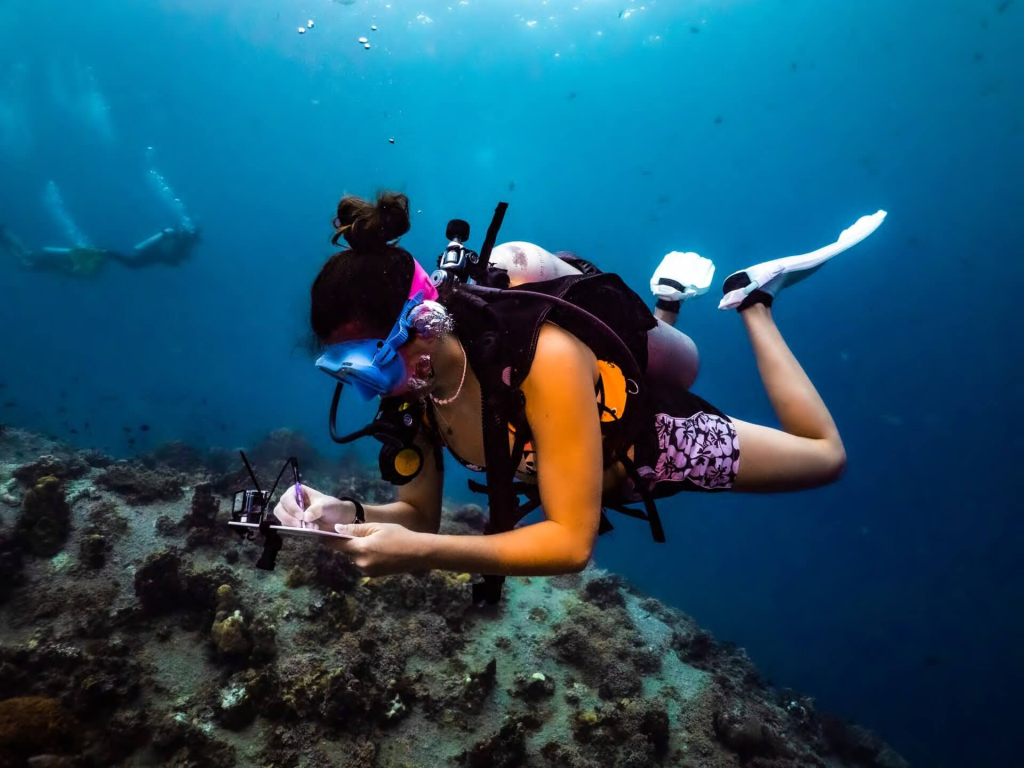
Few Koh Tao specimens have been examined in the published record (Mehrotra et al., 2021), so continued BTC slug survey sightings are a valuable way to monitor where and when this species is common around the island.
What to record
- When and where: date, time, dive site and dominant substrate.
- Depth and substrate: depth, plus substrate type (sand, silt, rubble, NIA etc.) and any sponge the slug is on or next to.
- Number: a count, noting any aggregations; record each animal in a trail separately and note the trail length.
- Size: to the nearest mm.
- Photos: a top view showing the spots and mantle edge, a side view showing the foot extending behind the mantle, and close-ups of the rhinophores and gills. Photograph any sponge it is feeding on.
It is good practice with this species to record identifications as Hypselodoris tryoni. If the spots form hollow rosettes or the mantle border is broad, record it as Hypselodoris cf. tryoni and flag the photos for checking against the look-alikes in Similar species.
Good practice
Never affect the behaviour of an individual, especially to induce trailing behaviour; wait for it to occur naturally. Keep fins and lights off the substrate it is on. Use a low strobe angle to show the white mantle-edge glands without touching the animal.
Join us: Sea Slug Ecology & Monitoring course
Our Sea Slug Ecology & Monitoring course turns you from a diver who spots nudibranchs into one who is able to understand where and why we spot them; and one who collects data scientists can use. Every survey you join feeds one of Black Turtle Conservation's current research questions: how sea slug abundance and diversity vary across different substrates around Koh Tao.
Why it matters: Our surveys compare slug numbers across dive sites, substrates, seasons, water temperature and benthic composition. Knowing where each species thrives helps target conservation efforts and guides the planning of artificial reefs around Koh Tao.
What you'll learn
- Ecology of the five sea slug clades/orders present on Koh Tao
- Identifying Koh Tao species with our cheat sheets and ID guide
- Recognising substrates using standard EMP substrate codes
- Why defences such as aposematism, camouflage and kleptocnidae evolved
- How sea slugs support ecotourism, medical research and reef monitoring
References
Online sources accessed 30 October 2026.
Black Turtle Conservation (n.d.) Photographic and video records of Hypselodoris tryoni from Koh Tao dive sites. Unpublished data.
Chaloklum Diving (n.d.) Hypselodoris tryoni. Available at: https://www.chaloklum-diving.com/marine-life-guide-koh-phangan/molluscs-mollusca/sea-slugs-opisthobranchia/true-nudibranch-nudibranchia/doridina/chromodorididae/hypselodoris-tryoni/.
Dean, L.J. and Prinsep, M.R. (2017) 'The chemistry and chemical ecology of nudibranchs', Natural Product Reports, 34, pp. 1359–1390. Available at: https://doi.org/10.1039/c7np00041c.
Epstein, H.E., Hallas, J.M., Johnson, R.F., Lopez, A. and Gosliner, T.M. (2019) 'Reading between the lines: revealing cryptic species diversity and colour patterns in Hypselodoris nudibranchs (Mollusca: Heterobranchia: Chromodorididae)', Zoological Journal of the Linnean Society, 186(1), pp. 116–189. Available at: https://doi.org/10.1093/zoolinnean/zly048.
Garrett, A. (1873) 'Description of a new species of Goniodoris', Proceedings of the Academy of Natural Sciences of Philadelphia, 25, p. 232, pl. 4. Available at: https://biostor.org/reference/120419.
Hayashi, M. and Nakano, H. (2024) 'Staging of post-settlement growth in the nudibranch Hypselodoris festiva', Scientific Reports, 14, 16157. Available at: https://doi.org/10.1038/s41598-024-66322-4.
IUCN (n.d.) The IUCN Red List of Threatened Species. Available at: https://www.iucnredlist.org.
Johnson, R.F. and Gosliner, T.M. (2012) 'Traditional taxonomic groupings mask evolutionary history: a molecular phylogeny and new classification of the chromodorid nudibranchs', PLoS ONE, 7(4), e33479. Available at: https://doi.org/10.1371/journal.pone.0033479.
Kimoto, N. (2026) Hypselodoris tryoni (Garrett, 1873). SEASLUG.WORLD. Available at: https://en.seaslug.world/species/hypselodoris_tryoni.
Korshunova, T., Fletcher, K. and Martynov, A. (2025) 'The endless forms are the most differentiated—how taxonomic pseudo-optimization masked natural diversity and evolution: the nudibranch case', Zoological Journal of the Linnean Society, 204(4), zlaf057. Available at: https://doi.org/10.1093/zoolinnean/zlaf057.
Mehrotra, R. and Urgell, P. (2018) Nudibranchs and sea slugs of Koh Tao and nearby islands: a Conservation Diver guidebook. Koh Tao: Conservation Diver.
Mehrotra, R., Caballer Gutiérrez, M.A., Scott, C.M., Arnold, S., Monchanin, C., Viyakarn, V. and Chavanich, S. (2021) 'An updated inventory of sea slugs from Koh Tao, Thailand, with notes on their ecology and a dramatic biodiversity increase for Thai waters', ZooKeys, 1042, pp. 73–188. Available at: https://doi.org/10.3897/zookeys.1042.64474.
Moles, J., Bonomo, L., Brenzinger, B., Camacho García, Y.E., Carmona, L., Cervera Currado, J.L., Donohoo, S., Fernández-Simón, J., Furfaro, G., Galià-Camps, C., Goodheart, J., Jensen, K., Krug, P.J., Layton, K.K.S., Malaquias, M.A.E., Martín-Hervás, M.R., Neusser, T.P., Padula, V., Paz-Sedano, S., Pola, M., Trainito, E., Valdés, Á., Wägele, H., Wilson, N.G., Yonow, N. and Gosliner, T.M. (2026) 'Towards systematics-based guidelines for stable taxonomy: lessons from sea slugs', Zoological Journal of the Linnean Society, 208(1), zlag141. Available at: https://doi.org/10.1093/zoolinnean/zlag141.
MolluscaBase eds. (2026) Hypselodoris tryoni (Garrett, 1873). Accessed through: World Register of Marine Species. Available at: https://www.marinespecies.org/aphia.php?p=taxdetails&id=558646.
Mudianta, I.W., Siregar, J.E., Rizki, A.F.M., Azmi, W.A., Pravitasari, N.E., Gholam, G.M., Putri, F.R., Kristiana, R., Cahyani, N.K.D. and Artika, I.M. (2024) 'Expanding the occurrence of antimalarial metabolites in dorid nudibranch Hypselodoris tryoni', Biochemical and Biophysical Research Communications, 737, 150921. Available at: https://doi.org/10.1016/j.bbrc.2024.150921.
Rudman, W.B. (1999a) Risbecia tryoni (Garrett, 1873) [Message in Sea Slug Forum], 22 January. Sydney: Australian Museum. Available at: http://www.seaslugforum.net/find/risbtryo.
Rudman, W.B. (1999b) Comment on 'Trailing' behaviour in Risbecia tryoni by Erwin Koehler [Message in Sea Slug Forum], 8 April. Sydney: Australian Museum. Available at: http://www.seaslugforum.net/find/760.
Rudman, W.B. (2001a) Comment on Risbecia pulchella – range extension by Michael D. Miller [Message in Sea Slug Forum], 14 March. Sydney: Australian Museum. Available at: http://www.seaslugforum.net/find/3975.
Rudman, W.B. (2001b) Comment on Chromodoris leopardus from Solomon Ids by Bruce Potter [Message in Sea Slug Forum], 23 May. Sydney: Australian Museum. Available at: http://www.seaslugforum.net/find/4357.
Rudman, W.B. (2003) Trailing behaviour [Message in Sea Slug Forum], 5 March. Sydney: Australian Museum. Available at: http://www.seaslugforum.net/find/trailing.
SeaLifeBase (n.d.) Hypselodoris tryoni, Tryon's Hypselodoris. Available at: https://www.sealifebase.ca/summary/SpeciesSummary.php?id=87303.
Solitary Islands Underwater Research Group (n.d.) Hypselodoris tryoni (Garret, 1873). Available at: https://www.surg.org.au/species/hypselodoris-tryoni-garret-1873/.
Turner, L.M. and Wilson, N.G. (2008) 'Polyphyly across oceans: a molecular phylogeny of the Chromodorididae (Mollusca, Nudibranchia)', Zoologica Scripta, 37, pp. 23–42. Available at: https://publications.australian.museum/paraphyly-across-oceans-a-molecular-phylogeny-of-the-chromodorididae-mollusca-nudibranchia/.