Overview of the Genus
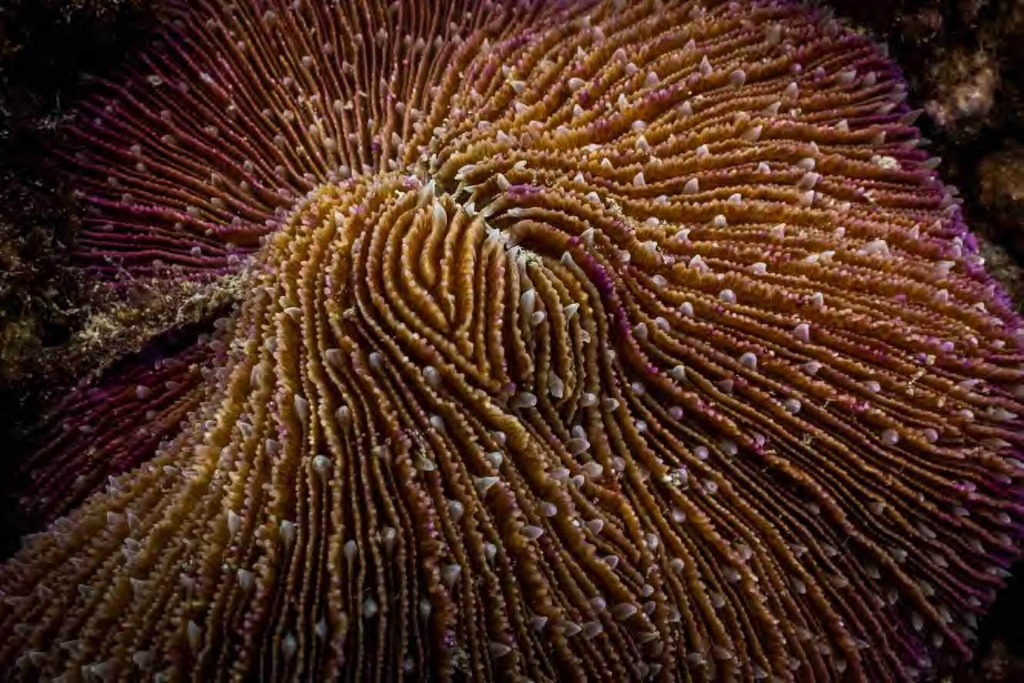
Pectinia is one of the most distinctive foliose coral genera on Indo-Pacific reefs. Its colonies start as a spiny rosette and grow continuously by extending numerous irregular, upright, fluted projections that resemble the leaves of a lettuce or the teeth of a comb.
The genus is part of the broader, colloquially-known ‘Bigmessidae’ assemblage of robust scleractinian corals that has been the focus of intensive taxonomic revision since 2010. Following the 2012 abolition of Pectiniidae, Pectinia now sits within the family Merulinidae, where its relationships to other foliose Merulinidae such as Mycedium are still being clarified.
On Koh Tao, Pectinia colonies are recognisable but less common than dominant foliose taxa such as Oxypora or Pavona. Their fluted comb-like projections make them visually distinctive at the dive sites where they occur.
Global and Local Importance
Globally, Pectinia is widespread across the tropical Indo-Pacific from the Maldives to Fiji and Japan. The genus contributes meaningfully to foliose reef structure in sheltered habitats and supports cryptobenthic invertebrate communities sheltering among the projections of mature colonies.
On Koh Tao, Pectinia is monitored as part of broader reef community surveys but is generally less abundant than other more dominant foliose taxa. Its presence and condition serve as a useful indicator of stable, low-disturbance habitat conditions on slope reefs.
Reef-Building Contribution and Habitat Provision
Pectinia colonies, although individually slow-growing, contribute substantial three-dimensional structure relative to their footprint area through their upright fluted projections. Mature colonies provide microhabitat for cryptobenthic invertebrates and small reef fish that exploit the protected spaces between leaves.
The thin, fluted laminae of Pectinia also create local turbulent flow patterns that bring suspended food into proximity with the polyps clustered along the leaf walls, supporting a productive heterotrophic feeding system within the colony.
Growth Forms and Colony Variation
Pectinia colonies typically begin as a spiny rosette and grow continuously by extending irregular upright projections. Pectinia lactuca produces meandroid valleys with vertical walls of relatively uniform height that resemble a lettuce head. Pectinia paeonia produces irregular upright spires without extended valleys. Pectinia alcicornis produces tall, antler-like projections.
On Koh Tao, the most commonly encountered forms are Pectinia lactuca and Pectinia paeonia, often appearing as upright fluted clusters on slope habitats. Colour is typically uniform brown, grey, or green, less variable than in some related Merulinidae.
Evolutionary and Taxonomic Notes
The transfer of Pectinia from the abolished Pectiniidae to Merulinidae in 2012 represents one of the more significant taxonomic revisions in modern scleractinian classification. The morphological similarity of Pectinia to other foliose Merulinidae such as Mycedium reflects this revised phylogenetic position, although species-level relationships within the genus remain under active investigation.