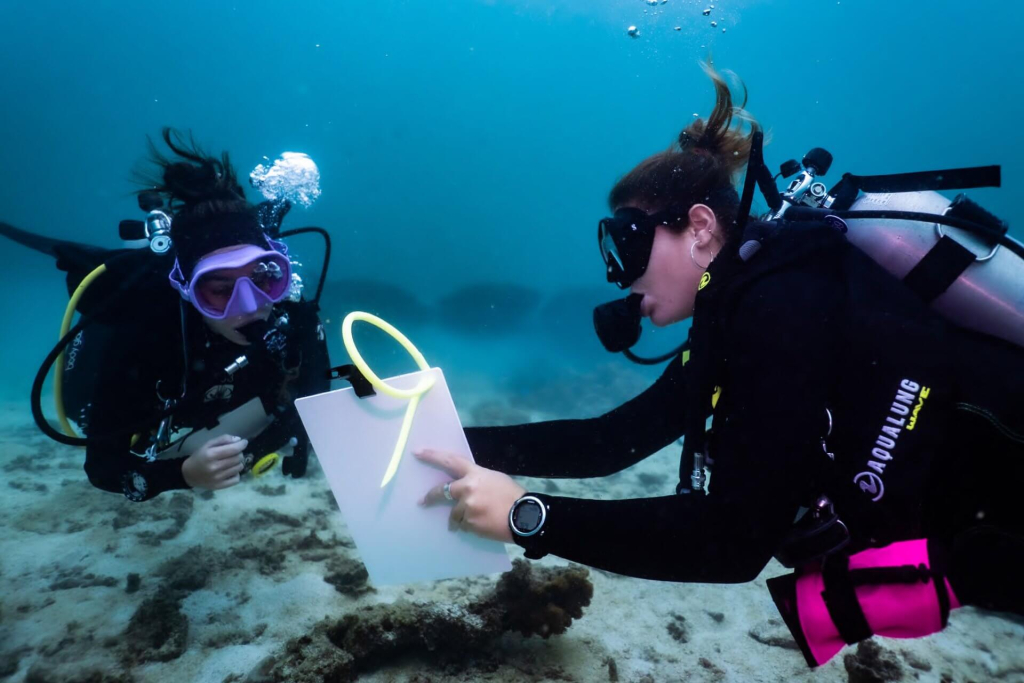
This collaborative monitoring project invites participants to actively assess the impact of tourism on Koh Tao’s vital shark nursery areas. Under the guidance of a Conservation Survey Leader, volunteers use standardised observational methods to compare shark presence and behaviour between a tourism-heavy site and a protected control area.

By understanding how human pressure influences long-term nursery use, this comparative data directly supports broader conservation initiatives across the island.

½ Day

1 snorkel session

600 THB

Join us for an afternoon dedicated to advancing Koh Tao’s marine conservation efforts.

Through a guided snorkel survey, you will gain practical field experience alongside fellow shark enthusiasts, directly contributing to active ecological monitoring projects.

While many visitors come to our local bays simply to observe juvenile Blacktip Reef Sharks, this programme empowers a community of conservation-minded individuals to actively collect the vital population data necessary to protect these vulnerable species.
Key Learning Takeaways:

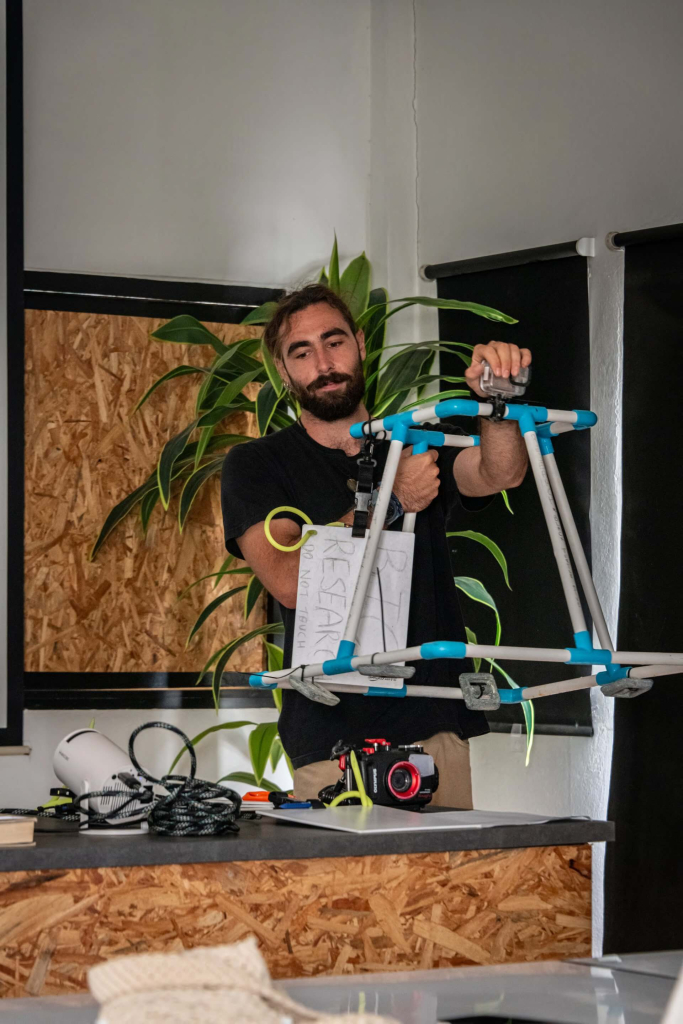
Scientific research shark monitoring and population studies in Koh Tao, recording sightings and survey data to assess reef shark nursery areas.
  • Anatomy & Evolutionary Adaptations: Explore the unique physiological traits that allow these sharks to thrive.
  • Ecological Importance & Habitat Dynamics: Understand the critical role of sharks in maintaining balanced, healthy reef ecosystems.
  • Anthropogenic Threats & Endangerment: Examine the human-driven pressures impacting both global and localised populations.
  • Non-Invasive Identification Techniques: Master the observational skills needed to document individuals without causing stress or altering behaviour.
  • Data Collection & Conservation Impact: Learn the standardised field protocols required to turn your in-water observations into actionable research.

This Course is Perfect for:

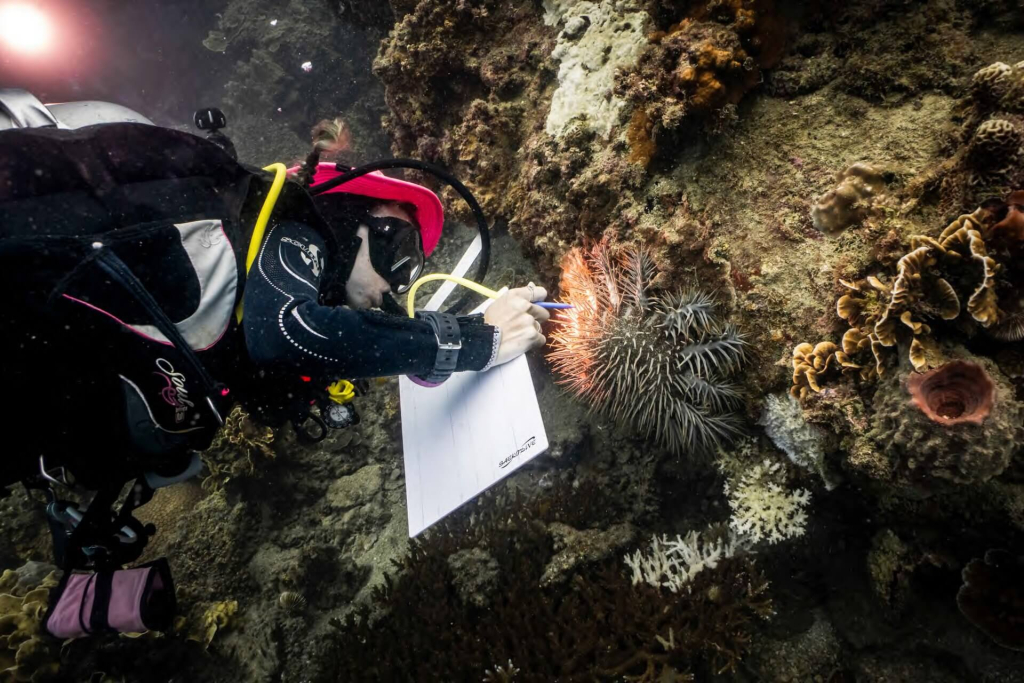
Master Conservationist diver recording underwater shark research data during conservation monitoring dives in Koh Tao, Thailand.
  • Ocean Advocates: Anyone passionate about protecting marine life and supporting localised conservation efforts.
  • Citizen Scientists: Snorkellers and divers looking to elevate their time in the water by contributing to authentic, data-driven research.
  • Eco-Conscious Explorers: Families, beginners, and environmentally minded travellers seeking a meaningful, impact-driven ocean experience.

Why This Survey Matters

Master Conservationist students conducting giant clam surveys and learning restoration techniques during conservation training dives in Koh Tao, Thailand.

A juvenile shark in a busy, shallow bay is one of the easiest conservation questions to answer wrongly. Watch a dozen of them moving through water full of swimmers and it is tempting to conclude that tourism costs these animals nothing. Watch an afternoon in which none appear and it is just as tempting to conclude the opposite.

Neither reading can be tested, because a single site observed on a single day has nothing to be measured against – no way to separate human presence from tide, season, weather or chance.

That is the reasoning behind a comparative design. Nursery areas are where the next generation of reef predators is produced, which makes the cost of disturbance there a delayed one: animals displaced from a nursery are not missing from the wider reef, or from the role sharks play in holding it in balance, until years later.

By running the same standardised method at a tourism-heavy site and at a protected control area, the survey supplies the one thing any honest conclusion about human pressure requires – a reference point. Your session contributes to a paired record, and it is the difference between the two sites, sustained across many weeks, that carries the signal.

Your Survey, Step by Step

Before You Enter the Water

Your Conservation Survey Leader opens with a comprehensive ecological briefing, covering the physiological traits that allow these sharks to thrive, the role they play in maintaining balanced reef ecosystems, and the global and localised human-driven pressures acting on them.

The briefing then turns to the design of the study, because this survey asks a comparative question and the method exists to protect that comparison. You will cover what a control area is for: a site chosen to resemble the tourism-heavy one in the respects that matter to a juvenile shark, so that human presence is what differs between the two and not the habitat itself.

You will cover why the protocol has to be run identically at both – the same search pattern, the same observation effort, the same recording categories – since any drift in method appears in the results as though it were a real difference between the sites.

And you will cover the observer problem: a survey team is itself a human presence, so your own conduct in the water is part of the method.

This survey is conducted as a snorkel session in Koh Tao’s shallow bays, which serve as crucial nursery grounds for Blacktip Reef Sharks. While we monitor specific established sites, the exact location is chosen on the day based on prevailing wind and sea conditions.

This ensures the water is calm and clear enough to execute the data collection protocols consistently. Your Conservation Survey Leader will confirm the final site with you before departure.

In the Water

Whichever of the two study sites your session covers, you follow exactly the same protocol. You record shark presence and the behaviour that goes with it – whether individuals are holding position, patrolling, or moving away – alongside the human activity present at the time, because at a tourism-heavy site that activity is the variable under study rather than background noise to be ignored.

Non-invasive observation is held strictly: no pursuit, no attempt to attract or hold an animal, no closing distance for a clearer view. Juvenile sharks repeatedly disturbed by survey teams generate data about the survey, not about tourism.

Back at the Centre

Your observations are logged to the standardised format and any photographs reviewed, and then the comparative work begins: your session is set against the accumulated record from the other site.

Your Conservation Survey Leader will be straightforward about what a single pairing can and cannot show. A difference between two afternoons is not evidence of anything. A difference that persists across weeks, with the method held steady at both sites, is – and that is why this survey runs weekly rather than occasionally.

Session Time Activity
Briefing Before departure Ecology briefing and survey methodology
Field survey Afternoon Guided snorkel survey recording shark presence, behaviour and human activity
Debrief On return Data logging, photo review and discussion

Please note that this schedule is indicative. Exact times will be confirmed before your survey begins.

What Your Data Contributes To

Master Conservationist diver recording underwater shark research data during conservation monitoring dives in Koh Tao, Thailand.
Master Conservationist students conducting giant clam surveys and learning restoration techniques during conservation training dives in Koh Tao, Thailand.

This survey contributes to our conservation programme in two specific ways, both of which depend on the paired structure of the dataset. It establishes an ecological baseline for nursery use – not a single baseline but two, held side by side, which is what makes any change in either one interpretable.

And it informs island policy, because decisions about how tourism is managed around nursery habitat have to rest on a defensible comparison rather than on competing impressions of what a bay looks like on a given day.

The survey is not built to identify new hotspots: its two study sites are fixed in advance, and the comparison between them is the whole point. Nor does it trigger intervention in the field. What it produces is a long-horizon, non-invasive record of whether sharks use a disturbed bay differently from a protected one—the question the project was designed around.

Over a 12 month period, 158 juvenile shark sightings were successfully logged. This longitudinal data enables us to track crucial behavioral patterns and assess exactly how seasonal shifts, tourism spikes, and associated fauna influence local shark populations.

Prerequisites:

Comfortable swimming in Open Water

Price Includes
600 ฿
  • 1 ecology briefing
  • 1 guided snorkel survey
  • Snorkel equipment & dive computer
  • Dive insurance
BOOK NOW

Timetable

Tuesday · indicative plan

  1. 15:00Introduction to shark ecology and survey briefing
  2. 16:00Snorkel monitoring survey
  3. 17:00Data review and input

This schedule is indicative. Exact times are confirmed before the survey.