Overview of the Genus
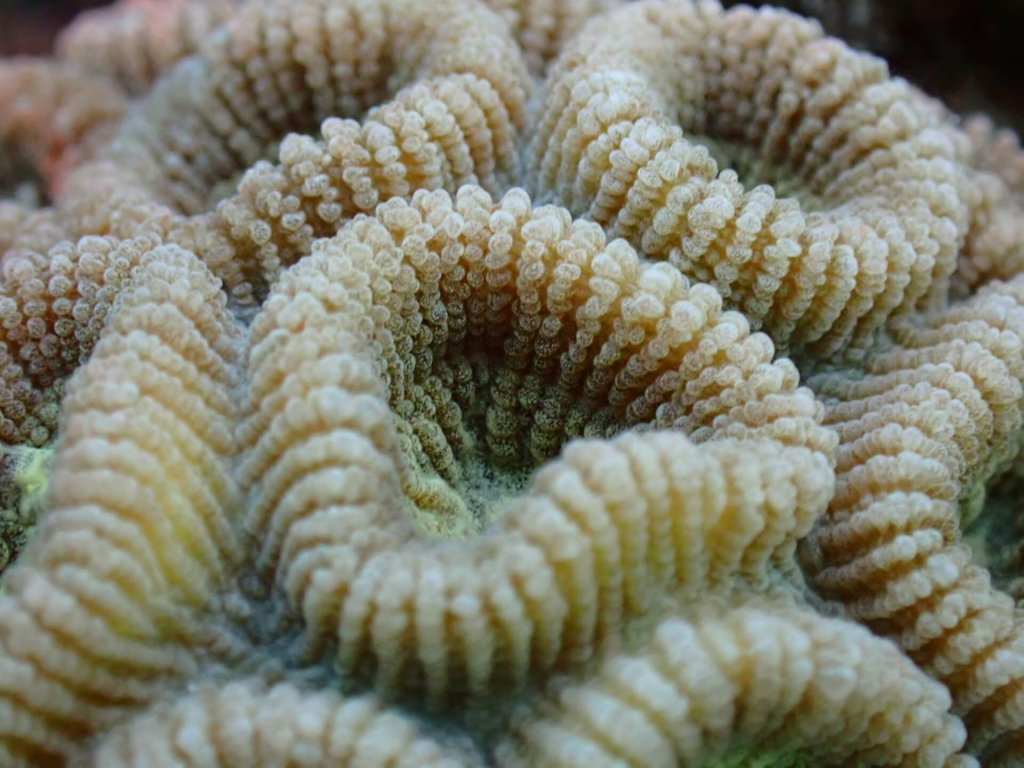
Goniopora is one of the most ecologically distinctive genera within the family Poritidae. Whereas its close relative Porites is dominated by massive, slow-growing forms with very small polyps, Goniopora is characterised by long fleshy polyps and more variable colony forms ranging from columnar to massive to encrusting.
Recent molecular work has confirmed Goniopora’s close relationship with Porites and other poritid genera, and has led to the consolidation of several morphologically similar former genera into Goniopora. The earlier separate genera Machadoporites and Poritipora were found to be indistinguishable from Goniopora at the molecular level.
On Koh Tao, Goniopora colonies are familiar features of sheltered slope habitats and are easily recognised by the dense forest of fleshy, daytime-extended polyps. Healthy colonies are visually striking and frequently photographed by recreational divers.
Global and Local Importance
Globally, Goniopora occurs across the Indo-Pacific from the Red Sea and East Africa through Southeast Asia and out to the Pacific Islands. The genus contributes meaningfully to reef-building in slope and back-reef habitats and supports cryptic invertebrate communities sheltering among the extended polyps.
On Koh Tao, Goniopora is a useful indicator taxon for water quality and nutrient flux. Its preference for areas with moderate suspended organic matter means colony health correlates well with site-level conditions and serves as a reference point for monitoring these factors.
Reef-Building Contribution and Habitat Provision
Goniopora colonies are slower-growing than fast-branching genera but contribute substantially to mid-depth reef structure where they occur. Massive and columnar colonies provide three-dimensional substrate, while the dense forest of extended polyps creates microhabitat for small commensal invertebrates and pipefish.
The fleshy polyp forest of Goniopora is also a noteworthy visual feature on Koh Tao reefs, often attracting the attention of divers and photographers and contributing to the aesthetic and educational value of the local reef ecosystem.
Growth Forms and Colony Variation
Goniopora exhibits considerable growth-form variation, with colonies ranging from massive boulder-like mounds to columnar finger-like forms to thick encrusting sheets. Different species display preferred growth forms, but environmental conditions also influence colony shape, with sheltered colonies often producing more elongated columnar branches.
On Koh Tao, the most commonly encountered forms are massive and columnar, with colonies often appearing as shaggy, polyp-covered boulders or thick fingers rising from the substrate. Colour is typically green, brown, cream, or pink, sometimes with contrasting tentacle tips.
Evolutionary and Taxonomic Notes
The 24-tentacle count of Goniopora polyps is a key character distinguishing the genus from the related Alveopora (12 tentacles), which has been transferred from Poritidae to Acroporidae following recent molecular evidence. The retention of 24 tentacles in Goniopora may represent an ancestral feature in the family Poritidae, reinforcing the genus’s central position within the family.