| Feature | Details |
|---|---|
| Common names | Sunrise Tentacle Aeolid (MolluscaBase eds., 2026a); Indian Caloria (Kimoto, 2026) |
| Scientific name | Caloria indica (Bergh, 1896); formerly Phidiana indica and Learchis indica (MolluscaBase eds., 2026a) |
| Classification | Mollusca › Gastropoda › Heterobranchia › Order Nudibranchia › Family Facelinidae (MolluscaBase eds., 2026a) |
| Size | 18–39 mm at Koh Tao; maximum about 40 mm (Mehrotra et al., 2021; Rothman et al., 2017) |
| Colour | Orange-red head with white lines; cerata banded orange, dark blue and pale yellow (Rothman et al., 2017) |
| Habitat | Coral reefs, rocky pinnacles and artificial reefs, 2–30 m at Koh Tao (Mehrotra et al., 2021) |
| Diet | Hydroids (Rudman, 1999; Rothman et al., 2017) |
| Defences | Stores stinging cells from its hydroid prey in its cerata (Rothman et al., 2017) |
| Conservation status | Not Evaluated on the IUCN Red List (IUCN, n.d.) |
| Koh Tao look-alike | Caloria militaris (Mehrotra and Urgell, 2018) |
At a glance
Identification
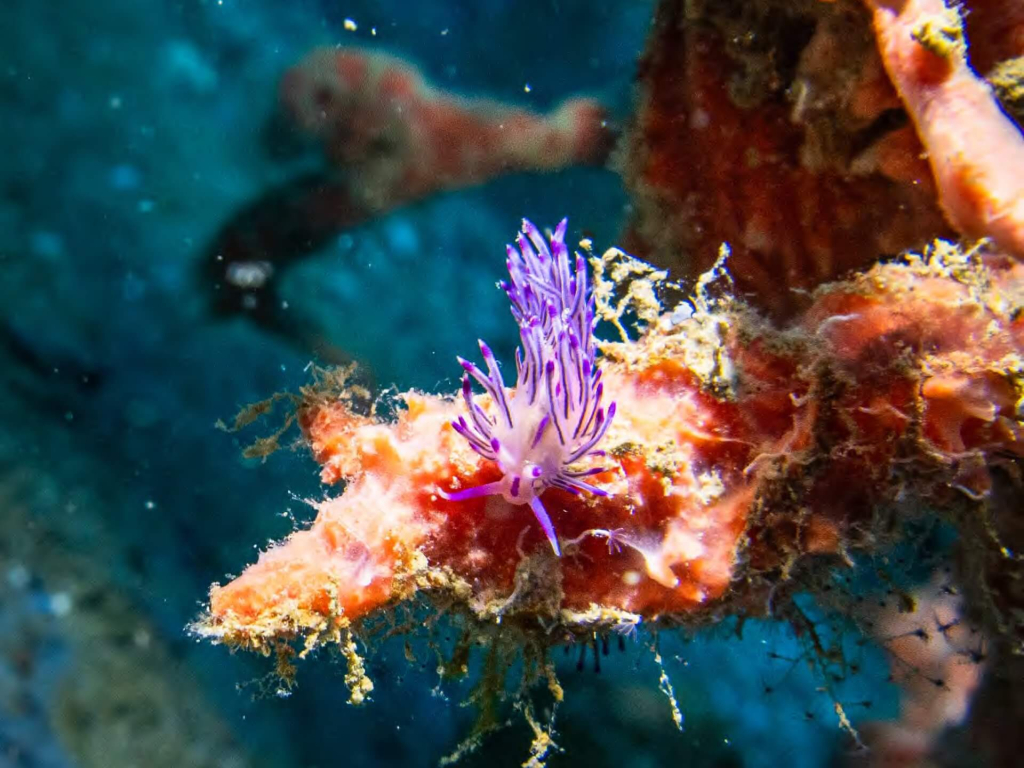
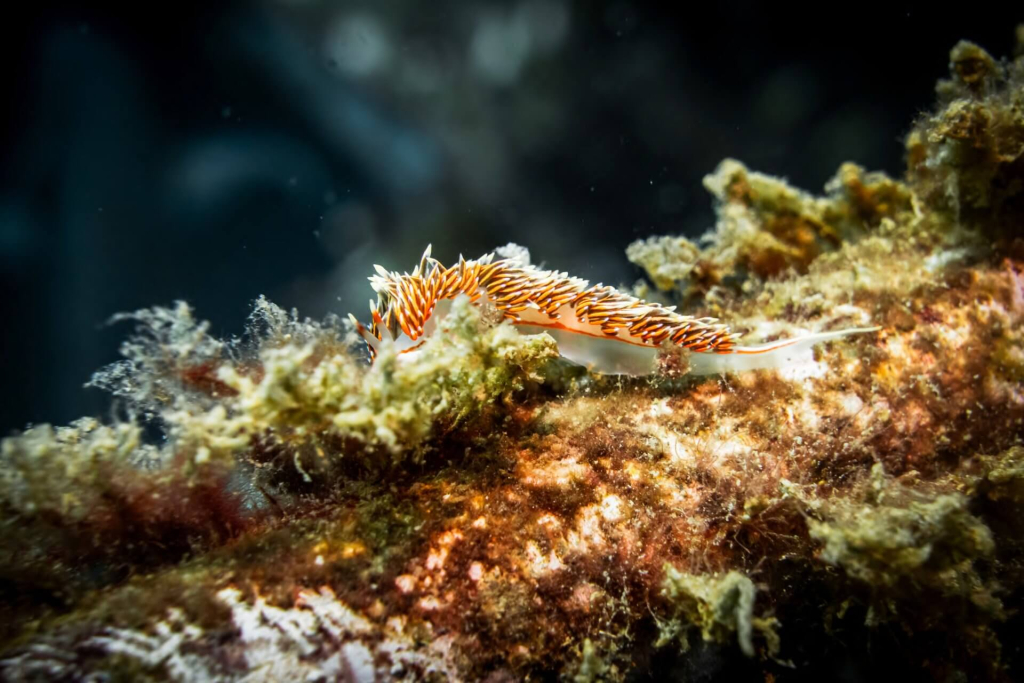
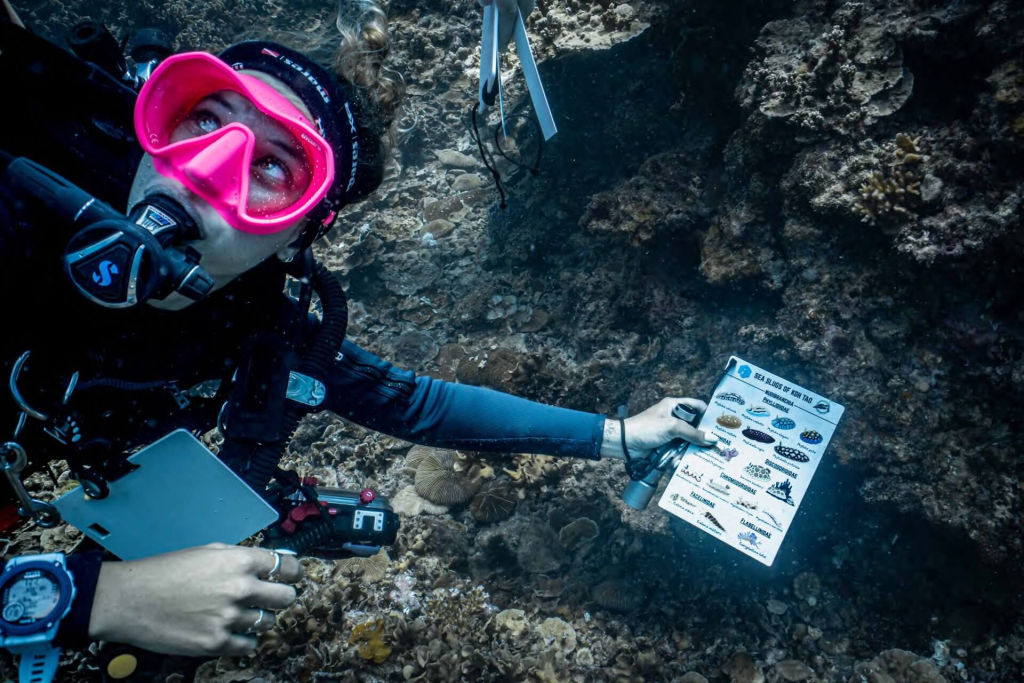
Look for a slim, pale aeolid with an orange head, white head lines and spiky cerata banded in blue and yellow, crawling over hydroids on rock or reef restoration frames.
Key field marks
- Body: slender and elongated, 18–39 mm in Koh Tao surveys (Mehrotra et al., 2021). The body is translucent white, with a white stripe along the middle of the back and a bright white tail (Rothman et al., 2017).
- Head pattern (the key feature): the head is orange with white lines. A white stripe runs from the base of each rhinophore to the base of the oral tentacle on the same side (Rudman, cited in Choojan, 2007; Rothman et al., 2017).
- Colour: cerata are banded orange, dark blue and pale yellow, with a translucent tip (Rothman et al., 2017). Some individuals are orange over the whole back, and the white back stripe can be broken or missing (Rudman, 1999; Kimoto, 2026).
- Head: rhinophores (the paired sensory tentacles on top of the head) are banded orange, white and yellow. The long oral tentacles at the front of the head are banded orange, pale yellow and translucent white, with pale yellow tips (Rothman et al., 2017).
- Back: many cerata, the finger-like projections that cover an aeolid’s back (Rothman et al., 2017). The foot is translucent, edged with yellow at the front.
- Behaviour: usually seen alone at Koh Tao (Mehrotra and Urgell, 2018). It crawls slowly over its prey. Never handle the animal to check.
Similar species
| Species | How to tell it apart |
|---|---|
| Caloria militaris | The reverse head pattern: white head with orange lines, where C. indica has an orange head with white lines (Rudman, cited in Choojan, 2007). The front corners of its foot are drawn out and tipped bright yellow (Rothman et al., 2017). Koh Tao specimens tend to be larger (30–40 mm), and it is often in pairs or small groups (Mehrotra and Urgell, 2018; Mehrotra et al., 2021). |
| Caloria sp. (Hawaii) | Not recorded at Koh Tao. Lacks orange rhinophore tips and the forked white head lines, and has red marks on the sides of the body (Pittman and Fiene, n.d.). |
This corrects a common error. The 2018 guidebook separates the two Koh Tao species by saying C. militaris lacks blue on its cerata (Mehrotra and Urgell, 2018). Later photographs show C. militaris with blue bands as well (Rothman et al., 2017), so ceratal colour alone is not safe. Use the head pattern.
Taxonomic amendments
The name Caloria indica is accepted on WoRMS. Phidiana indica, used in older field guides and on the Sea Slug Forum, is now a synonym, as is Learchis indica, the name Bergh first used (MolluscaBase eds., 2026a). The orange-bodied form once named Learchis howensis is also treated as this species (MolluscaBase eds., 2026a; Rudman, 1999).
The look-alike appears as Phidiana militaris in both local sources (Mehrotra and Urgell, 2018; Mehrotra et al., 2021). WoRMS now lists it as Caloria militaris, so the two Koh Tao look-alikes sit in the same genus (MolluscaBase eds., 2026b). Some older Hawaiian books also called C. indica by the name C. militaris (Pittman and Fiene, n.d.).
Recorders should use Caloria indica when the orange head with white lines is clearly visible in photos. If the head is not visible, record Caloria sp. (indica/militaris).
What makes it an aeolid nudibranch?
Nudibranchs (Order Nudibranchia) are sea slugs that lose their shell completely as adults; the larva has a thin shell that is soon lost (Mehrotra and Urgell, 2018). Aeolids are the nudibranchs of the superfamily Aeolidioidea, within the suborder Cladobranchia (MolluscaBase eds., 2026a). Instead of the gill rosette of a dorid, their backs carry rows of cerata, and many eat cnidarians such as hydroids and anemones (Goodheart and Bely, 2017).
| Feature | Caloria indica |
|---|---|
| Diet | Hydroids (Rudman, 1999) |
| Breathing | Through the cerata, which take the place of gills (Mehrotra and Urgell, 2018) |
| Shell | None as an adult (Mehrotra and Urgell, 2018) |
| Swimming | Not recorded; crawls on its foot |
| Defence | Stolen stinging cells stored in the ceratal tips (Rothman et al., 2017) |
The cerata are the defining feature. Each one holds a branch of the digestive gland, and at its tip sits a small muscular sac, the cnidosac (Goodheart and Bely, 2017). Aeolids that eat hydroids move some of the prey's unfired stinging cells into these sacs. Cerata can also be shed (autotomised) when the animal is attacked (Goodheart and Bely, 2017).
What's in the name? The species name indica is Latin for "of India" (Ballesteros, Madrenas and Pontes, 2025), although the species was described from Ambon in eastern Indonesia. The Danish zoologist Rudolph Bergh described it in 1896 as Learchis indica; his preserved type specimen was 16 mm long (Kimoto, 2026). Its Japanese name, Hibusa-mino-umiushi, refers to the flame-coloured head and banded cerata (Kimoto, 2026).
Diet, feeding and defence
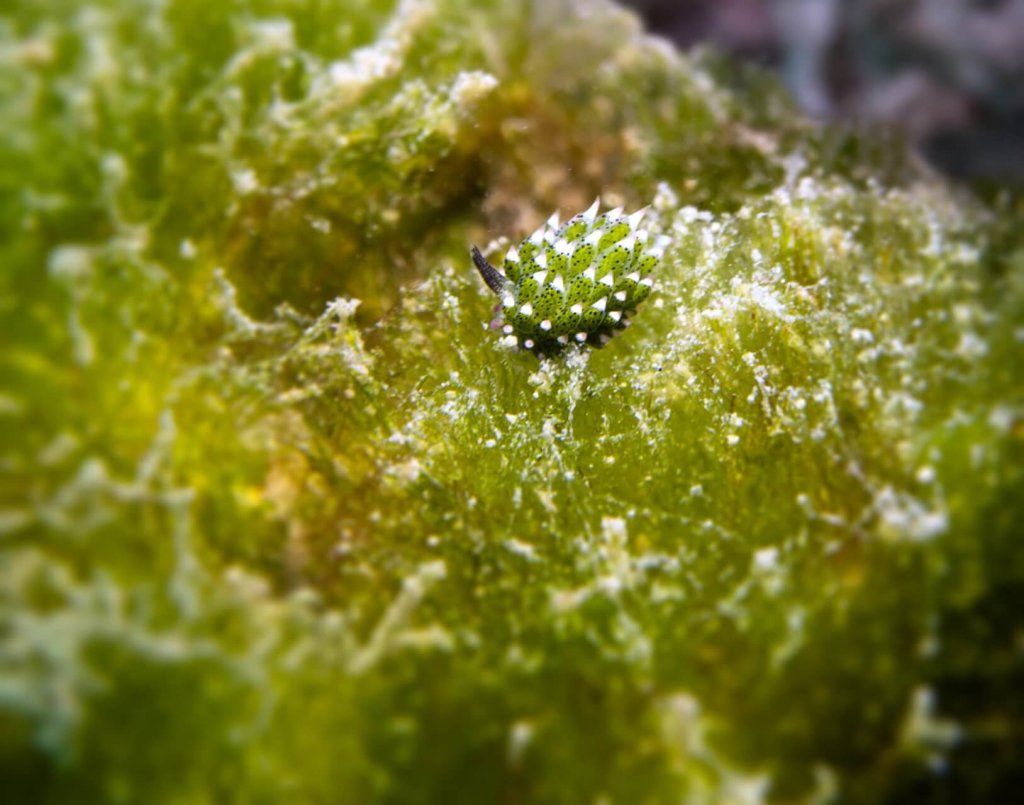
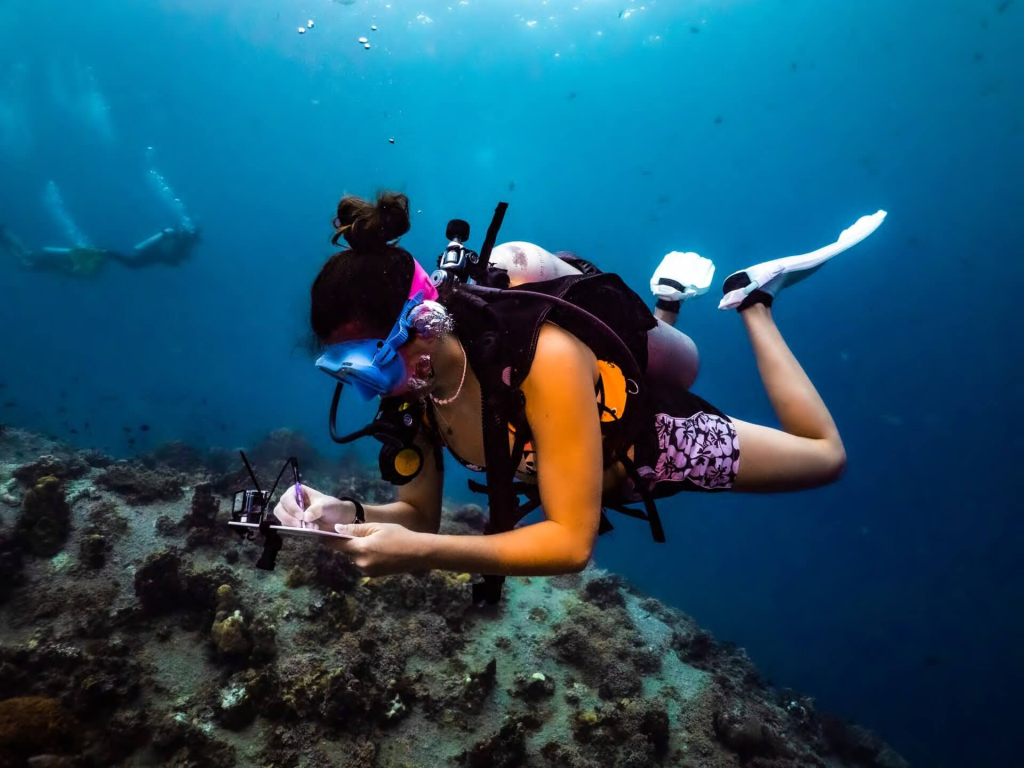
Caloria indica feeds on hydroids, the small, feathery colonial relatives of jellyfish (Rothman et al., 2017). Recorded prey include Salacia tetracythara in Tanzania and Pennaria in Hawaii (Rudman, 1999). Its prey at Koh Tao has not yet been recorded, though many photo records place them on small patches of sponge. Pennaria disticha does grow at Koh Tao, where it hosts another aeolid called Myja cf. longicornis (Mehrotra et al., 2021), so it is worth checking.
Careful eating
In Hawaii, one animal was watched eating a Pennaria disticha polyp from the bottom up. It let the ball-shaped tentacle tips fall away, perhaps to avoid the stinging cells packed into them (Pittman and Fiene, n.d.).
Borrowed stinging cells
Aeolids that eat cnidarians pass some of their prey's unfired stinging cells (nematocysts) through the gut into the cnidosacs at their ceratal tips. They keep only some nematocyst types, and can release them when threatened (Goodheart and Bely, 2017). This is called kleptocnidae, literally translating to "stolen stingers". C. indica does the same (Rothman et al., 2017), and the bright ceratal bands advertise this defence.
Diver note: look but do not touch. Handling can make an aeolid shed cerata (Goodheart and Bely, 2017), and lifting it off its hydroid separates it from its food.
Habitat and distribution
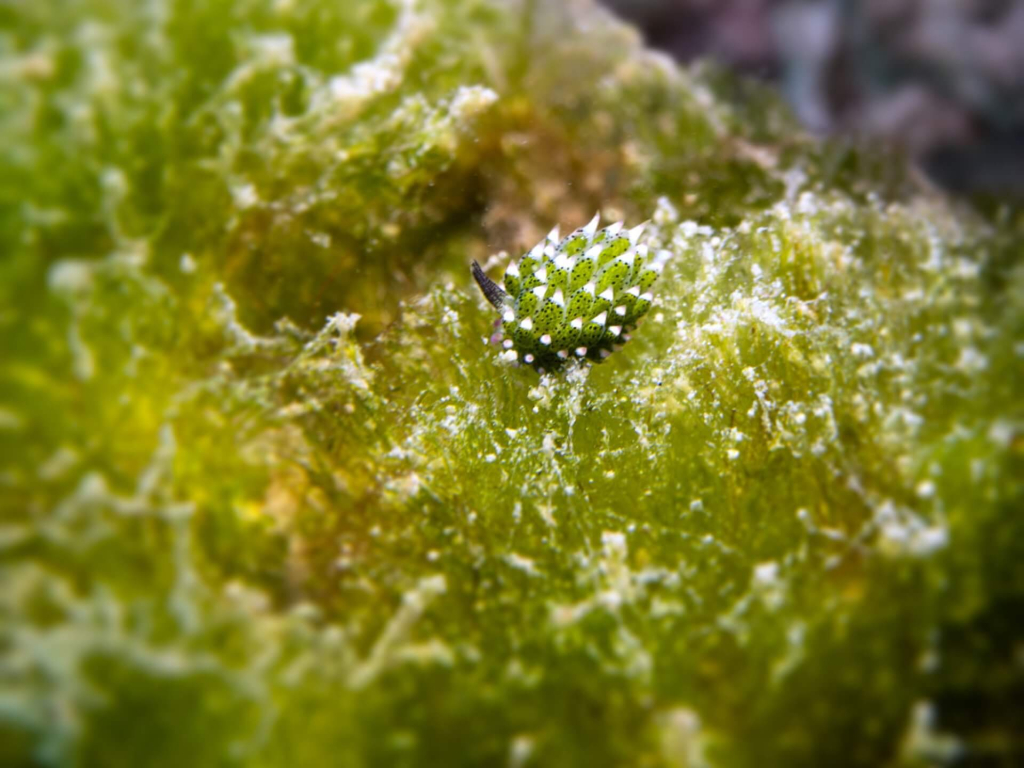
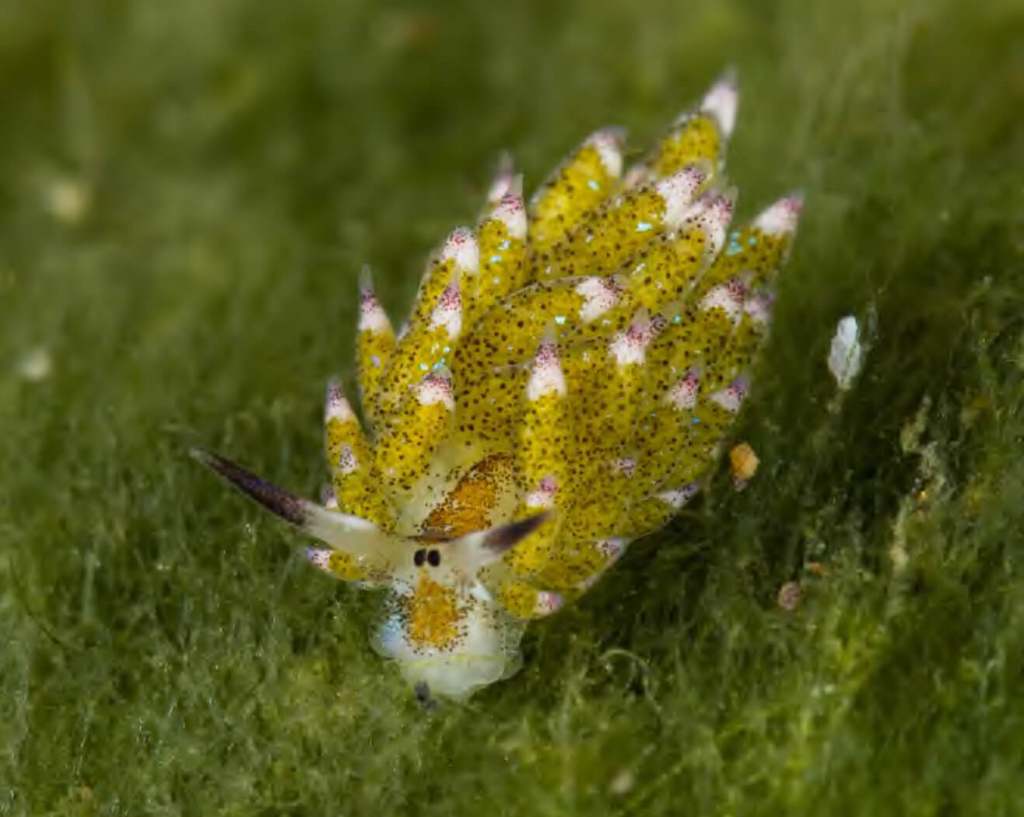
Caloria indica lives on hard surfaces where hydroids grow. At Koh Tao it is abundant on coral reefs, especially reef restoration structures, and on rocky pinnacles near shore and offshore, at 2–30 m (Mehrotra et al., 2021). Elsewhere it is also found on wrecks, buoys and pipelines (Rothman et al., 2017).
Global range
It is widespread in the tropical Indo-West Pacific, from the Red Sea, Oman and East Africa (South Africa, Mozambique, Tanzania) across the Indian Ocean to Hawaii and Fiji (Mehrotra et al., 2021; Rothman et al., 2017). Records include India, the Maldives, Myanmar, Malaysia, Indonesia, the Philippines, Hong Kong, Japan, Australia, Papua New Guinea, the Solomon Islands and New Caledonia (Mehrotra et al., 2021; Kimoto, 2026). It is known from both the Andaman Sea and the Gulf of Thailand coasts of Thailand (Mehrotra et al., 2021).
Spread into the Mediterranean
Caloria indica has reached the eastern Mediterranean, probably through the Suez Canal. Single animals of 13–15 mm were collected at 12 m off Ashqelon, Israel, in 1986 and 1987. A 25 mm animal was photographed at 26 m on a wreck off northern Israel on 18 June 2016, about 180 km further north (Rothman et al., 2017).
On Koh Tao
A 2021 paper by Rahul Mehrotra gives a depth range for the species rather than a depth for each specimen, from 2 – 30m (Mehrotra et al., 2021). The guidebook for Koh Tao, of the same author, rates it "among the most common nudibranchs around the island" (Mehrotra and Urgell, 2018).
Black Turtle Conservation divers have also recorded Caloria indica in various habitats, most commonly off-shore pinnacles and artificial reef sites (Black Turtle Conservation, n.d.).
Behaviour and life cycle
Caloria indica is a mostly solitary, slow-moving hydroid hunter that is usually found by day at Koh Tao.
Day or night?
Sources disagree. One study suggests nocturnal habits may explain why it is rarely recorded in some regions (Rothman et al., 2017). In Hawaii it is described as generally active by day, though also seen foraging at night (Pittman and Fiene, n.d.). At Koh Tao, mostly daytime surveys found it abundant (Mehrotra et al., 2021), so divers here should expect to see it on day dives.
A liking for artificial reefs
At Koh Tao it is found reliably on the reef restoration structures at Hin Fai, where many reef sea slugs gather, and at the base of mooring lines (Mehrotra and Urgell, 2018; Mehrotra et al., 2021). Artificial substrates may support prey that are scarcer on natural reef (Mehrotra et al., 2021). It is sometimes photographed on sponges (Rothman et al., 2017), but these are probably just surfaces it is crossing, not food (Rudman, 1999).
Mating
Like all sea slugs, each animal is a hermaphrodite, with both male and female reproductive organs (Mehrotra and Urgell, 2018).
Life cycle
- Eggs: an irregularly kinked white egg mass (Pittman and Fiene, n.d.). Temperature limits are not known.
- Larvae: the larva has a thin shell that is lost as it grows (Mehrotra and Urgell, 2018). The larval type and how long it spends in the plankton have not been recorded for this species.
- Settlement: not yet studied for this species.
- Adults: juveniles of 5–10 mm have been photographed (Rudman, 1999); adults reach about 40 mm (Rothman et al., 2017). Growth rate and lifespan are unknown.
Conservation status and threats
Caloria indica has not been assessed for the IUCN Red List, so its status is Not Evaluated (IUCN, n.d.). It is common and widespread, and no threat specific to it has been documented.
Because it depends on hydroids, anything that removes hydroid growth from reefs and structures could reduce local numbers. Its preference for restoration structures at Koh Tao means changes to those structures may matter too (Mehrotra et al., 2021).
Local knowledge gaps: its prey hydroids at Koh Tao, whether numbers change with season or monsoon, how it shares sites with C. militaris, and its breeding season are all unrecorded.
Observing and recording it with Black Turtle Conservation
Because C. indica is common and easy to spot, good local records can show how its numbers differ between natural reef, pinnacles and restoration structures. They can also finally pin down what it eats at Koh Tao.
What to record
- When and where: date, time, dive site and dominant substrate.
- Depth and substrate: depth, plus substrate type (sand, silt, rubble, NIA etc.) and whether it is on natural reef or an artificial structure; note any hydroid it is on or feeding from.
- Number: a count, noting any aggregations.
- Size: to the nearest mm.
- Photos: a clear shot of the head from above showing the rhinophores, oral tentacles and head lines; a side view of the cerata; and the hydroid it is on.
It is good practice with this species to record identifications as Caloria indica only when the head pattern is visible, and otherwise as Caloria sp. (indica/militaris).
Good practice
Photograph without touching the animal or its hydroid, and keep fins clear of any natural or artificial substrate. Where C. indica and C. militaris occur at the same site (for example Hin Fai), photograph every animal's head, as the two are easily confused (Mehrotra and Urgell, 2018). If you see it feeding, a close-up of the hydroid helps identify the prey.
Join us: Sea Slug Ecology & Monitoring course
Our Sea Slug Ecology & Monitoring course turns you from a diver who spots nudibranchs into one who is able to understand where and why we spot them; and one who collects data scientists can use. Every survey you join feeds one of Black Turtle Conservation's current research questions: how sea slug abundance and diversity vary across different substrates around Koh Tao.
Why it matters: Our surveys compare slug numbers across dive sites, substrates, seasons, water temperature and benthic composition. Knowing where each species thrives helps target conservation efforts and guides the planning of artificial reefs around Koh Tao.
What you'll learn
- Ecology of the five sea slug clades/orders present on Koh Tao
- Identifying Koh Tao species with our cheat sheets and ID guide
- Recognising substrates using standard EMP substrate codes
- Why defences such as aposematism, camouflage and kleptocnidae evolved
- How sea slugs support ecotourism, medical research and reef monitoring
References
Online sources accessed 28 October 2026.
Ballesteros, M., Madrenas, E. and Pontes, M. (2025) Caloria indica. OPK-Opistobranquis. Available at: https://opistobranquis.info/en/guia/nudibranchia/cladobranchia/aeolidioidea/facelinidae/caloria-indica/.
Black Turtle Conservation (n.d.) Photographic and video records of Caloria indica from Koh Tao dive sites. Unpublished data.
Choojan, S. (2007) Phidiana indica from the Gulf of Thailand [Message in Sea Slug Forum], 31 October. Sydney: Australian Museum. Available at: https://www.seaslugforum.net/message/21052.
Goodheart, J.A. and Bely, A.E. (2017) 'Sequestration of nematocysts by divergent cnidarian predators: mechanism, function, and evolution', Invertebrate Biology, 136(1), pp. 75–91. Available at: https://doi.org/10.1111/ivb.12154.
IUCN (n.d.) The IUCN Red List of Threatened Species. Available at: https://www.iucnredlist.org.
Mehrotra, R. and Urgell, P. (2018) Nudibranchs and sea slugs of Koh Tao and nearby islands: a Conservation Diver guidebook. Koh Tao: Conservation Diver.
Mehrotra, R., Caballer Gutiérrez, M.A., Scott, C.M., Arnold, S., Monchanin, C., Viyakarn, V. and Chavanich, S. (2021) 'An updated inventory of sea slugs from Koh Tao, Thailand, with notes on their ecology and a dramatic biodiversity increase for Thai waters', ZooKeys, 1042, pp. 73–188. Available at: https://doi.org/10.3897/zookeys.1042.64474.
MolluscaBase eds. (2026a) MolluscaBase. Caloria indica (Bergh, 1896). Accessed through: World Register of Marine Species. Available at: https://www.marinespecies.org/aphia.php?p=taxdetails&id=181240.
MolluscaBase eds. (2026b) MolluscaBase. Caloria militaris (Alder & Hancock, 1864). Accessed through: World Register of Marine Species. Available at: https://www.marinespecies.org/aphia.php?p=taxdetails&id=872548.
Pittman, C. and Fiene, P. (n.d.) Caloria indica. Sea Slugs of Hawai'i. Available at: https://seaslugsofhawaii.com/species/Caloria-indica-a.html.
Rothman, S.B.-S., Mienis, H.K. and Galil, B.S. (2017) 'Alien facelinid nudibranchs in the Eastern Mediterranean: first report of Phidiana militaris (Alder and Hancock, 1864) and report of Caloria indica (Bergh, 1896) 30 years after its previous sighting', BioInvasions Records, 6(2), pp. 125–128. Available at: https://doi.org/10.3391/bir.2017.6.2.06.
Rudman, W.B. (1999) Phidiana indica (Bergh, 1896) [Message in Sea Slug Forum], 4 March. Sydney: Australian Museum. Available at: https://www.seaslugforum.net/showall/phidindi.
Kimoto, N. (2026) Caloria indica (Bergh, 1896). SEASLUG.WORLD. Available at: https://en.seaslug.world/species/caloria_indica.