| Feature | Details |
|---|---|
| Common names | Lined Headshield Slug; Lined Philinopsis (Meerwasser-Lexikon, n.d.) |
| Scientific name | Tubulophilinopsis lineolata (H. Adams and A. Adams, 1854); formerly Philinopsis lineolata and Aglaja lineolata (Zamora-Silva and Malaquias, 2018) |
| Classification | Mollusca › Gastropoda › Heterobranchia › Order Cephalaspidea › Family Aglajidae (Zamora-Silva and Malaquias, 2018) |
| Size | Usually 30–45 mm at Koh Tao (Mehrotra et al., 2021); maximum about 50 mm (Rudman, 1998a; Kimoto, 2026) |
| Colour | Iridescent, with many dark crosswise stripes over the back and sides and blue tips to the head and tail; pattern varies (Mehrotra and Urgell, 2018; Kimoto, 2026; Burn, 1978) |
| Habitat | Sand and silt beyond the coral reef, 12–18 m at Koh Tao (Mehrotra et al., 2021); 0–60 m across its range (ABRS, n.d.) |
| Diet | Not yet recorded; a predator, like all aglajids (Zamora-Silva and Malaquias, 2016; Kimoto, 2026) |
| Defences | Burrows into sand very quickly (Mehrotra and Urgell, 2018); aglajids typically release a yellow ink (Rudman, 2001b) |
| Conservation status | Not Evaluated on the IUCN Red List (IUCN, n.d.) |
| Koh Tao look-alike | Tubulophilinopsis reticulata and T. pilsbryi (Mehrotra and Urgell, 2018) |
At a glance
Identification
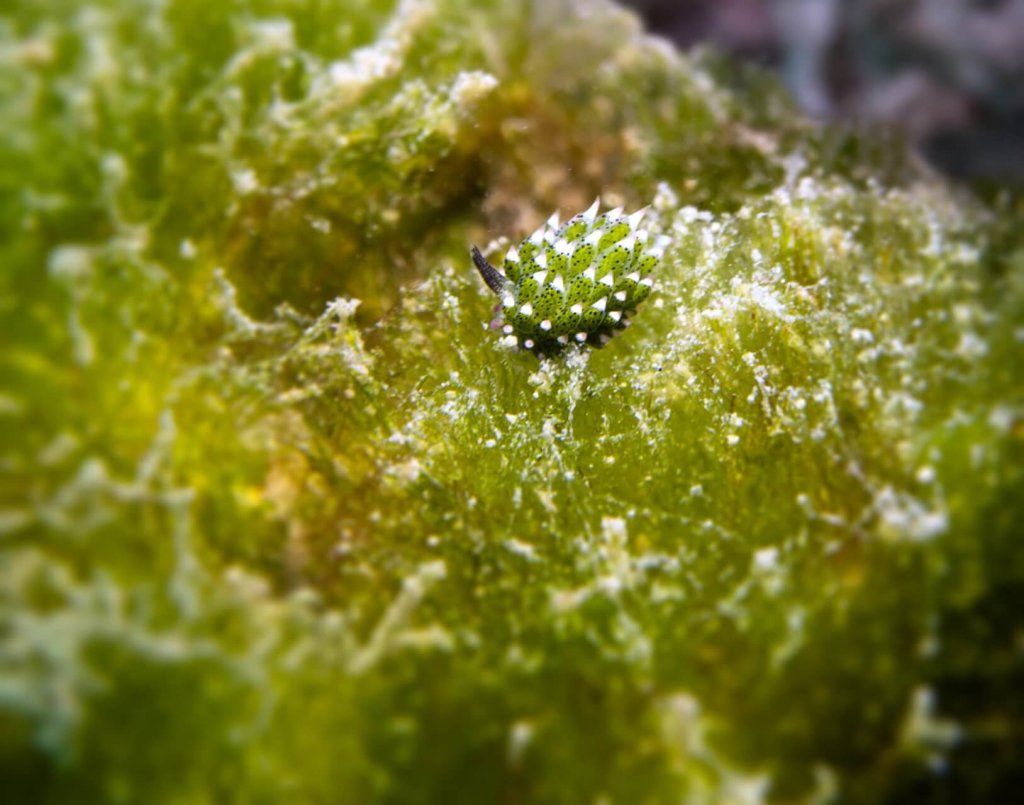
Look for a smooth, oval slug the length of your thumb, shimmering and finely striped like a zebra, with a rounded hump on its head and blue tips at both ends, gliding over or into sand and silt in the muck.
Key field marks
- Body: broad, smooth and oval, divided into a front head shield and a rear body shield that ends in two short, rounded tail lobes (Zamora-Silva and Malaquias, 2018). Koh Tao animals measured 32–45 mm (Mehrotra et al., 2021).
- Head hump: a raised, rounded crest on the head shield. It is caused by the long, tube-shaped feeding organ folded up inside the head, and it marks the whole genus (Rudman, 2007; Zamora-Silva and Malaquias, 2018).
- Colour: an iridescent ground colour, from pale grey to brown, crossed by many fine dark stripes that run side to side over the back and down the flanks. The front edge of the head shield and the tail lobes are tipped with bright blue (Mehrotra and Urgell, 2018; Kimoto, 2026). The pattern varies between individuals (Rudman, 1998a), and animals from cool Australian waters are much darker with no blue (Burn, 1978).
- Head: no rhinophores (the sensory “horns” of nudibranchs). Two small eyes sit in pale circular patches at the front of the head shield, and its touch-and-taste bristles are too small to see, though highly sensitive (Zamora-Silva and Malaquias, 2018).
- Back: fleshy side flaps called parapodia fold up against the body and cover the mantle cavity, where the gill sits (Mehrotra and Urgell, 2018).
- Behaviour: it can plough under the sand very quickly (Mehrotra and Urgell, 2018). Never handle the animal to affect its behaviour.
Similar species
| Species | How to tell it apart |
|---|---|
| Tubulophilinopsis reticulata | Same head hump, but the sides and head carry a net of often colourful spots or rings, and the tail has a blue margin. Its back can show crosswise stripes, so always photograph the sides (Mehrotra and Urgell, 2018). |
| Tubulophilinopsis pilsbryi | Same head hump, but a pale body with bold black net-like markings rather than fine parallel stripes. It is the commonest headshield slug in Koh Tao's muck, often in pairs or small groups (Mehrotra and Urgell, 2018). |
| Philinopsis speciosa | No rounded hump: the head shield is angular, giving a square-headed look. Usually dark with bright edge colours (Mehrotra and Urgell, 2018). |
Taxonomic amendments
The Adams brothers described this species in 1854 as Aglaia (later spelled Aglaja) lineolata. For most of the 20th century it sat in Philinopsis (Burn, 1978; ABRS, n.d.). In a 2018 DNA study of the whole family, Zamora-Silva and Malaquias showed that Philinopsis was not a natural group. They moved the species with a tube-shaped feeding organ into a new genus, Tubulophilinopsis, with T. pilsbryi as its type species (Zamora-Silva and Malaquias, 2018). The paper appeared online in 2017, which is why some databases date the genus to 2017. Tubulophilinopsis lineolata is the current accepted name (ABRS, n.d.; OBIS, n.d.).
The Koh Tao local guidebook already uses Tubulophilinopsis in its page heading but P. lineolata in the text: both refer to this species (Mehrotra and Urgell, 2018). Older field guides and dive logs may also use Philinopsis or Aglaja.
The species may hide more than one lineage. Burn (1978) separated a pale tropical form with blue edges from a dark temperate form without blue, and placed the earlier Thai records in the tropical form. Koh Tao animals match the tropical form (Mehrotra and Urgell, 2018). To our knowledge, the forms have not been compared using DNA.
Label to use: When using photo data, record individuals showing the head hump, fine crosswise stripes and blue tips as Tubulophilinopsis lineolata. If the photos do not show the flanks and head clearly enough to rule out T. reticulata, it is good practice to record it as Tubulophilinopsis sp.
What makes it a headshield slug?
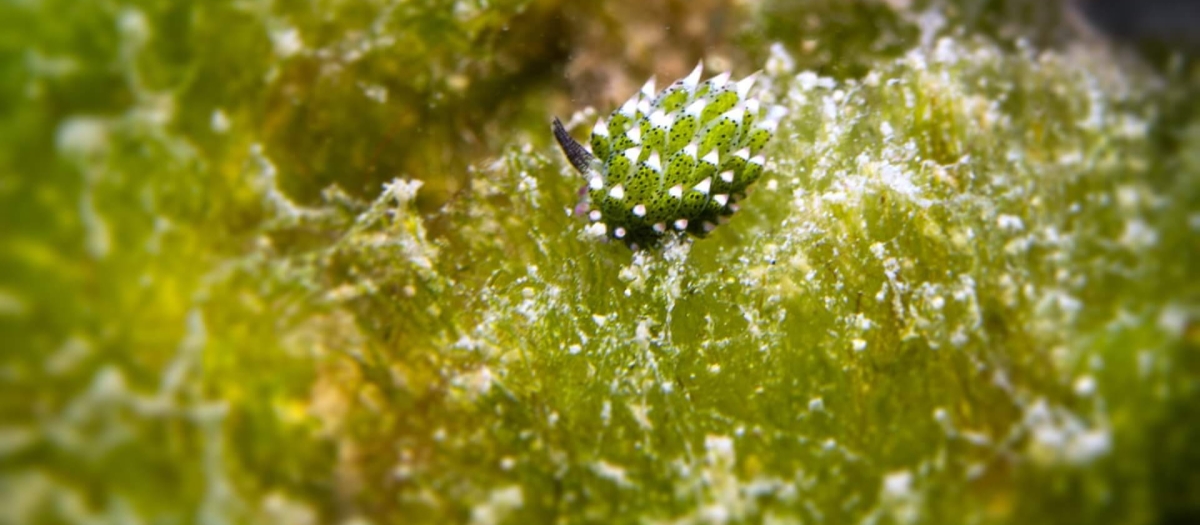
Headshield slugs (Order Cephalaspidea) are sea slugs that mostly lack rhinophores and use a broad shield behind the head to dig and to protect the mantle cavity, unlike nudibranchs, which carry exposed gills and sensory horns. Most still keep a shell, either outside or tucked inside the body (Mehrotra and Urgell, 2018). T. lineolata belongs to the family Aglajidae, whose members are all predators: they have lost the rasping tongue (radula) and grinding plates that other bubble snails use, and they swallow their prey whole (Mehrotra and Urgell, 2018; Zamora-Silva and Malaquias, 2016).
| Feature | Tubulophilinopsis lineolata |
|---|---|
| Diet | Predator with no radula; prey swallowed whole. Its own prey is not yet recorded (Zamora-Silva and Malaquias, 2016; Kimoto, 2026) |
| Breathing | A gill hidden in the mantle cavity, covered by the side flaps and shields (Mehrotra and Urgell, 2018) |
| Shell | Small, flat, thin and internal, buried under the rear body shield (Kimoto, 2026) |
| Swimming | Not seen swimming at Koh Tao. Two young animals in Hawaii were found drifting in open water at night (Pittman and Fiene, n.d.a) |
| Defence | Fast burrowing (Mehrotra and Urgell, 2018); a yellow ink is typical of the family (Rudman, 2001b) |
The feature that defines its genus is the buccal bulb, the muscular pump at the start of the gut that seizes and swallows food. In most aglajids it is a large, rounded bulb (Zamora-Silva and Malaquias, 2016). In Tubulophilinopsis it is instead a long, narrow, muscular tube, folded up inside the head, and this folding produces the visible hump (Rudman, 1998b; Zamora-Silva and Malaquias, 2018). Zamora-Silva and Malaquias (2018) treat it as the genus's defining trait. Rudolph Bergh once suggested the informal name "Boridium" for this group but never formally published it (Rudman, 1998b).
This corrects a common error. Some older descriptions say this tube is pushed out like a proboscis to pull worms from their burrows. That is only an educated guess: nobody has yet watched how the tube is used (Rudman, 1998b). A dissection study of the family also found that Philinopsis, the genus these species then belonged to, cannot turn its buccal bulb inside out, unlike some other aglajids (Zamora-Silva and Malaquias, 2016).
What's in the name? Tubulophilinopsis joins the Latin for "tube" to the older genus name Philinopsis, after its tube-shaped buccal bulb (Zamora-Silva and Malaquias, 2018). The species name lineolata is Latin for "finely lined", after its stripes (Kimoto, 2026). The English brothers Henry and Arthur Adams described it in 1854 as Aglaia lineolata, in their book The Genera of Recent Mollusca (ABRS, n.d.). It was originally described from Australia (Burn, 1978), but the status of the original type specimen is unknown (ABRS, n.d.).
Diet, feeding and defence
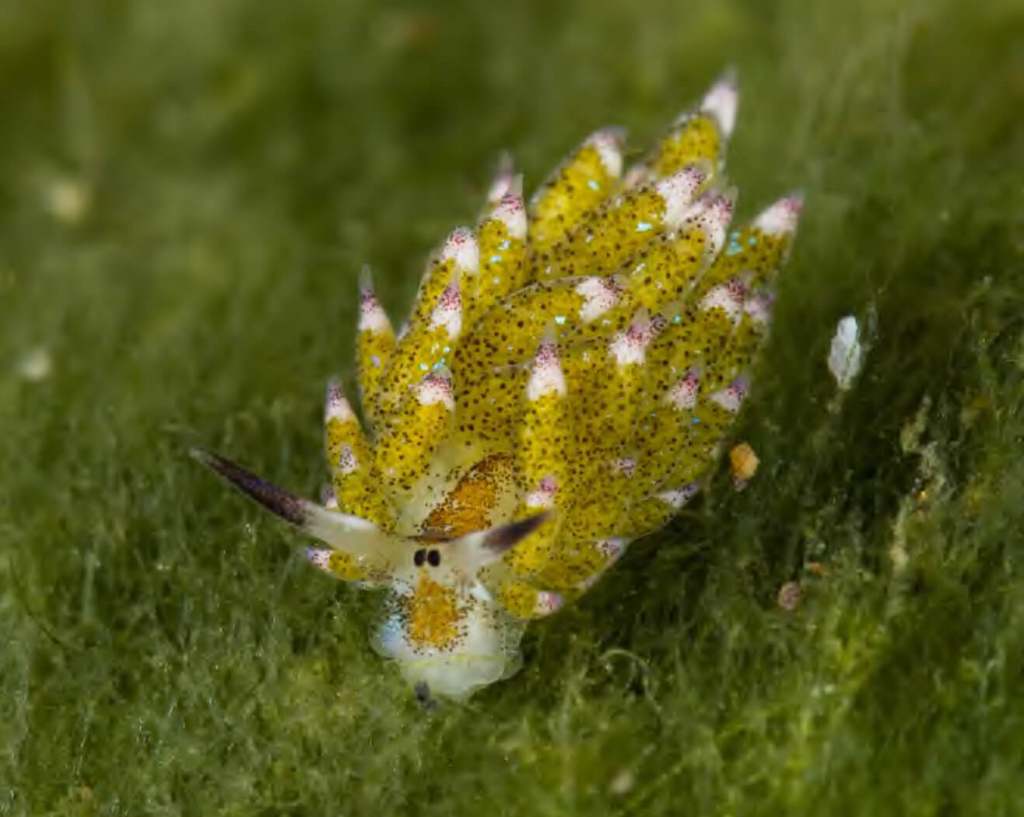

Nobody has yet documented or published the specific diet of T. lineolata (Kimoto, 2026). Its family gives strong clues. Gut-content studies show aglajids are pure carnivores, and 94% of the prey items found were mobile animals rather than fixed ones (Zamora-Silva and Malaquias, 2016). Their close relatives in Philinopsis eat other headshield slugs and bristle worms (polychaetes) (Zamora-Silva and Malaquias, 2016).
Aglajids hunt by smell and taste, using sensory bristles on the head to detect chemicals from prey such as worms, small clams and other sea slugs (Mehrotra and Urgell, 2018). Koh Tao's muck is full of potential prey, including the abundant bubble snail Aliculastrum debile (Mehrotra and Urgell, 2018), but no one has yet documented T. lineolata preying on it.
A feeding tube for hidden prey?
The long, folded buccal bulb is very different from the big engulfing bulb that typical Philinopsis use to swallow bubble snails whole. Rudman (1998b) suggested the tube may let these species reach prey, perhaps worms, in narrow burrows or crevices. This remains untested, so a photo or video of a feeding animal at Koh Tao would be a novel contribution to science.
Escape by burrowing
Its main known defence is to disappear. It can plough under the sand very quickly, using the head shield like a bulldozer blade (Mehrotra and Urgell, 2018).
Yellow ink
Most aglajids release a yellow ink from a gland near the anus when disturbed (Rudman, 2001b). This "yellow gland" secretion is known to harm cnidarians and polychaete worms, but its effect on predators is not yet known (Mehrotra and Urgell, 2018). Inking has not yet been documented for T. lineolata itself.
Predators
Few animals are known to eat headshield slugs, and the main predators of muck sea slugs are other sea slugs (Mehrotra and Urgell, 2018). Aglajids will eat other aglajids: Philinopsis depicta has been recorded eating Aglaja felis (Rudman, 2004). At Koh Tao, BTC divers watched a T. pilsbryi likely hunting a T. lineolata (Black Turtle Conservation, n.d.). At Koh Tao the free-living coral Heteropsammia cochlea has also been seen swallowing a T. pilsbryi, so its striped cousin may face the same risk (Mehrotra et al., 2021).
Diver note: never touch or move this slug. Disturbance can trigger inking and sends it burrowing, which costs it energy and hunting time. Keep fins and hands off the sand around it.
Habitat and distribution
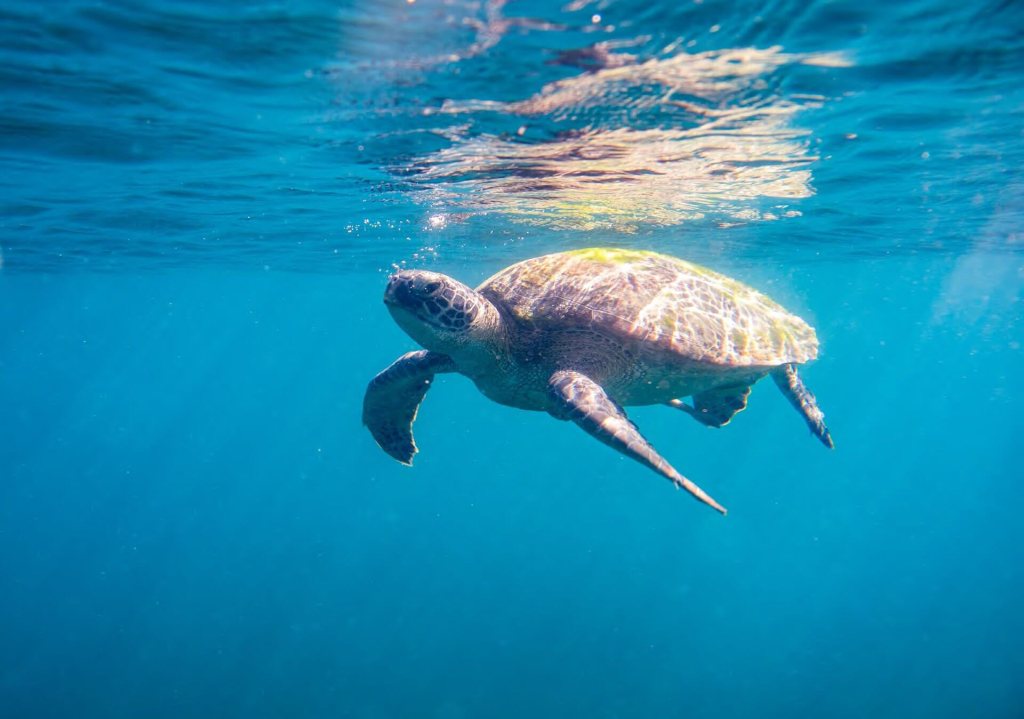
This is a soft-bottom species. It lives on and in sand and sandy mud, from the intertidal zone down to 60 m (Burn, 1978; ABRS, n.d.). At Koh Tao every record comes from the sand and silt outside the coral reef, not from the reef itself (Mehrotra et al., 2021).
Global range
T. lineolata was first described from Australia and is now known across the Indo-West Pacific. Early records came from Thailand (Bergh, 1902, cited in Burn, 1978), the Andaman Islands and Japan, and later from both tropical and temperate eastern Australia (Burn, 1978). It is listed from every mainland Australian state and from New Zealand (ABRS, n.d.). In June and August 2023 it was recorded in Hawaii for the first time, from two small animals drifting at night off the Big Island (Pittman and Fiene, n.d.a).
Range changes: first Mediterranean record
In 2026 the species was reported from Libya, the first record for the Mediterranean Sea. It was found during heterobranch surveys run from 2023 to 2025 (Rizgalla, 2026). The paper places the find among non-native species that reach the Mediterranean with shipping, as ports along the Libyan coast are hotspots for such arrivals (Rizgalla, 2026). This makes it a recent example of an Indo-Pacific sea slug spreading far outside its native range.
On Koh Tao
The Koh Tao guidebook rates the species as rare, known from only a handful of individuals. Its distribution map shows the muck areas along the south and south-west of the island (Mehrotra and Urgell, 2018).
The peer-reviewed inventory, based on surveys from January 2016 to February 2020, examined a handful of individuals (Mehrotra et al., 2021).
The 12–18 m depth range is given for the species as a whole, not for each site, and the three animals ranged from 32 to 45 mm (Mehrotra et al., 2021).
Black Turtle Conservation divers have recorded Tubulophilinopsis lineolata at Tao Tong and Junkyard, on sand and silt at a depth range of 12–22 m (Black Turtle Conservation, n.d.). Across the water, photodocumentation from divers on Koh Phangan confirms its presence around the neighbouring island (Chaloklum Diving, n.d.).
Behaviour and life cycle
T. lineolata is a fast-moving hunter in the muck that spends part of its life buried and part crawling in the open. Much of its behaviour is still unknown.
Active by day at Koh Tao
BTC divers find it crawling over the sand on day dives and have watched it plough under the surface (Black Turtle Conservation, n.d.). Some online sources describe aglajids as mostly nocturnal (Meerwasser-Lexikon, n.d.), but this species is regularly seen out by day at Koh Tao.
Encounters with T. pilsbryi
At Koh Tao it shares the muck with its more common relative T. pilsbryi (Mehrotra and Urgell, 2018), which BTC divers have seen pursuing T. lineolata.
Mating
Headshield slugs are mostly simultaneous hermaphrodites, meaning each adult has working male and female organs at the same time (SeaLifeBase, n.d.). In Tubulophilinopsis the male organ ends in a cone-shaped penis (Zamora-Silva and Malaquias, 2018). Mating has not yet been described for T. lineolata, so photos of pairs are valuable.
Life cycle
- Eggs: the egg mass of T. lineolata has not been described. A related, undescribed Hawaiian Tubulophilinopsis lays a white, barrel-shaped mass made of a tangled egg string, anchored in sand or algal turf (Pittman and Fiene, n.d.b).
- Larvae: eggs of that Hawaiian relative hatched after about four days in the laboratory (Pittman and Fiene, n.d.b). The larval stage of T. lineolata has not been studied, although its wide range suggests that its young can drift long distances.
- Settlement: what triggers larvae to settle is unknown.
- Adults: juveniles as small as 3 mm have been photographed in Okinawa, Japan (Furuta, 2025). Koh Tao adults measured 32–45 mm (Mehrotra et al., 2021). Growth rate and lifespan are unknown.
Ecological role and value as an indicator
As a predator in the muck, T. lineolata is part of the food web that sits beyond the reef. In Koh Tao's muck, prey species such as bubble snails are common while predators are rare, and the predators are mostly other sea slugs (Mehrotra and Urgell, 2018). Its exact role cannot be judged until its prey is described.
A single sighting shows only that suitable sand or silt habitat is present at that site; it says nothing about the health of the wider muck. Long-term BTC records could show whether it is seasonal, whether it is increasing or declining, and which substrates it prefers. Its recent arrivals in Hawaii and the Mediterranean also show how well-kept local records can pick up range changes (Pittman and Fiene, n.d.a; Rizgalla, 2026).
Conservation status and threats
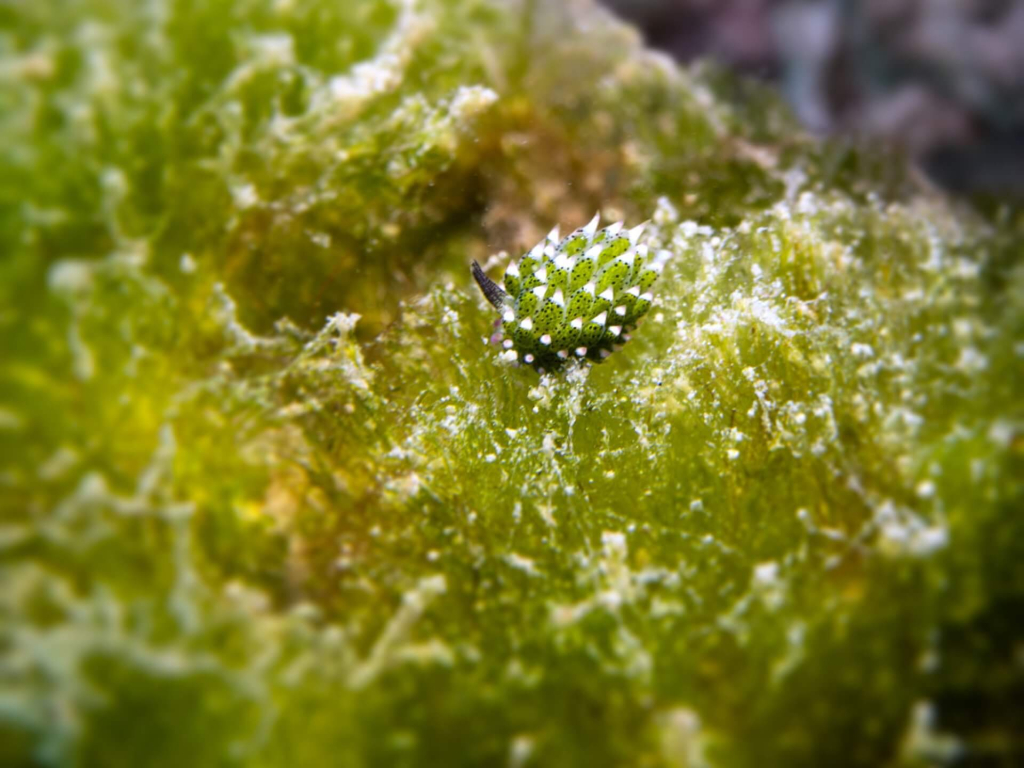
T. lineolata is Not Evaluated on the IUCN Red List (IUCN, n.d.). No study has measured threats to it. Its wide range, from temperate Australia to Japan, suggests it is not at risk globally (Burn, 1978; ABRS, n.d.).
Locally, it depends on the muck. These soft-sediment habitats need a soft bottom, shelter from waves and good currents to bring food, and many of their species are found nowhere else around Koh Tao (Mehrotra and Urgell, 2018). Muck habitats also have economic value: muck-diving tourism has been valued at around US$152 million a year in Indonesia and the Philippines alone (De Brauwer et al., 2017).
Local knowledge gaps:
- What it eats, and whether T. pilsbryi regularly preys on it.
- How common it is, and whether numbers change with season or year.
- How it mates and what its eggs look like.
- Whether Koh Tao animals belong to the same lineage as temperate Australian animals.
Observing and recording it with Black Turtle Conservation
Few Koh Tao individuals have been published (Mehrotra et al., 2021), so every record adds valuable data to local research. Its prey, its mating behaviour and its encounters with T. pilsbryi are all undocumented in the scientific literature.
What to record
- When and where: date, time, dive site and dominant substrate.
- Depth and substrate: depth, plus substrate type (sand, silt, rubble, NIA etc.) and any bubble snails, worm tubes or other headshield slugs nearby.
- Number: a count, noting any pairs or groups.
- Size: to the nearest mm.
- Photos: a top view showing the stripes, a side view of the flanks and head hump (to rule out T. reticulata), and close-ups of the blue head and tail tips.
- Behaviour: crawling, burrowing, feeding, mating, inking or interacting with other slugs. Video is best.
It is good practice with this species to record identifications as Tubulophilinopsis lineolata only when the head hump, fine crosswise stripes and blue tips are all visible in the photos; otherwise use Tubulophilinopsis sp.
Good practice
Move slowly and stay off the bottom: a fin kick that lifts silt can hide the slug or make it burrow. Never touch it, nudge it into the open or dig for it. Shoot from the side at sand level rather than from above, so the head hump shows in profile. If you see it near a T. pilsbryi or anything that might be prey, hold back and film. Patient video is the best way to capture a first feeding or predation record.
Join us: Sea Slug Ecology & Monitoring course
Our Sea Slug Ecology & Monitoring course turns you from a diver who spots nudibranchs into one who is able to understand where and why we spot them; and one who collects data scientists can use. Every survey you join feeds one of Black Turtle Conservation's current research questions: how sea slug abundance and diversity vary across different substrates around Koh Tao.
Why it matters: Our surveys compare slug numbers across dive sites, substrates, seasons, water temperature and benthic composition. Knowing where each species thrives helps target conservation efforts and guides the planning of artificial reefs around Koh Tao.
What you'll learn
- Ecology of the five sea slug clades/orders present on Koh Tao
- Identifying Koh Tao species with our cheat sheets and ID guide
- Recognising substrates using standard EMP substrate codes
- Why defences such as aposematism, camouflage and kleptocnidae evolved
- How sea slugs support ecotourism, medical research and reef monitoring
References
Online sources accessed 31 October 2026.
ABRS (n.d.) Species Tubulophilinopsis lineolata (H. & A. Adams, 1854). Australian Faunal Directory. Canberra: Australian Biological Resources Study. Available at: https://biodiversity.org.au/afd/taxa/Aglaja_lineolata.
Black Turtle Conservation (n.d.) Photographic and video records of Tubulophilinopsis lineolata from Koh Tao dive sites. Unpublished data.
Burn, R. (1978) 'Records of Philinopsis lineolata (H. & A. Adams, 1854) (Opisthobranchia: Aglajidae) from south-eastern Australia', Journal of the Malacological Society of Australia, 4(1–2), p. 6. Available at: https://www.biodiversitylibrary.org/part/316483.
Chaloklum Diving (n.d.) Headshield slugs; Cephalaspidea. Available at: https://www.chaloklum-diving.com/marine-life-guide-koh-phangan/molluscs-mollusca/sea-slugs-opisthobranchia/headshield-slugs-cephalaspidea/.
De Brauwer, M., Harvey, E.S., McIlwain, J.L., Hobbs, J.-P.A., Jompa, J. and Burton, M. (2017) 'The economic contribution of the muck dive industry to tourism in Southeast Asia', Marine Policy, 83, pp. 92–99. Available at: https://www.sciencedirect.com/science/article/pii/S0308597X17300581.
Furuta, H. (2025) Tubulophilinopsis lineolata [observation, Nashiro, Okinawa, 14 August 2025]. SEASLUG.WORLD. Available at: https://en.seaslug.world/observation/44079.
IUCN (n.d.) The IUCN Red List of Threatened Species. Available at: https://www.iucnredlist.org.
Kimoto, N. (2026) Tubulophilinopsis lineolata. SEASLUG.WORLD. Available at: https://en.seaslug.world/species/tubulophilinopsis_lineolata.
Meerwasser-Lexikon (n.d.) Tubulophilinopsis lineolata – Lined Philinopsis. Available at: https://www.reeflex.net/tiere/5324_Tubulophilinopsis_lineolata.htm.
Mehrotra, R. and Urgell, P. (2018) Nudibranchs and sea slugs of Koh Tao and nearby islands: a Conservation Diver guidebook. Koh Tao: Conservation Diver.
Mehrotra, R., Caballer Gutiérrez, M.A., Scott, C.M., Arnold, S., Monchanin, C., Viyakarn, V. and Chavanich, S. (2021) 'An updated inventory of sea slugs from Koh Tao, Thailand, with notes on their ecology and a dramatic biodiversity increase for Thai waters', ZooKeys, 1042, pp. 73–188. Available at: https://doi.org/10.3897/zookeys.1042.64474.
OBIS (n.d.) Tubulophilinopsis lineolata (H. Adams & A. Adams, 1854). Ocean Biodiversity Information System. Available at: https://obis.org/taxon/1055267.
Pittman, C. and Fiene, P. (n.d.a) Tubulophilinopsis lineolata. Sea Slugs of Hawaii. Available at: https://seaslugsofhawaii.com/species/Tubulophilinopsis-lineolata-a.html.
Pittman, C. and Fiene, P. (n.d.b) Tubulophilinopsis sp. #1. Sea Slugs of Hawaii. Available at: https://seaslugsofhawaii.com/species/Tubulophilinopsis-sp1-a.html.
Rizgalla, J. (2026) 'Crossing frontiers: Tubulophilinopsis lineolata reaches the Mediterranean: a new record from the Libyan coast', Acta Adriatica, 67(1), pp. 95–99. Available at: https://doi.org/10.32582/aa.67.1.10.
Rudman, W.B. (1998a) Philinopsis lineolata (H. & A. Adams, 1854) [Sea Slug Forum fact sheet], 14 October. Sydney: Australian Museum. Available at: http://www.seaslugforum.net/find/phillin.
Rudman, W.B. (1998b) Philinopsis gardineri (Eliot, 1903) [Sea Slug Forum fact sheet], 14 October. Sydney: Australian Museum. Available at: http://www.seaslugforum.net/find/philgard.
Rudman, W.B. (2001a) Philinopsis sp. 1 [Sea Slug Forum fact sheet], 16 January. Sydney: Australian Museum. Available at: http://www.seaslugforum.net/find/philinsp1.
Rudman, W.B. (2001b) Comment on New Philinopsis from Japan by Rie Nakano [Message in Sea Slug Forum], 18 January. Sydney: Australian Museum. Available at: http://www.seaslugforum.net/find/3547.
Rudman, W.B. (2004) Comment on Philinopsis depicta eating Aglaja felis by Marina Poddubetskaia [Message in Sea Slug Forum], 25 March. Sydney: Australian Museum. Available at: http://www.seaslugforum.net/find/12520.
Rudman, W.B. (2007) Comment on Philinopsis pilsbryi from Milne Bay, PNG by Clinton Bauder [Message in Sea Slug Forum], 18 July. Sydney: Australian Museum. Available at: http://www.seaslugforum.net/find/20119.
SeaLifeBase (n.d.) Philinopsis pilsbry, Pilsbry's Philinopsis. Available at: https://sealifebase.org/summary/87103.
Zamora-Silva, A. and Malaquias, M.A.E. (2016) 'Diet preferences of the Aglajidae: a family of cephalaspidean gastropod predators on tropical and temperate shores', Journal of the Marine Biological Association of the United Kingdom, 96(5), pp. 1101–1112. Available at: https://doi.org/10.1017/S0025315415000739.
Zamora-Silva, A. and Malaquias, M.A.E. (2018) 'Molecular phylogeny of the Aglajidae head-shield sea slugs (Heterobranchia: Cephalaspidea): new evolutionary lineages revealed and proposal of a new classification', Zoological Journal of the Linnean Society, 183(1), pp. 1–51. Available at: https://doi.org/10.1093/zoolinnean/zlx064.